
Black diamonds are one of the easiest ways for a man to wear diamonds without looking dressed up. They sit closer to the look of oxidised silver or a dark watch dial than to bridal sparkle, and they suit a kurta and a shirt equally. This guide is a map of every piece of black diamond jewellery a man is likely to consider, with what each needs to be well made, and links to our detailed guides for each piece.
It also covers the three things that apply to every piece: what kind of black diamond you are buying, which settings protect it, and how to make sure you are paying for real diamonds rather than black stones that only look like them.
What counts as a black diamond?
A black diamond is a real diamond, pure carbon and 10 on the Mohs scale, that looks black because of dense inclusions, treatment or how it was grown. Three kinds are sold, and the difference drives price.
| Type | Why it is black | Price position | What the invoice should say |
|---|---|---|---|
| Natural-colour black diamond | Countless tiny dark inclusions such as graphite | Highest, especially with a lab report | Natural black diamond |
| Treated black diamond | A natural, included diamond heated or irradiated to turn black | Lower; common in jewellery | Treated black diamond |
| Laboratory-grown black diamond | Grown by HPHT or CVD, with colour from lattice defects | Lower | Laboratory-grown black diamond |
GIA's guide to black diamonds explains that black diamonds are graded under its coloured diamond system as "Fancy Black", with even colour and a good polish mattering more than clarity. India's diamond terminology standard, IS 19469:2025, requires any treatment and any laboratory origin to be disclosed, according to BIS. Our explainer on whether black diamonds are real covers formation and treatment in depth.
Which black diamond piece should a man start with?
Start with the piece you will wear most. For most men that is a ring or studs; the rest follow.
| Piece | Typical black diamond set-up | Best for | Detailed guide |
|---|---|---|---|
| Ring or band | Two-row eternity, pavé band or a single stone | Daily wear, weddings | Black diamond rings |
| Studs and earrings | One stone per ear in a bezel, or a pavé hoop | Daily wear | Diamond studs |
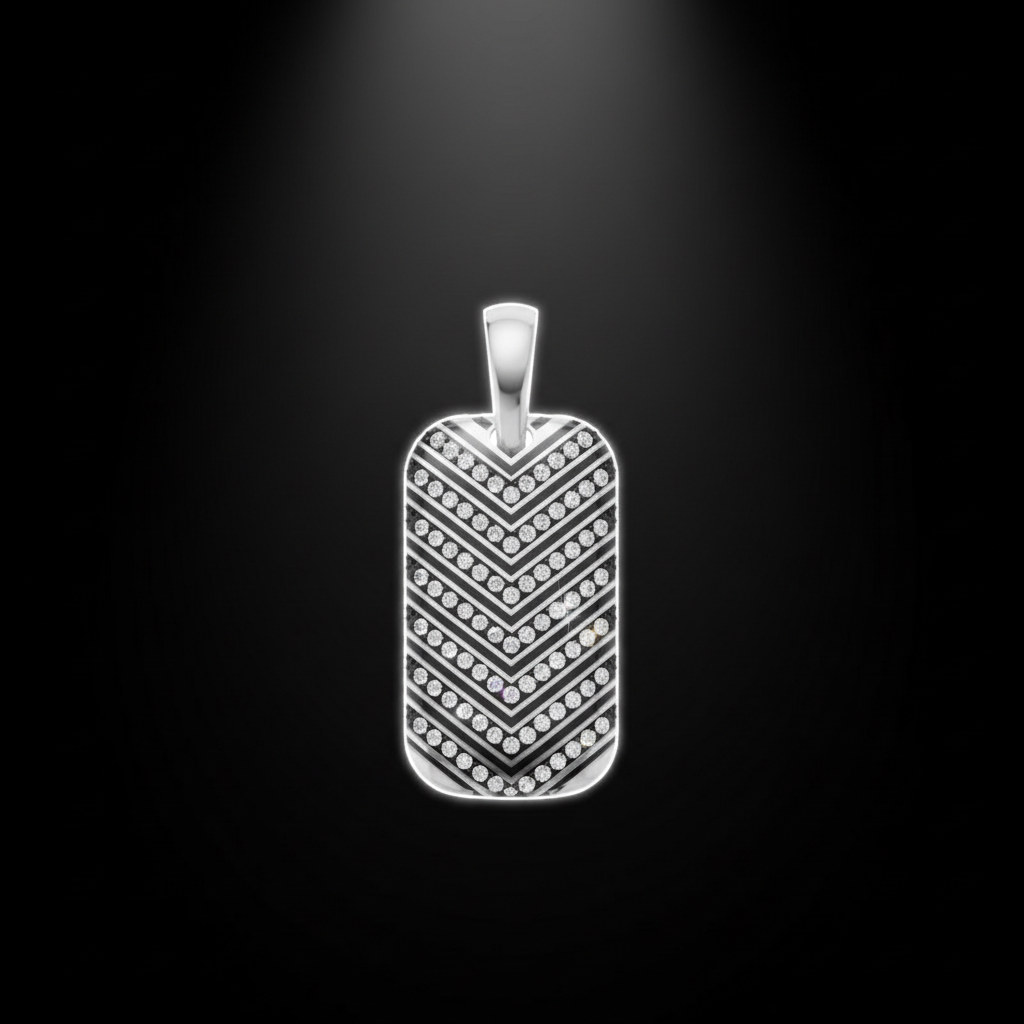
| Pendant | Pavé shape or a single stone on a chain | Over a T-shirt or under an open collar | Diamond pendants |
| Necklace or chain | A pendant necklace, or a chain with set stations | Statement wear | Pendant guide, as above |
| Bracelet | Links or a line of set stones | Evenings, weddings, daily if well set | Diamond bracelets |
| Kada or cuff | Stones set along a rigid band | Festive and statement wear | Diamond kadas |
| Cufflinks, buttons, lapel pins | Pavé faces or a single stone | Suits, bandhgalas, sherwanis | Formal wear only |
Black diamond rings
A black diamond ring is the easiest piece to wear every day, and a two-row eternity band or a pavé band in silver or white gold is the most wearable style. Indian buyers also search for gents or male black diamond rings; the advice is the same. Keep the stones flush or channel-set if you work with your hands, because the ring takes more knocks than anything else you wear.
Black diamond studs and earrings for men
Single black diamond studs in a bezel on a screw back are the secure everyday choice; hoops lined with small black diamonds are the next step up. A bezel protects the stone's edge, which matters with black diamonds because their inclusions make them less tough than white ones. Black studs also read more quietly than white studs of the same size, because they do not return light the way white diamonds do, so a slightly larger black stud still looks restrained.
Black diamond pendant and necklace for men
A black diamond pendant necklace usually means a pavé shape, a cross, a geometric form or a single bezel-set stone on a chain. The chain matters as much as the pendant: it must be strong enough to carry the weight and have a bail wide enough to move freely.
A black diamond chain for men, with stones set along the links, is rarer and costs more, because every link is set by hand. If you want stones around the neck without that cost, a chain with a few set stations is the middle ground.
Black diamond bracelets and kadas for men
Black diamond bracelets come flexible (links or a line of stones) or rigid (a cuff or kada). Flexible bracelets are more comfortable for all-day wear; rigid ones stay put and make a stronger statement, and they are the Indian form most men already own in plain metal. Setting security matters more on the wrist than anywhere else, because the underside rests on desks and keyboards.
Black diamond cufflinks, buttons and lapel pins
Black diamonds suit formal wear because they read as dark, not sparkly, against a black or navy suit or a sherwani. A pavé button set, a pair of cufflinks or a small lapel pin is a sensible first black diamond piece for a groom or a wedding guest, because it is worn on the outfit rather than the body and outlasts the occasion.
How should black diamonds be set for daily wear?
Use protective settings. Black diamonds are as hard as white diamonds but less tough: GIA notes that the fractures and inclusions that make them black can leave them prone to chipping if struck sharply.
- Bezel: a metal rim around the stone. The safest for studs, pendants and single stones.
- Channel: stones sit in a groove between two walls. Ideal for bands and kadas.
- Flush or gypsy: the stone sits level with the metal surface. The toughest choice for rings.
- Pavé: many small stones held by tiny beads of metal. Looks rich, needs a yearly check.
- Prong (claw): shows more stone but exposes the edges. Best kept to pieces that take few knocks, such as pendants.
Which metal suits black diamonds?
The metal decides the look more than the stones do. Black diamonds in white metal look monochrome and modern; in yellow gold, they look traditional and bold.
| Metal | Look with black diamonds | Wear and care |
|---|---|---|
| 925 sterling silver | Monochrome; can be oxidised for a darker look | Softer; settings must be well built; tarnishes, polishes back |
| Black rhodium over silver or white gold | Stones blend into a dark surface | Plating wears at contact points and needs redoing |
| 18K white gold | Bright, cool contrast | Harder; holds settings longer |
| 18K or 14K yellow gold | Strong contrast; suits Indian occasion wear | 14K is harder and costs less than 18K |
Black, white or both?
All black reads quiet and graphic; black with white reads more formal and draws the eye. Mixing works best when one colour clearly leads, for example a black diamond band with a few white stones at the centre, rather than an even half-and-half split.
Black diamonds also solve a practical problem for men who are new to diamonds. White stones are judged on brightness and colour, so a small or low-grade white stone can look dull next to a good one. Black stones are judged mainly on even colour and polish, which makes small black diamonds look consistent across a band, a bracelet or a set of buttons.
How to wear black diamond pieces together
Wear one black diamond piece as the focus and let anything else stay plain. Two pieces close together, such as a ring and a bracelet on the same hand, should share a metal colour.
| Occasion | What works | What to avoid |
|---|---|---|
| Office | Studs, or a slim band, or a small pendant under the shirt | Several set pieces at once |
| Evenings and parties | A pendant over a T-shirt, or a bracelet on the non-watch wrist | A bracelet grinding against a watch |
| Weddings and festivals | A kada or bracelet, with buttons or a lapel pin on the outfit | Mixing yellow and white metals on one hand |
| Formal suit | Cufflinks or a lapel pin, plus a band | A large pendant over a tie |
Wear bracelets and kadas on the wrist without the watch. Diamonds are harder than any watch case or crystal and will scratch them.
What does black diamond jewellery cost in India?
Black diamond jewellery is priced from the metal weight, the stones, the setting labour and GST at 3%. Carat for carat, treated and lab-grown black diamonds cost less than white diamonds, so in many men's pieces the metal and the hours of hand-setting move the price more than the stones.
Three practical rules:
- Compare total carat weight, not stone count. Forty tiny stones can weigh less than four larger ones.
- Ask what kind of black diamond. Natural-colour stones with a laboratory report cost more than treated ones.
- Treat very low prices as a warning. A "black diamond" piece priced like fashion jewellery is almost certainly onyx, spinel, black cubic zirconia or moissanite.
How AXIOM approaches this
Natural black diamonds are AXIOM's signature stone, and the product listings name the stone type alongside the metal, so you know which kind you are buying. The Stud is set with a single natural black diamond in 925 sterling silver, from ₹18,000 at the time of writing, and the Apex Pendant sets natural black diamonds in sterling silver, from ₹73,200. Any black diamond piece can also be made to order in 14K or 18K gold through bespoke commissions, with about three weeks to make, plus delivery.
The practical takeaway
Pick one piece you will wear every week, choose a bezel, channel or flush setting, and decide on white or yellow metal before you compare prices. Then get three things in writing: natural, treated or laboratory-grown black diamond, the total carat weight, and the metal and its purity.
