
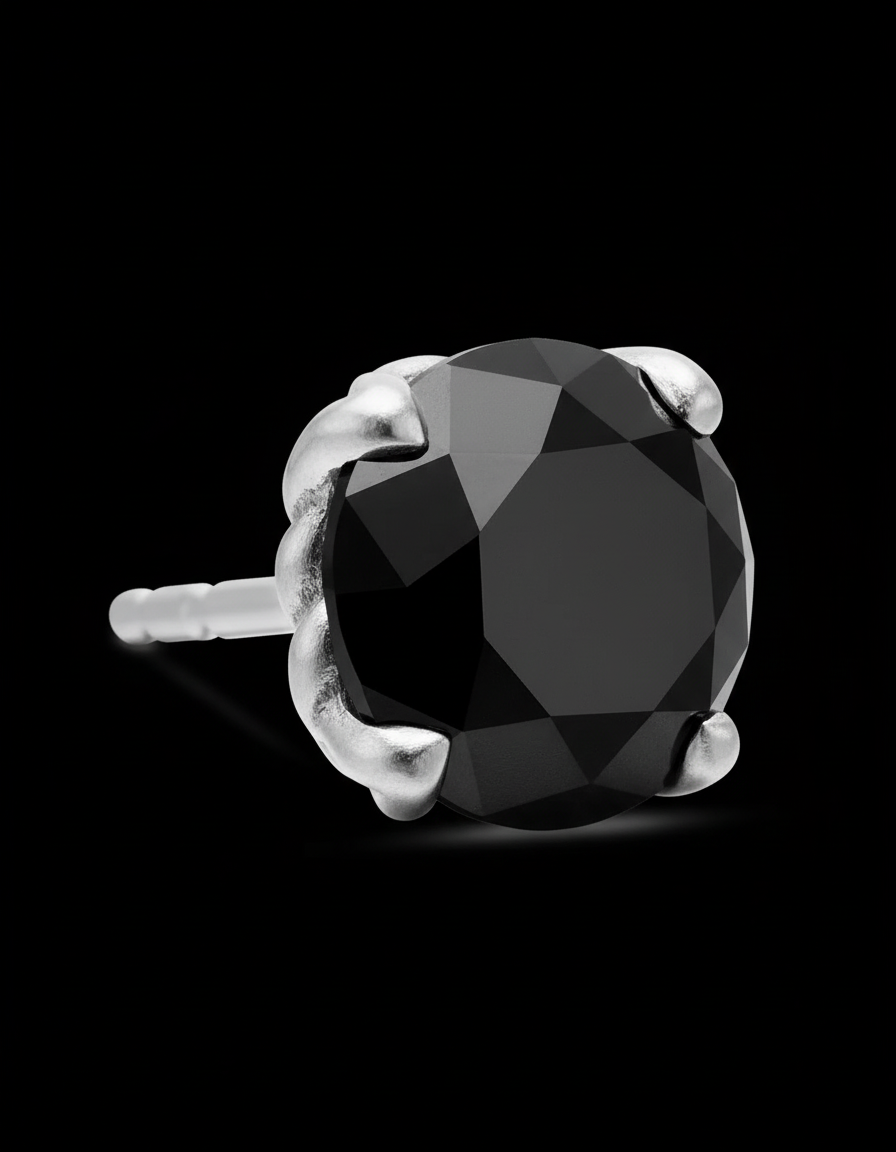
A diamond stud is the one piece of jewellery many men wear every day without thinking about it, so the details matter more than the sparkle. Size decides whether the stud reads as a quiet point of light or a statement. Setting and back decide whether you still have it in six months. And the stone itself, black or white, mined or lab-grown, decides most of the price. This guide takes each in turn.
What size diamond studs should a man wear?
For most men, 3.5 mm to 5 mm across is the right range: about 0.15 to 0.45 carat per stone. It is visible in conversation and in photographs without looking like it belongs to someone else's ear.
| Diameter (round) | Approx. carat per stone | How it reads on a man's ear |
|---|---|---|
| 3.0 mm | 0.10 ct | A small glint; subtle, office-friendly |
| 3.8 mm | 0.20 ct | Clearly a diamond at conversation distance |
| 4.0 to 4.1 mm | 0.25 ct | The most versatile everyday size |
| 4.4 to 4.5 mm | 0.33 ct | Noticeable across a room |
| 5.1 to 5.2 mm | 0.50 ct | Confident, still wearable daily |
| 5.8 to 5.9 mm | 0.75 ct | A statement on most lobes |
| 6.4 to 6.5 mm | 1.00 ct | Bold; suits larger lobes |
These are averages for a well-cut round brilliant. One carat is 200 milligrams, as GIA explains in its guide to carat weight, and carat measures weight, not width. A stone cut deep carries more weight below the setting and looks smaller from the front; a shallow stone looks larger but can lose brightness. The millimetre figures above come from the standard estimate for round brilliants and agree with published diamond-education charts to within about 0.1 mm.
Two practical checks: hold a ruler against your lobe in a mirror, and remember that a stud looks slightly larger in a bezel, because the metal rim frames the stone.
Which setting is best for men's diamond studs?
A bezel or a four-prong setting suits most men. The bezel is the most secure and the least likely to catch; four prongs show the most diamond.
| Setting | Look | Security | Snag risk | Best for |
|---|---|---|---|---|
| Bezel (metal rim all round) | Clean, architectural | Highest | Lowest | Daily wear, sport, sleeping in them |
| Four-prong | Square outline, more diamond visible | Good | Moderate | Maximum sparkle for the size |
| Six-prong | Rounder outline | Very good | Moderate | Larger stones, 5.5 mm and up |
| Flush or gypsy (set into metal) | Minimal | Highest | Lowest | Very small stones, understated style |
Prongs wear down and bend over years. If you choose prongs, have a jeweller check them once a year, especially on a stud you never take out.
Screw back or push back?
For men's studs worn daily, a screw back is the more secure choice. A push back is easier to take on and off and is fine for lighter studs worn occasionally.
| Back | How it holds | Security | Everyday notes |
|---|---|---|---|
| Push back (butterfly) | Friction on a grooved post | Adequate for small studs | Loosens with time; replace the back when it slides easily |
| Screw back | Threaded post and nut | High | Takes a few seconds longer; hard to lose |
| Locking back | Mechanism grips the post | High | Bulkier behind the ear |
| Flat back | Disc behind the lobe | Good | Most comfortable for sleeping |
The most common way to lose a stud is a tired push back, not a failed setting. If your studs have push backs, check the fit every few weeks.
Black or white diamond studs?
White diamonds catch light and read as classic; black diamonds absorb light and read as darker, graphic and more masculine to many eyes. Neither is more correct, and the choice shows up in price.
- White diamond studs are graded on colour, clarity and cut, and the price per carat climbs steeply with size and grade.
- Black diamond studs are opaque, so they are not graded on the white-diamond colour and clarity scales. Size, cut and evenness of colour drive the price, and a natural black diamond generally costs less than a natural white diamond of the same size. Some black diamonds sold in the trade have been treated to produce or even out their colour, so ask the seller whether a stone is treated, and see are black diamonds real for how natural and treated black diamonds differ.
Black studs also hide small size differences better, which makes a single black stud a forgiving first diamond earring.
Natural or lab-grown diamond studs?
Both are real diamonds; lab-grown stones generally cost less at the same size and grade. The question is what you are paying for.
| Natural white | Lab-grown white | Natural black | |
|---|---|---|---|
| What it is | Mined diamond | Diamond grown in a laboratory | Mined, opaque diamond |
| Graded on | Colour, clarity, cut, carat | Colour, clarity, cut, carat | Size, cut, colour evenness |
| Price basis | Highest per carat; rises steeply with size | Generally lower than natural at the same grade | Generally lower than natural white at the same size |
| Worth asking | Grading report | Grading report and disclosure | Whether the stone is treated |
Whichever you choose, get the stone type in writing on the invoice. If you are buying from someone you do not know, how to check a real diamond at home covers the simple checks and their limits.
How are diamond stud prices worked out in India?
A diamond stud's price is mostly the diamond, then the metal, then the making and the tax. Understanding the parts lets you compare two quotes fairly.
- Per stud or per pair. Check first. Many listings price a pair; a single stud can be roughly half.
- Carat weight. Price per carat rises with size, so a 0.50 ct stone usually costs more than twice a 0.25 ct stone of the same grade.
- Stone type and grade. Natural white, lab-grown white and natural black are priced on different bases, as above.
- Metal. 925 sterling silver, 14K or 18K gold and platinum sit at very different prices for the same small setting.
- Setting and back. A bezel uses more metal than four prongs; screw backs cost slightly more than push backs.
- Making charges and GST. These are added on top; ask for them shown separately.
We do not quote a fixed price range here, because diamond and metal prices move. Ask any seller for the stone weight, type and metal per stud, and you can compare like with like.
How to tell a well-made diamond stud
A good stud is decided as much by the metalwork behind the ear as by the stone in front. Before buying, in a shop or from photographs, check these points:
- The post. It should be straight, smooth and long enough to pass through your lobe with the back fitted, without pressing. A post that is too short pinches.
- The thread or grooves. On a screw back, the nut should turn smoothly and stop firmly. On a push back, you should feel it click into a groove rather than slide freely.
- The setting height. A stone set low sits closer to the ear, catches less and looks more masculine. A tall setting shows more of the stone from the side but snags more.
- The prongs or bezel. Prongs should be even, rounded at the tips and tight against the stone. A bezel should meet the stone evenly all the way round, with no gap.
- The match. For a pair, both stones should look the same size and colour side by side. Black diamonds should be evenly black with no grey or brown patches.
- The paperwork. The invoice should state the metal, the stone type (natural, lab-grown or treated), the weight per stone and the price per stud or pair.
A stud that fails on the post or the back is one you will lose; a stud that fails on the match is one you will notice every time you look in the mirror.
Diamond stud size by ear and face
Lobe size matters more than face shape. A 4 mm stud looks generous on a small lobe and modest on a large one.
| Your lobe | Understated | Balanced | Statement |
|---|---|---|---|
| Small (short, close to the head) | 3.0 mm | 3.5 to 4.0 mm | 4.5 to 5.0 mm |
| Medium | 3.5 mm | 4.0 to 4.5 mm | 5.0 to 5.5 mm |
| Large or long | 4.0 mm | 4.5 to 5.0 mm | 5.5 to 6.5 mm |
A beard frames the lower face and can make a small stud disappear, so bearded men often go half a millimetre up. Wearing a single stud? The same sizes apply; one stone does not need to be larger to be seen.
Can you wear diamond studs all the time?
Yes, once the piercing is fully healed, a well-set stud can be worn daily, including in the shower. A few habits keep it secure and clean.
- Take studs out for swimming, contact sport and the gym if you wear helmets or headgear.
- Clean the post and back weekly with mild soap and warm water and a soft brush; skin oil and soap build up behind the stone and dull it.
- Check the back is tight every time you clean.
- If you sleep in studs, a bezel setting with a flat or screw back is the most comfortable and the least likely to catch on bedding.
If you are still choosing between a stud and a small hoop, hoops vs studs for men compares the two by occasion. Our men's earrings guide covers the wider range.
How AXIOM approaches diamond studs
AXIOM makes a single Stud in 925 sterling silver with natural black diamonds, from ₹18,000 at the time of writing: one stone, nothing else. Certification details are available on request. It sits alongside the Pulse Hoop in the men's earrings range for men who prefer a hoop.
The practical takeaway
Start at 4 mm (about a quarter carat) in a bezel or four-prong setting on a screw back, and decide between black and white by the look you want, not the price alone. Compare every quote per stud, with stone type, weight and metal written down.
