
Men ask this question more than almost any other about earrings, usually because they have heard that one side "means something". It does not, and it has not for a long time. What remains are practical questions: which side suits your face, whether one earring or two looks better, and, in India, how ear piercing sits alongside older family and religious customs. This guide answers each plainly.
Which ear should a guy wear an earring in?
Either ear is correct. Pick the side that works for you, using practical reasons rather than symbolic ones.
- The side people see most. If you usually sit to one side of people at work or in photographs, an earring on that side is seen more.
- Your hair and beard. A side parting or longer hair on one side can hide an earring. Wear it on the open side.
- Your phone ear. Pressing a phone against a stud all day is uncomfortable, so a single earring is easier on the other side.
- Your sleeping side. If you plan to sleep in it, the ear you do not sleep on is more comfortable, especially while healing.
Where did the left ear, right ear idea come from?
You may have heard that a man's choice of ear signals something about him, usually his sexuality. We looked for a reliable account of this rule and could not find one: the versions people repeat disagree about which ear meant what, and none of them was ever written down as an agreed code. Treat it as a rumour from a time when few men wore earrings. It has no standing today, and nobody reading your ear in 2026 is decoding it.
The history behind it is more interesting than the rumour. As the encyclopaedia entry on earrings records, ear piercing among men in the West made inroads from the late 1960s through the hippie and gay communities, having long been popular among sailors, and then spread through musicians and athletes. By the early twenty-first century it had become widely accepted for teenage boys and men to pierce one or both ears. Once earrings were ordinary on men, the idea that one side carried a message stopped making sense.
Wearing a single earring is much older than the rumour. Portraits of Elizabethan and Stuart gentlemen, from Sir Walter Raleigh to Charles I, show a single earring in one ear, and among sailors a pierced earlobe was a sign that the wearer had crossed the equator or sailed round the world.
Why do Indian men and Hindu boys wear earrings?
In India, ear ornaments for men are part of a long tradition, not a recent fashion. Gold earrings have been found at Lothal, a Harappan site in Gujarat, and elaborate ear ornaments have remained popular in India ever since.
In Hindu tradition, ear piercing is also a rite of passage: karnavedha, literally "piercing the ear", one of the samskaras that mark stages of life.
- When it happens. Texts that describe it give different timings, some within the first weeks of life and others within the first year, and some families perform it later, occasionally alongside other childhood rites.
- For whom. It has been performed for both boys and girls. How widely it is still performed for boys varies from one community to another.
- Which ear first. Texts summarised in the standard reference works say a boy's right earlobe is pierced first and a girl's left, as described in the overview of Hindu samskaras.
- Why. Texts link it to adornment, to the child's place in family and community, and to hearing: the ear that will receive sacred sound and learning.
Practice varies widely. Names, ages and ceremonies differ between regions and communities. Some families treat karnavedha as an important samskara, others as optional, and many do not perform it at all. It is a family and religious decision, and nothing about it obliges an adult man to wear earrings or not.
Claims you may see online that ear piercing brings specific health "benefits" come from traditional belief, not from medical evidence. Respect the belief; do not rely on it as health advice. For the practical side of getting pierced as an adult, see ear piercing for men in India.
Should a man wear one earring or two?
Both are normal. The difference is how much attention you want the earring to draw and how balanced you want the look to be.
| Style choice | Effect | Suits |
|---|---|---|
| Single stud, either ear | Understated; one point of light | First earring, office, everyday |
| Matching studs, both ears | Balanced, slightly more formal | Weddings, evening, clean-shaven faces |
| Single small hoop or huggie | Relaxed, more character than a stud | Weekends, casual dress |
| Stud in one ear, hoop in the other | Deliberately asymmetric | Confident personal style |
| Two piercings in one ear | Draws the eye to one side | Men already comfortable with earrings |
A practical rule of thumb: start with one small stud. If you like it after a few months, add the second ear or a hoop. A hoop has more character than a stud but catches more easily, so it is better as a second earring than a first.
What earring should a man start with?
A small stud, 3 to 4 mm across, in one ear is the easiest first earring for most men. It is visible without being loud, it works with office and traditional dress alike, and it is comfortable enough to forget about.
| First earring | Size | Why it works |
|---|---|---|
| Plain metal stud | 3 to 4 mm | Lowest-key option; suits any dress code |
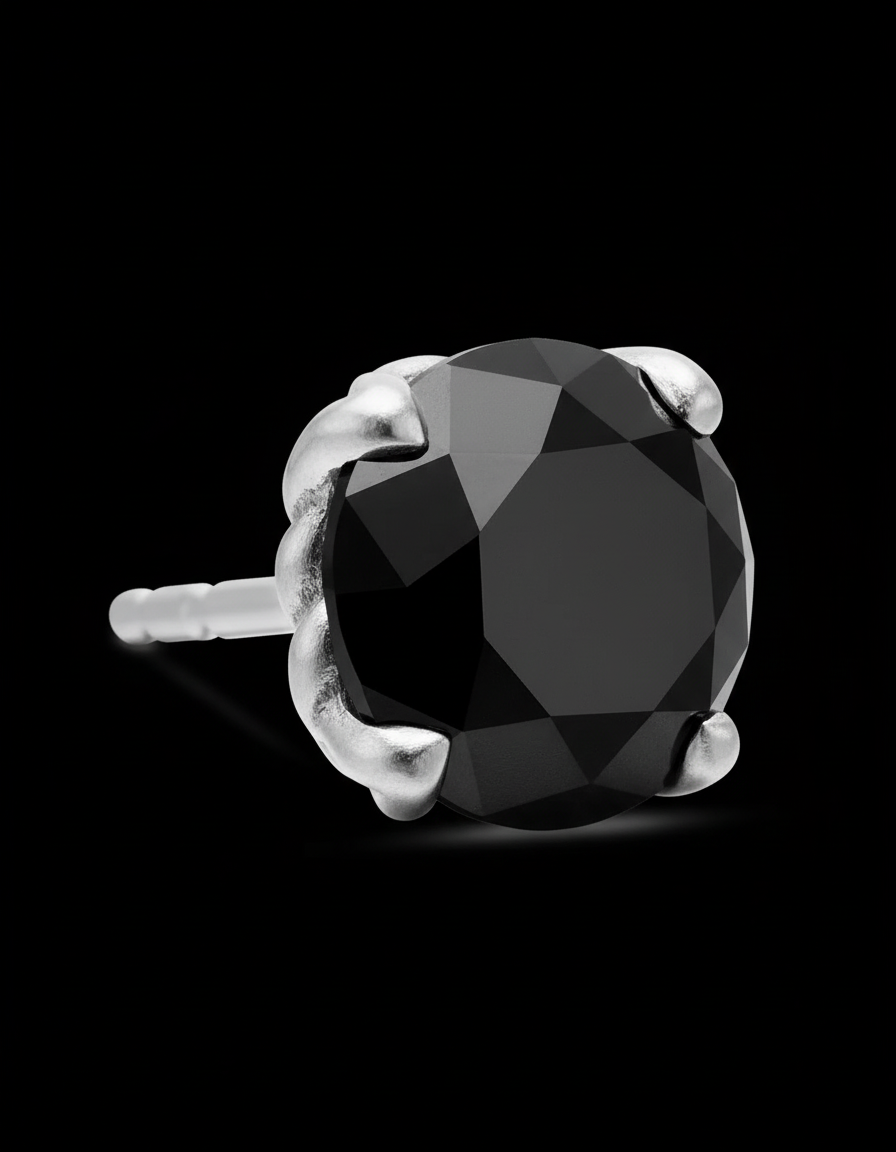
| Black diamond stud | 3 to 4 mm | Darker, graphic look; reads masculine to many eyes |
| White diamond stud | 3 to 4 mm | Classic point of light; good for weddings and evenings |
| Small huggie hoop | 8 to 10 mm | A step beyond a stud without a dangling ring |
Wait until a new piercing has healed before you change to your chosen earring; the starter jewellery your piercer fits comes first. Our men's earrings guide covers the other styles once you are ready for more.
Do families in India mind men wearing earrings?
It depends entirely on the family and the community. In some families, an earring on a man is ordinary, especially where karnavedha is still performed or where earrings are part of regional dress. In others, particularly among older relatives, an adult man's earring may be seen as a fashion statement they are not used to. Neither view is more authentic; both exist in India today.
If you are unsure, a small stud is the least likely to become a topic of conversation, and it is easy to take out for a family occasion if you prefer.
Can men wear earrings to work in India?
Usually yes, with a small stud being the safest choice. Workplaces differ: creative and technology companies rarely notice a stud, while some client-facing, uniformed or conservative workplaces have dress codes. If in doubt, a small black or white stud of 3 to 4 mm is the least conspicuous option. Our guide to men's jewellery for the office covers what reads as polished in different settings, and why Indian men wear jewellery covers the wider tradition.
Which ear should a man wear a single stud in: a quick guide
| Your situation | Suggested side |
|---|---|
| You hold your phone to your right ear | Left |
| Side parting on the left | Right (the open side) |
| You sleep on your right side | Left, while it heals |
| Family custom, such as karnavedha, pierced one ear first | The ear already pierced |
| No preference | Whichever side you see first in a mirror |
A note on AXIOM earrings
For men choosing a first earring, AXIOM makes a single Stud in 925 sterling silver with natural black diamonds; other styles are in the men's earrings range.
The practical takeaway
Wear your earring in whichever ear suits your face, hair and habits. The old left-or-right code is gone; what matters now is fit, comfort and a healed piercing. If family tradition has already pierced one ear, that is a perfectly good place to start.
