
Ask a room of Indian men whether men should wear jewellery and some will say it is not for them. Then look at their wrists, ears and fingers. There will be a kara, a thread tied at a temple, a wedding band, a gold chain from a parent, a ring set with a stone an astrologer recommended. Indian men wear a great deal of jewellery; they simply do not always call it that.
This essay looks at why. It covers the traditions behind the pieces Indian men wear, how those traditions vary by faith and region, the question of whether jewellery is feminine, and what men actually wear today. It ends with practical advice for a man who wants to start.
Do Indian men traditionally wear jewellery?
Yes, and across almost every community. Men's jewellery in India has carried faith, family, status and marriage for centuries. The forms differ from region to region and community to community, but the principle that men wear meaningful metal is old and widespread.
The table below summarises the main traditions. Each is described in more detail after it.
| Piece | Traditional meaning | Who commonly wears it | Modern everyday version |
|---|---|---|---|
| Kara or kada | Sikh article of faith; protection or family custom for others | Sikh men; many Punjabi and North Indian men | Steel, silver or gold kada |
| Ear ornaments | Karnavedha, a Hindu rite of passage for wearing ornaments | Boys in many Hindu communities | A single stud or small hoop |
| Sacred thread | Upanayana initiation | Men in some Hindu communities | Worn under clothing, unchanged |
| Rings | Marriage, family seals, astrological gemstones | Men across communities | A plain band or signet ring |
| Chains and pendants | Family gifts, religious symbols | Men across communities | A fine chain with a small pendant |
| Groom jewellery | Status and blessing at marriage | Grooms, often from the bride's or groom's family | Sherwani buttons, a statement ring |
The kara and the kada
For initiated Sikhs, the kara is an article of faith, not an ornament. It is a steel bracelet, one of the Five Ks that Guru Gobind Singh established for the Khalsa in 1699, alongside kesh, kangha, kirpan and kachera. Its meaning is set by the faith, and it is worn as such. Our article on the Sikh kara and its significance explains it properly.
Many men who are not Sikh also wear a kada, especially in Punjab and North India. For some it is family custom, for some a belief in protection, and for many simply style. The word kada covers a wide range, from a plain steel ring to a heavy gold bangle. Our guide to what a kada is and how to wear one covers the styles.
These are two different things that share a shape. A kara worn as an article of faith should not be treated as a fashion piece, and a kada worn for style does not carry the kara's religious meaning.
Ear piercing: karnavedha
Ear piercing for boys is part of Hindu tradition. Britannica's entry on the samskaras lists karnavedha, the piercing of the ears for the wearing of ornaments, among the traditional rites of childhood. The same entry notes that observance of the samskaras differs considerably by region, caste and family, and that many are not fully performed today.
In practice, many Indian men had their ears pierced as children and let the holes close. Others kept them and wear a small gold ring or stud. Among younger men in cities, a single stud or hoop has become common as style, with no ritual connection.
Sacred threads, pendants and religious symbols
Much of what Indian men wear is devotional. In some Hindu communities, the upanayana rite confers the sacred thread, worn by men throughout life. Men of many faiths wear a pendant carrying a symbol of their faith: an Om, a deity, a cross, a verse, a khanda. Many wear threads tied at temples, dargahs or family ceremonies, and replace them when they wear through.
These pieces are rarely thought of as jewellery by the men who wear them. They are worn for faith or family, often out of sight, and often for decades. That is worth remembering when someone says Indian men do not wear jewellery.
Rings: marriage, seals and stones
The ring is the piece Indian men wear most, and for the widest range of reasons.
- Wedding and engagement bands. Exchanging rings at an engagement or wedding is now common across many communities, though not part of every tradition.
- Signet rings. A ring carrying a family crest or initial descends from the seal ring once used to mark documents. Some families pass one down.
- Gemstone rings. Many men wear a ring set with a stone chosen according to astrological belief, often on a specific finger. This is a matter of belief, and practice varies widely between families and astrologers.
- Faith. In Islamic tradition, the silver ring holds a particular place, and scholars discuss in detail which metals and pieces are permitted to men.
Groom jewellery
At a wedding, Indian men traditionally wear more jewellery than at any other time. Depending on region and community, a groom may wear a sehra or turban ornament, a necklace or layered chains, rings, sherwani buttons and a kada, often gifted by one family or the other.
Customs vary a great deal. What a Marwari groom wears differs from what a Tamil or Bengali groom wears, and families within the same community make different choices. Our guide to regional groom jewellery traditions goes region by region.
Jewellery as family gift and inheritance
A great deal of what Indian men wear was not bought by them. It was given. A chain at a naming ceremony, a ring at a thread ceremony or a milestone birthday, a kada from a mother, a watch and ring set at a wedding. In many families, gold given to a son is part blessing and part savings, meant to be worn and, if ever needed, to hold value.
This shapes how men relate to their jewellery. A piece given by a parent is worn out of respect as much as taste, and it is rarely replaced even when a man's style changes. It also explains why so many men own jewellery they do not wear daily: the piece is kept for occasions, or kept safe, rather than worn.
Heirlooms add another layer. A grandfather's ring, resized for a grandson, carries family history in a way a new piece cannot. Many jewellers are asked to remodel or recreate such pieces, keeping the metal or the design while making them wearable for a new generation.
Is it feminine for men to wear jewellery?
No, not by the measure of Indian tradition. Men in India have worn kadas, rings, ear ornaments, chains and sacred threads for generations. The idea that jewellery belongs to women alone is narrower than the country's own history.
What people usually react to is not jewellery but a particular look. A few principles explain most of it:
- Design. Men's pieces tend to be heavier in form, plainer in finish, and built around geometry rather than florals. A plain band reads differently from a delicate one.
- Quantity. One or two pieces read as considered. Several pieces at once read as a statement, which some men want and some do not.
- Context. What suits a wedding may not suit an office. Norms also differ between cities, families and workplaces.
None of this is a rule. It is simply why the same man can wear a kara and a wedding band without comment, and still hesitate over a bracelet.
What Indian men wear today
Today, many Indian men wear jewellery for reasons that sit alongside tradition rather than replacing it. A man may wear his grandfather's ring, a kada his mother gave him and a stud he chose himself, each for a different reason.
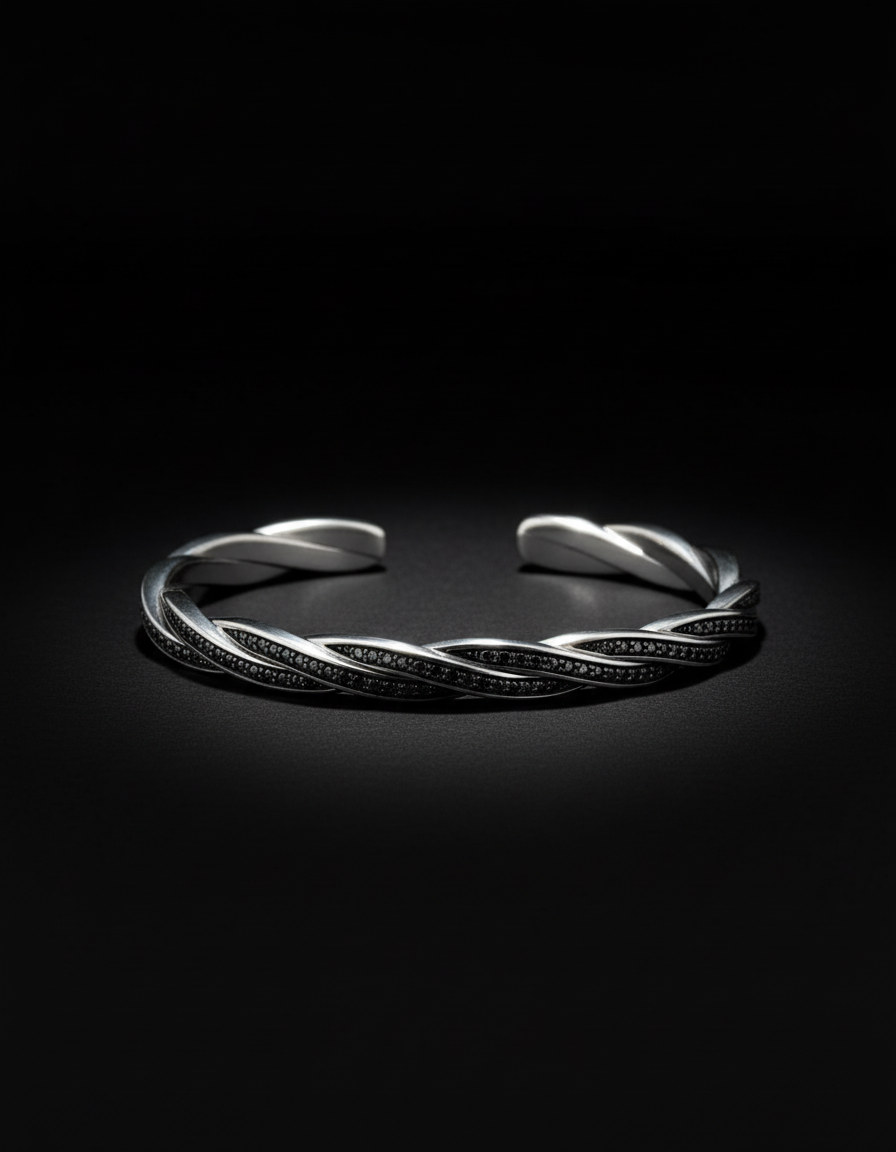
The pieces have also changed in material and design. Alongside gold, many men now wear 925 sterling silver, which costs far less and suits white-metal watches, and pieces set with black or white diamonds. Designs have moved towards clean lines and restrained finishes, which suit daily wear.
The most common everyday pieces are:
- A band or ring. Worn daily, often the first piece a man owns.
- A chain, with or without a pendant. Often worn under a shirt.
- A kada or bracelet. Especially for men who already wear a watch.
- A single stud. More common among younger men.
- Occasion pieces. Cufflinks, lapel pins and sherwani buttons for weddings and formal events.
How to start wearing jewellery
Start with one piece and wear it every day. The first few days feel conspicuous; after a couple of weeks, most men stop noticing it.
- Choose a piece that fits your routine. A band if your hands are free, a fine chain if you wear collared shirts, a bracelet if you already wear a watch.
- Pick one metal colour. Match your watch or wedding band, so everything you wear looks deliberate.
- Keep the first piece simple. A plain or lightly detailed piece is easier to wear every day than a statement piece.
- Get the size right. A ring or kada that is too tight will be taken off and left off.
- Add slowly. Once the first piece feels normal, add a second in the same metal.
Our guide to building a men's jewellery wardrobe explains how pieces fit together over time.
How AXIOM approaches men's jewellery
AXIOM makes jewellery for men only. Before AXIOM was a brand, we were a bench at the Bharat Diamond Bourse in Mumbai for more than 15 years, manufacturing for other names; we now design for the men who wear the pieces, which you can read about on our about page. Our pieces are organised by what they are, from rings to kadas to pendants, across our men's jewellery categories.
The practical takeaway
Indian men have always worn jewellery; the question has only ever been which pieces, and why. If you are unsure, start with the one piece that already has meaning for you, a kada, a ring or a pendant, and wear it well before adding anything else.
