
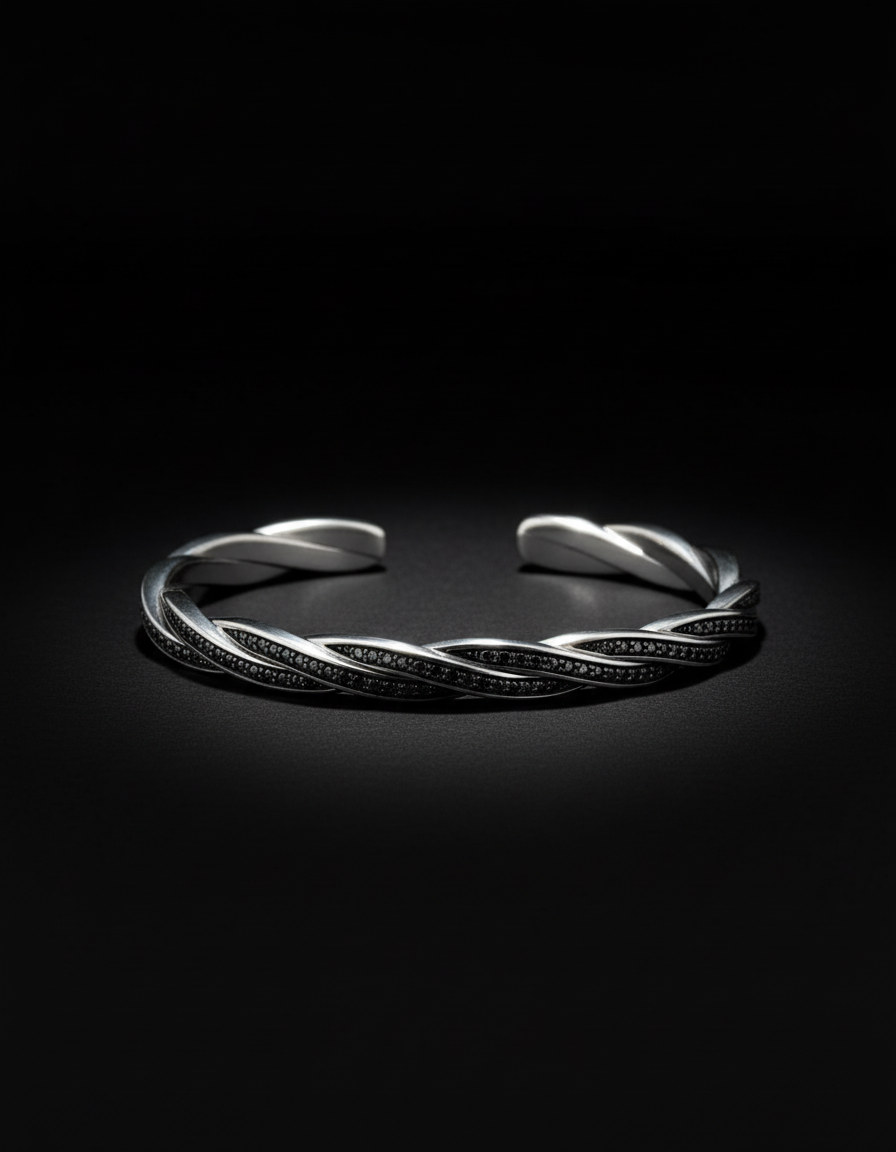
Kada in English is a bangle, or more precisely a rigid bracelet. A kada with an opening at the back is a cuff. The Hindi word is kada (कड़ा) and the Punjabi word is kara; for the Sikh article of faith, English writing keeps the word kara.
What is a kada called in English?
The English word for a kada is bangle: a rigid ring worn on the wrist that slips over the hand, as opposed to a bracelet made of links. This answers the Hindi search "hath me pahne wala kada ko english me kya kehte".
| Word | Language | English equivalent |
|---|---|---|
| Kada (कड़ा) | Hindi, Urdu | Bangle, rigid bracelet |
| Kara (ਕੜਾ) | Punjabi | Bangle; for Sikhs, the kara itself |
| Open kada | Hindi | Cuff (or cuff bracelet) |
So in everyday English, "a silver kada" is "a silver bangle", and "a gold kada for men" is "a men's gold bangle" or "a gold cuff" if it opens. The rest of this guide covers what the word means, how a kada differs from the Sikh kara, and how to wear one.
What does kada mean?
Kada (Hindi कड़ा, often written kara or karha) is the everyday word for a thick ring worn on the wrist or ankle. Platts' Dictionary of Urdu, Classical Hindi and English defines it as "a massive ring of gold or silver" worn on the wrists or ankles, "a bangle, bracelet", and traces it to the Sanskrit kaṭaka, a ring or bracelet (Platts, via the University of Chicago's Digital South Asia Library).
So the literal meaning is plain: a kada is a bangle. The same entry lists other ring-shaped things called kada, such as the link of a chain or a door handle, which shows how ordinary the word is.
You will often read that kada comes from the Hindi adjective kada, meaning hard or stiff. The two words sound alike, and a kada is certainly rigid, but the dictionary derivation for the bangle sense is the Sanskrit word for a bracelet. The popular explanation is a neat coincidence, not the origin.
Kada vs kara: are they the same thing?
They are the same word, and often the same object. Kara is the Punjabi form (ਕੜਾ) and kada is the Hindi form (कड़ा). Both are written with the same retroflex sound, which English spells as r, d or rh, so kara, kada and karha are all transliterations of one word.
The real difference is what the object is doing.
| Kara (Sikh article of faith) | Kada (worn as an ornament) | |
|---|---|---|
| What it is | One of the Five Ks worn by initiated Sikhs | A rigid bangle worn by choice |
| Metal | Steel (traditionally iron or steel) | Any: steel, silver, gold, brass |
| Decoration | Plain by intention | Can be engraved, textured or stone-set |
| When worn | At all times, for an initiated Sikh | Whenever the wearer likes |
| Who decides the rules | Sikh code of conduct | Personal and family custom |
The kara is an article of faith. It is one of the five articles, all beginning with K, that Guru Gobind Singh gave the Khalsa in 1699: kesh (uncut hair), kangha (comb), kara (steel bracelet), kachhera (undergarment) and kirpan (sword). The Sikh code of conduct, the Sikh Rehat Maryada published by the SGPC, tells an initiated Sikh to have the five Ks on their person at all times and describes the kara as a steel bracelet, adding that it "should be of pure steel".
A kada worn as jewellery is a different thing, even when it looks similar. A gold or diamond-set kada is an ornament. It is not a kara and does not take the place of one. For the full faith context, including amrit, the Khalsa and etiquette, read our guide to the Sikh kara and its significance.
What does a kada symbolise?
For Sikhs, the kara stands for restraint and a bond with the Guru. The BBC's guide to the Five Ks sets out the meanings most often given:
- Restraint. It reminds the wearer not to do anything the Guru would not approve of, which is why it sits on the hand that acts.
- God without beginning or end. A circle has no start and no finish.
- Belonging. It marks a permanent bond with the Sikh community, each wearer a link in the Khalsa.
- Not an ornament. The same BBC page notes that the kara is steel rather than gold or silver precisely because it is not meant to decorate.
Outside Sikh practice, the meanings are looser and more personal. Men describe a kada as a mark of strength, of family (a kada given at a wedding, a naming or on reaching adulthood), or of where they come from. None of these is a formal doctrine, and they vary by family and region. It is fair to say a kada means what the wearer and the giver intend, while the kara carries a specific, shared meaning.
Why do men wear a kada?
Men wear a kada for four overlapping reasons: faith, family, region and style.
- Faith. For an initiated (amritdhari) Sikh, the kara is not optional. Many Sikhs who have not taken amrit also wear one as a mark of identity.
- Family. A kada is a common gift from a parent, grandparent or in-laws, and it gets worn because of who gave it.
- Region. In Punjab and much of north India a steel or silver kada on a man's wrist is ordinary dress, worn by Sikhs, Hindus and others alike.
- Style. The kada is one of the few pieces of men's jewellery with deep Indian roots. It sits where a watch already lives, has real weight, and works with a kurta as well as a shirt.
Some Hindu men also wear a copper, iron or silver kada on the advice of an astrologer or a family priest. That is a matter of personal belief rather than doctrine, it varies by family and region, and this guide describes the practice without making any claim about its effects.
The common thread is restraint rather than display. A kada is usually worn alone, and a single plain band says more than a stack.
What is a kada made of?
A kada can be made of iron, stainless steel, brass or copper, 925 sterling silver, or gold, usually 22K or 18K. The metal changes the meaning, the upkeep and the price, so choose it for the reason you are wearing one.
| Metal | Feel on the wrist | Upkeep | How the price is set | Typical reason to choose it |
|---|---|---|---|---|
| Iron | Dense, darkens with age | Rusts if left wet; keep dry and oiled | Low; mostly labour | Traditional kara |
| Stainless steel | Hard, stays bright | Almost none | Low; mostly labour | Everyday kara, gym and water |
| 925 sterling silver (92.5% silver) | Medium weight, warm colour | Tarnishes; polish now and then | Silver weight plus making | Ornamental kada, first kada |
| 18K gold (75% gold) | Heavy, holds shape and detail well | Low; check for wear yearly | Gold weight plus making | Daily-wear gold kada |
| 22K gold (91.6% gold) | Heaviest, richest yellow, softer | Dents and scratches more easily | Gold weight plus making | Traditional gift, heirloom |
For how much a silver kada should weigh and what drives its price, see our silver kada guide. For kadas set with real diamonds, and the settings that survive a rigid band, see the diamond kada guide.
Two practical points. Hallmarked gold jewellery sold in India must carry a six-digit HUID code alongside the BIS mark and purity grade, so check for all three on any gold kada. And a stone-set kada costs far more than its metal weight suggests, because the stones and the setting labour make up much of the price. Our comparison of gold, silver and steel kadas goes through the trade-offs metal by metal.
Which hand should you wear a kada on?
Most Sikhs wear the kara on the right wrist, or on the dominant hand, since the reminder is meant for the hand that acts. The Rehat Maryada itself does not name a wrist, and practice varies: some Sikh teachers (Sikh Dharma International, for example) say men wear it on the right and women on the left, while others go by the dominant hand, which for a left-handed person is the left.
For a kada worn as jewellery there is no rule. Most men choose the wrist without the watch, so the two do not knock together. If you want both on one wrist, wear the kada above the watch, closer to the elbow, and choose a slimmer band.
| Situation | Usual choice |
|---|---|
| Sikh kara | Right wrist, or the dominant hand |
| Fashion kada, you wear a watch on the left | Right wrist |
| Fashion kada, you wear a watch on the right | Left wrist |
| Kada and watch on the same wrist | Kada above the watch, slimmer band |
How should a kada fit?
A closed kada has to pass over your knuckles, so you size it to your hand, not your wrist. Bring your thumb across your palm towards your little finger, as if slipping a bangle on, then wrap a tape or paper strip around the widest part of the hand. Divide that circumference by 3.14 to get the inner diameter you need.
Indian bangle and kada sizes are written as 2.4, 2.6, 2.8, 2.10 and so on. The figure before the point is inches and the figure after it is sixteenths of an inch, so a 2.8 has an inner diameter of 2 and 8/16 inches, or 63.5 mm.
| Indian size | Inner diameter (inches) | Inner diameter (mm) | Hand measurement (cm) |
|---|---|---|---|
| 2.4 | 2.25 | 57.2 | 18.0 |
| 2.6 | 2.375 | 60.3 | 18.9 |
| 2.8 | 2.5 | 63.5 | 20.0 |
| 2.10 | 2.625 | 66.7 | 21.0 |
| 2.12 | 2.75 | 69.9 | 22.0 |
| 2.14 | 2.875 | 73.0 | 22.9 |
If you fall between two sizes, go up: a kada that will not clear your knuckles cannot be worn at all. A kada that opens, as a cuff or on a hinge, never has to pass the knuckles, so it is sized to the wrist and is usually smaller. Our kada size guide covers both types in more detail.
Can you wear a kada every day?
Yes. Steel and iron karas are worn permanently, including in water and sleep, and that is the norm rather than the exception.
Silver and gold need a little more thought:
- Water. A shower does not harm steel, silver or gold. Silver tarnishes faster in humid, coastal air and around sulphur, so it needs an occasional polish.
- Gym. Take off a silver or gold kada before lifting. A loaded bar against a precious-metal band will dent it, and stone settings do not like impact.
- Marks. A kada worn daily will pick up fine scratches. That is honest wear, and it can be refinished.
- Check. Once a year, look at the point where the kada rests on the wrist bone. Thinning shows there first.
How AXIOM approaches the kada
AXIOM makes fashion kadas, not karas, and we keep the two separate. Our Strength Kada and The Torque Kada, a cable cuff-style bracelet, are 925 sterling silver set with natural black diamonds, made to order at the Bharat Diamond Bourse in Mumbai in solid silver rather than plated base metal. Both sit in our bracelets and kada collection alongside link bracelets and cuffs.
The practical takeaway
If you are wearing a kada for faith, wear a plain steel kara on the hand that acts and follow your own tradition. If you are wearing one as jewellery, size it to your knuckles, pick the metal for how you live, and wear it on its own. To decide between a kada and a flexible bracelet, see kada vs bracelet.
