
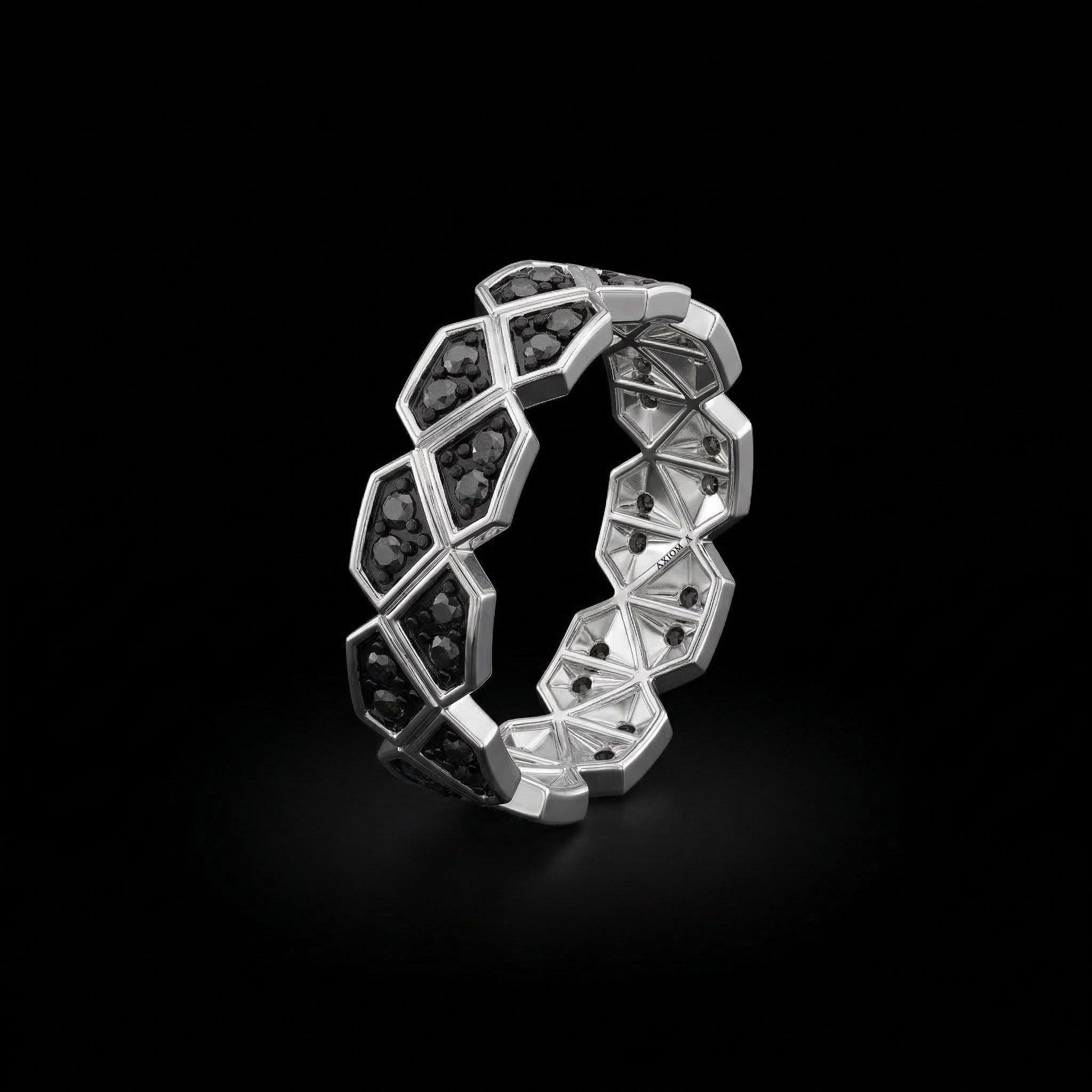
A man's jewellery wardrobe is not a collection. It is a short list of pieces that each do one job well, bought slowly, worn often. The mistake most first-time buyers make is not choosing the wrong piece. It is buying three pieces in a weekend and discovering that only one of them ever leaves the drawer.
This guide is for two readers: the man who has never worn anything beyond a watch and wants to know where to begin, and the man who owns a few pieces bought at random and wants them to work together. It covers what each of the six essentials is for, what to look for in it, which order to buy them in, and how to wear them without looking overdone. Everything here comes from how we design and fit men's jewellery at the bench, not from trend reports.
What are the six men's jewellery essentials?
The six essentials are a daily band or ring, an everyday chain, a bracelet or kada, a pendant, an occasion piece and an heirloom piece. The first three are worn most days. The last three are worn for meaning or for events, and they are the ones worth waiting and saving for.
| Piece | When it is worn | What to look for | Budget logic |
|---|---|---|---|
| Band or ring | Daily, office to weekend | 4 to 8 mm width, comfort-fit inside, no raised stones | Lowest entry point; plain metal costs least |
| Everyday chain | Daily, under or over a shirt | 50 to 55 cm length, solid links, secure clasp | Priced mostly by metal weight |
| Bracelet or kada | Daily or most days | 1.3 to 2.5 cm of ease over the wrist, smooth inner edge | Mid to high; stones raise it quickly |
| Pendant | Most days or on occasions | Scale to your build, bail wide enough for your chain | Mid; design and stones drive price |
| Occasion piece | Weddings, festivals, black tie | Cufflinks, buttons, a lapel pin or a statement ring | Bought once, worn rarely, so buy quality |
| Heirloom piece | Milestones, handed down | Solid construction, precious metal, hallmark | Highest; worth waiting for |
1. The band or ring: the easiest first piece
A ring is the best first piece for most men because it is small, sits on a part of the body you already look at, and works with a T-shirt as well as a suit. It also teaches you quickly whether you enjoy wearing metal, without the commitment of something around your neck.
Most men's bands are made between about 4 and 8 mm wide. On shorter or slimmer fingers, 4 to 6 mm reads as proportionate; on large hands, 6 to 8 mm holds its own. A comfort-fit band, rounded on the inside, is easier to wear all day than a flat interior. If you type for a living, avoid stones that stand proud of the surface. A flush setting, where the stone sits level with the metal, will not catch.
Where to wear it is a matter of convention rather than rule. The fourth finger of either hand can be read as a wedding finger (Indian tradition places a man's ring on the right hand, and many men now wear it on the left), so a first fashion ring often goes on the little finger or the middle finger instead. A signet ring is traditionally worn on the little finger. Our guide to types of rings for men covers bands, signets, eternity rings and statement rings in detail.
2. The everyday chain: length matters more than thickness
An everyday chain should sit at or just below the collarbone, which for most men means 50 to 55 cm (20 to 22 inches). At that length it shows at an open collar and hides under a buttoned shirt, which is exactly what a daily chain needs to do.
| Chain length | In inches | Where it sits on most men |
|---|---|---|
| 45 cm | 18 in | At the base of the neck, close fitting |
| 50 cm | 20 in | At the collarbone, the most versatile length |
| 55 cm | 22 in | Just below the collarbone, shows at an open collar |
| 60 cm | 24 in | Mid chest, better for carrying a pendant |
Choose a solid link over a hollow one for daily wear. Hollow chains are lighter and cheaper, but they dent and are harder to repair. Curb, box and rope links all wear well; very fine snake or herringbone chains can kink. Check the clasp: a lobster clasp is more secure than a spring ring. Our piece on how to style a men's chain goes further into link types and layering.
3. The bracelet or kada: rigid or flexible
A bracelet adds presence to the wrist without drawing the eye to the face, which is why many men find it easier to wear than a chain. The choice is between a flexible chain or link bracelet and a rigid kada or cuff.
A flexible bracelet should have about 1.3 to 2.5 cm of ease over your wrist measurement, so it moves without sliding over the hand. A kada is sized by its inner diameter because it slips over the hand rather than fastening, so the widest part of your hand decides the fit, not your wrist. The kada also carries meaning for many Indian men. For initiated Sikhs the kara, traditionally of iron or steel, is one of the five articles of faith, and that practice deserves to be understood on its own terms, separate from the kada worn as a fashion piece.
If you wear a watch, the usual choice is to put the bracelet on the other wrist. Diamonds can scratch even a sapphire watch crystal, and any metal bracelet will mark a polished case over time.
4. The pendant: the most personal piece
A pendant is the piece most men choose for meaning: a deity, an initial, a symbol, a stone. That is also why it is the one to buy slowly. A pendant chosen in a hurry is rarely worn.
Scale matters more than style. As a working guide, the pendant should be noticeably smaller than the knot of a tie, and it should sit a few centimetres below the collarbone, which usually means a 55 to 60 cm chain. Check that the bail (the loop the chain passes through) is wide enough for the chain you already own. A thick chain through a narrow bail is a common and annoying mismatch.
Religious pendants deserve particular care. Many men wear an Om, a Ganesh, a cross, a khanda or an Ayat as a private devotion, and customs about metal, placement and when to remove them vary by family and community. Ask the person who taught you the practice before you ask a jeweller.
5. The occasion piece: what you wear to weddings
An occasion piece is jewellery you wear a handful of times a year, so it can be bolder than anything you wear daily. For Indian men that usually means one of four things: sherwani or kurta buttons, cufflinks for a French-cuff shirt, a lapel pin or brooch for a bandhgala or suit, or a statement ring.
Because it is worn rarely, buy one good occasion piece rather than several average ones. It should match the metal of your daily pieces, so you can wear them together at a reception without clashing. A white-metal button set, for example, works with a silver or white-gold band and a steel watch. If you only attend a few weddings a year, the piece you choose should suit both an ivory sherwani and a dark bandhgala.
6. The heirloom piece: the one you keep
An heirloom piece is the one you intend to wear for decades and hand on. It is usually marked by a milestone: a wedding, a first salary, the birth of a child, the passing of a parent. It is the piece where material and construction matter most.
Heirloom jewellery needs to be solid, not plated, because plating wears through within years of daily wear. It needs to be hallmarked, so its purity can be proved in thirty years to someone who never met the buyer. The Bureau of Indian Standards hallmarking FAQ lists the grades it recognises, including 18K gold (750) and 22K gold (916), and 925 for silver. And it should be designed so it can be serviced: stones that can be reset, a shank that can be resized.
Which piece should a man buy first?
Buy a ring first, unless you already know you prefer something on the wrist or neck. Then wear it every day for at least two or three months before buying anything else. That period tells you what you actually need to know: whether you like the metal colour against your skin, whether the width suits your hand, and whether you want more.
A sensible order for most men looks like this:
- A daily ring or band. The lowest-cost serious piece and the easiest to wear.
- A chain or a bracelet, whichever you found yourself wanting while wearing the ring. Most men know by then.
- The other one of the two, in the same metal colour.
- An occasion piece, bought when a wedding or event gives you a reason.
- A pendant, when you have something you want to carry.
- An heirloom piece, marked by a milestone rather than bought on impulse.
What to skip at the start: matched sets, very wide rings, heavy chains, anything plated, and anything bought purely because it was on offer. A first piece should be something you would be happy to be wearing in ten years.
Gold, silver or white gold: which metal to start with?
Start with the metal that matches the watch you wear most and that your budget can carry in solid form. A steel watch pairs naturally with 925 sterling silver or white gold. A yellow-gold watch pairs with yellow gold.
925 sterling silver is 92.5 percent pure silver alloyed for strength, and it costs far less per gram than gold, which makes it a practical metal for building a first set. It does tarnish over time and needs occasional cleaning. 18K gold does not tarnish in normal wear, is hard enough for daily use, and costs considerably more. For how silver behaves in daily wear, read is 925 sterling silver good for men.
Whatever you choose, keep one metal colour across your daily pieces. Mixing a yellow chain with a white band can work, but it takes more thought than most men want to give it every morning.
How to wear the pieces together without looking overdone
The simplest rule is one focal point at a time. If you are wearing a pendant on the outside of your shirt, keep the wrist quiet. If you are wearing a statement bracelet, tuck the chain in. Two or three pieces at once is a comfortable daily number for most men.
A few combinations that work in practice:
- Office: band plus watch. Add a slim bracelet on the free wrist if your workplace is relaxed.
- Weekend: band, chain at 50 cm and a bracelet, all in one metal colour.
- Festival or puja: kada, a pendant worn over a kurta, and your usual ring.
- Wedding reception: occasion buttons or cufflinks, your band, and a watch. Leave the chain inside the shirt.
Our guide on how much jewellery a man should wear goes into limits for rings, chains and bracelets by setting.
How AXIOM approaches this
We build our pieces in 925 sterling silver set with natural black or lab-grown white diamonds, solid metal rather than plated base metal, with select 18K white gold options, and we organise them by category so a first-time buyer can see a ring, a bracelet and a pendant side by side on our men's jewellery categories page. A daily-ring example is the Vector Ring, in 925 sterling silver with natural black diamonds; for the wrist, the Strength Kada is 925 sterling silver with natural black diamonds; and the Sentinel Pendant is the same pairing in pendant form. Every piece is made to order at the Bharat Diamond Bourse in Mumbai and carries a lifetime craftsmanship guarantee.
The practical takeaway
Buy one ring, wear it daily for a season, and let that decide your second piece. Keep your daily pieces in one metal colour, save boldness for the occasion piece, and wait for a real milestone before buying the heirloom. Six pieces, bought over several years, will serve you better than a dozen bought in a month.
