
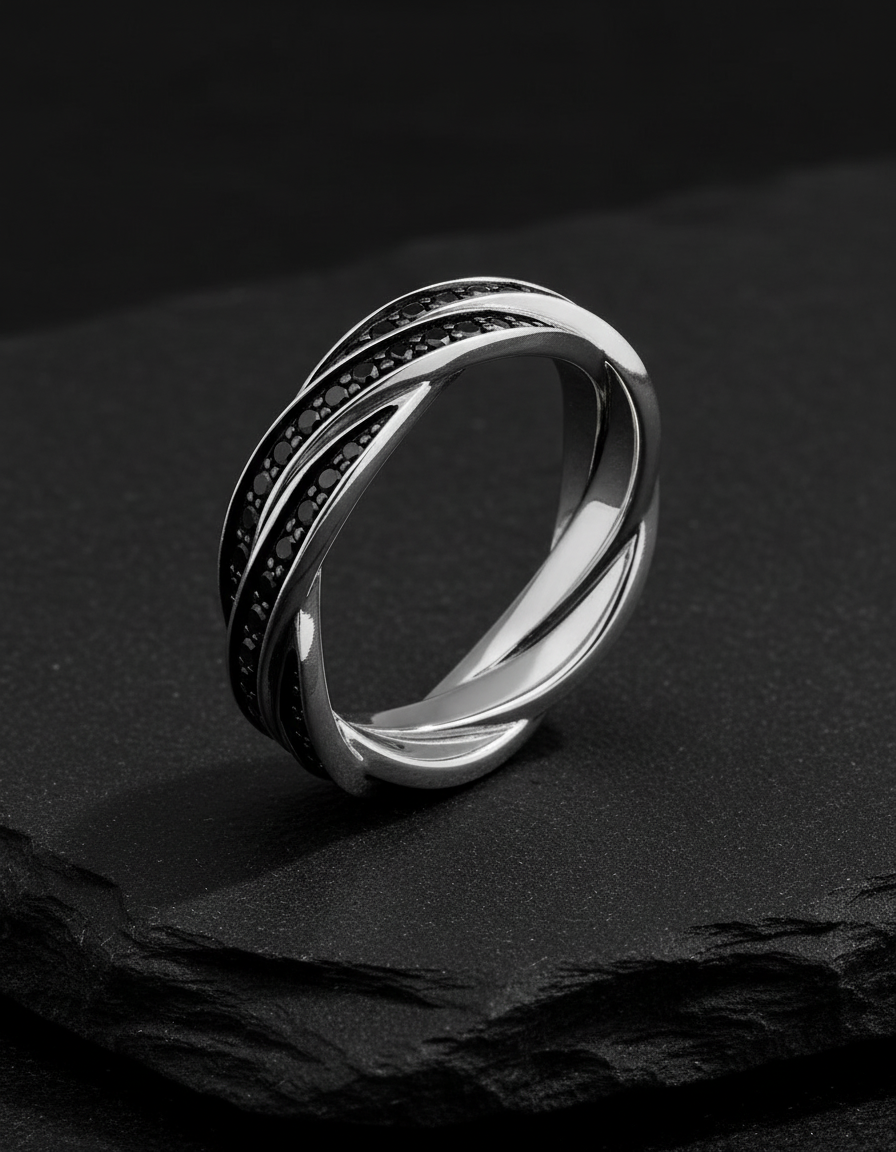
Yes, black diamonds are real diamonds. A black diamond is carbon crystallised in the same lattice as a colourless diamond, with the same hardness of 10 on the Mohs scale; it is black because dense inclusions such as graphite, or a polycrystalline structure called carbonado, stop light passing through it. Black diamonds sit oddly in the jewellery trade. For most of history they were treated as industrial material, and they only became fashionable in the late twentieth century. That short history is why so many men who like the look are unsure whether they are buying a real gem, a dyed stone or glass. This guide explains the three routes by which a diamond ends up black, and how to protect yourself when buying one.
Are black diamonds real diamonds?
Black diamonds are real diamonds. They are carbon crystallised in the same lattice as a colourless diamond, and they share its hardness of 10 on the Mohs scale. GIA's guide to black diamonds describes naturally coloured black diamonds as "fancy black", the trade term for a natural colour diamond in this shade.
What makes the question confusing is that three quite different things are all sold as black diamonds, and several look-alike stones are sold beside them. The diamond part is real in every case below. The colour's origin is what varies.
| Type | Origin of the stone | Origin of the colour | What to ask for |
|---|---|---|---|
| Natural-colour black diamond | Mined | Dense inclusions or polycrystalline structure | A report stating natural colour |
| Treated black diamond | Mined | Heat or irradiation after mining | Disclosure of treatment |
| Laboratory-grown black diamond | Grown in a factory | Growth conditions or post-growth treatment | Disclosure as laboratory-grown |
| Simulant (onyx, spinel, CZ, moissanite) | Not diamond | Natural or dyed | Correct name of the material |
What makes a black diamond black?
A diamond turns black when light cannot pass through it. In a colourless diamond, light enters, bounces off internal facets and returns as sparkle. In a black diamond, something inside absorbs that light before it can come back out.
GIA explains that most naturally coloured black diamonds get their colour from enormous numbers of tiny mineral inclusions, such as graphite, pyrite or hematite, spread through the stone. Many also have fractures that have darkened, or areas that have turned to graphite. Under strong light, some of these stones are not truly black inside at all but deep brown or olive green, packed with dark material.
How are black diamonds formed?
Natural black diamonds form in one of two ways. The first is the ordinary route for any diamond: a single crystal grows deep in the earth, but it traps so much dark mineral material, or suffers so much internal fracturing, that it becomes opaque. These stones come from the same kinds of deposits as white diamonds.
The second route is carbonado, a rarer and stranger material. Carbonado is polycrystalline: instead of one crystal, it is a porous mass of countless tiny diamond crystals fused with graphite and other carbon. It has been found mainly in Brazil and the Central African Republic, in rocks that are not the usual volcanic source of gem diamonds, and its origin is still debated by scientists. Carbonado is unusually tough because its many crystals point in different directions, but it is scarce, so it is rarely what you are buying in a piece of jewellery.
Are most black diamonds treated?
Yes. GIA states that most black diamonds used in jewellery have been treated. The starting material is usually a mined diamond of low commercial value, heavily included or fractured, which is then processed to make its colour an even, saturated black.
The two common treatments are:
- Heating at high temperature and low pressure, which turns the walls of internal fractures to graphite and blackens the stone.
- Irradiation, which can produce a colour so deep green it reads as black to the eye.
A treated black diamond is still a natural diamond in origin; only its colour has been altered. That distinction matters for price and disclosure. "Natural black diamond" on a tag describes a mined stone; "natural-colour black diamond" describes a stone whose colour was not treated. If the difference matters to you, ask the seller which one they mean, and ask for it in writing.
Black diamond vs onyx, spinel and other look-alikes
A black diamond is harder, brighter-surfaced and more expensive than any of its common look-alikes. On a counter they can look very similar, especially small stones set in a row. Here is how they compare.
| Stone | What it is | Mohs hardness | Surface look | Price basis |
|---|---|---|---|---|
| Black diamond | Carbon | 10 | Mirror-like, sharp facet edges | Diamond pricing, per carat |
| Black moissanite | Silicon carbide, laboratory-made | About 9.25 to 9.5 | Very bright, slightly metallic | Low to moderate |
| Black spinel | Magnesium aluminium oxide | 8 | Glassy, bright | Low |
| Black cubic zirconia | Zirconium oxide, laboratory-made | 8 to 8.5 | Glassy, facet edges soften with wear | Very low |
| Black onyx | Chalcedony (quartz family), usually dyed | 6.5 to 7 | Waxy to glassy, often cut flat or as cabochon | Very low |
Black onyx is the most common substitute, and most black onyx on the market is dyed chalcedony. It is a fine material in its own right, but it scratches far more easily than diamond, and it is usually cut as a flat plate or smooth dome rather than faceted.
How to tell if a black diamond is real
A black diamond is hard to check at home because you cannot look through it the way you can with a white stone. These checks narrow it down, but only a laboratory settles it.
- Ask for paperwork first. A seller of real black diamonds should state the stone as diamond on the invoice and tell you whether the colour is natural or treated.
- Look at the facet edges under a 10x loupe. Diamond edges stay crisp for decades. Rounded, scuffed edges on a piece that has been worn suggest a softer stone such as CZ or onyx.
- Look at the surface lustre. Diamond has a hard, mirror-like surface. Onyx looks waxy or glassy by comparison.
- Use a thermal diamond tester if you have access to one. It will separate diamond from onyx, spinel and CZ, but moissanite can read like diamond on thermal testers, so a pass is not final proof.
- Weigh loose stones if you can. Cubic zirconia is roughly 1.7 times as dense as diamond, so a CZ of the same size is noticeably heavier.
- For certainty, send it to a laboratory. GIA and other labs issue coloured diamond reports that state whether a black colour is natural or treated.
For white stones, our guide on how to check a real diamond at home covers the tests that work and the ones that do not.
Are black diamonds durable enough for daily wear?
Black diamonds are hard but more brittle than white diamonds. Hardness and toughness are different things: hardness is resistance to scratching, where diamond is unbeaten, and toughness is resistance to breaking. GIA notes that a black diamond can contain hundreds to thousands of tiny fractures, which make it more likely to chip from a sharp knock than a colourless stone.
In practice this means:
- Choose protective settings for rings and bracelets: bezel, channel or flush settings shield the edges; tall claw settings expose them.
- Take rings off for gym work, construction and anything involving tools or weights.
- Never clean black diamonds in an ultrasonic or steam cleaner. GIA advises against both. Warm water, a drop of mild soap and a soft brush are enough.
- Have settings checked once a year, especially rows of small stones in a band.
Is a black diamond good to wear?
For most men, yes. A black diamond does not show dirt the way a white stone does, it reads as understated rather than flashy, and it sits well against silver or white gold. Its meaning and symbolism are a separate question, covered in black diamond meaning, and if you are choosing between colours on price, see black diamond vs white diamond price.
How AXIOM approaches this
Black diamonds appear across a large share of the AXIOM catalogue, and each of those pieces is listed on its product page as set with natural black diamonds in 925 sterling silver. The Strength Ring sets them in a men's ring and the Checkmate Bracelet in a bracelet; more are in our men's rings and bands. Certification details are available on request, and that is the place to ask about any specific piece. For ring styles, see our guide to black diamond rings for men.
The practical takeaway
A black diamond is a real diamond; the question worth asking is how it became black. Get the stone named as diamond on your invoice, ask whether the colour is natural or treated, choose a setting that protects the edges, and keep it away from ultrasonic cleaners.
