
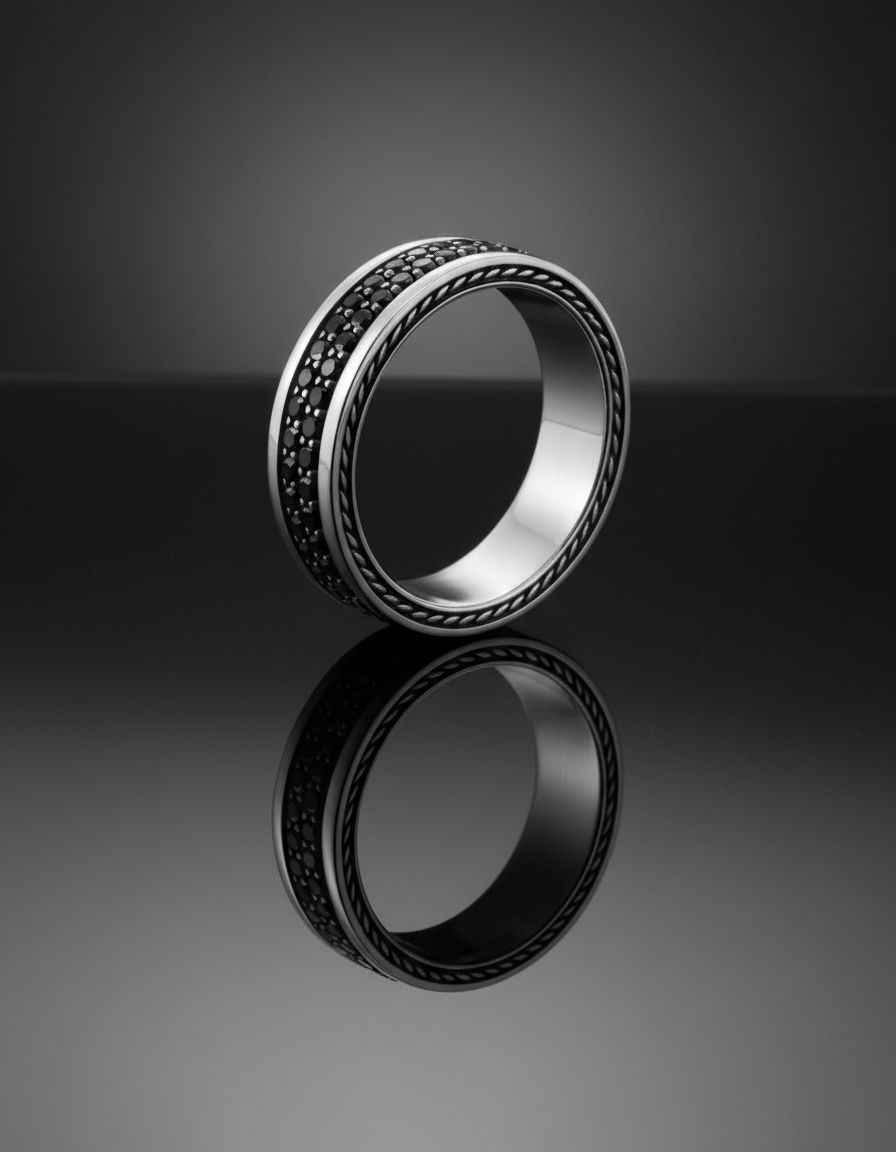
Black diamonds suit men who want a diamond ring that does not look like a diamond ring from across the room. They absorb light instead of throwing it, so a band of black stones reads as texture and depth rather than sparkle. The catch is that "black diamond" covers three very different stones with very different prices, and plenty of rings sold under that name are not diamonds at all. This guide explains what you are actually buying, which styles work for daily wear, and how the price is built.
What is a black diamond?
A black diamond is a diamond that looks opaque black. It is still crystallised carbon and still ranks 10 on the Mohs hardness scale. What makes it black depends on how it formed or what was done to it afterwards, and that is the single most important question to ask before you buy.
Natural black diamonds
Natural-colour black diamonds get their colour from enormous numbers of dark inclusions, such as graphite, packed through the stone, or from dark staining along internal fractures. GIA's black diamond buying guide describes countless tiny inclusions spread through the stone as the cause. These stones came out of the ground black.
Treated black diamonds
Many black diamonds in the market started as heavily fractured grey or white diamonds of low value. They are then treated to turn black, usually by one of two methods:
- Heating (annealing) at low pressure, which turns the material in the fractures into graphite and darkens the whole stone.
- Irradiation, which changes the crystal structure and produces a green so dark it looks black.
The treatment is permanent. It is not a coating and does not wash off. A treated black diamond is still a real diamond, but it should be sold and priced as treated.
Lab-grown black diamonds
Lab-grown black diamonds are grown by the HPHT or CVD process and made black during growth or afterwards. They are real diamonds with the same chemistry, and they tend to look more even and glossy than natural black stones, which often show a slightly pitted, graphite-grey surface under magnification.
| Type | What makes it black | Real diamond? | Price basis |
|---|---|---|---|
| Natural-colour black diamond | Dense natural inclusions or staining | Yes | Highest of the three per carat |
| Treated black diamond | Heating or irradiation of low-grade diamond | Yes | Lower; treatment must be disclosed |
| Lab-grown black diamond | Grown and coloured in a lab | Yes | Usually lower than natural |
| Black moissanite | Silicon carbide, a different mineral | No | Lower still |
| Black onyx or black CZ | Dyed chalcedony or synthetic zirconia | No | Lowest |
How can you tell which one you have?
By eye, you usually cannot. A gem lab report is the reliable way: GIA reports on coloured diamonds state whether the colour origin is natural or treated. For a ring set with many small stones, individual reports are rare, so ask the seller to state the stone type in writing on the invoice.
Black diamond vs black moissanite, onyx and CZ
Black moissanite, onyx and cubic zirconia are the common look-alikes. They are legitimate materials in their own right, but none of them is a diamond and none should be priced like one.
| Stone | What it is | Mohs hardness | How it wears |
|---|---|---|---|
| Black diamond | Carbon | 10 | Resists scratching; can chip if knocked |
| Black moissanite | Silicon carbide | 9.25 to 9.5 | Very hard, glossy surface |
| Black cubic zirconia | Synthetic zirconium oxide | 8 to 8.5 | Scratches and dulls over years |
| Black onyx | Chalcedony, usually dyed black | 6.5 to 7 | Softer; edges and polish wear faster |
Two practical points help when shopping. Moissanite conducts heat much like diamond, so a basic thermal diamond tester can read it as diamond; a jeweller needs a combined tester or a lab to separate them. And GIA notes that what is sold as "black onyx" is almost always dyed chalcedony, which is fine for a signet face but should never be sold as diamond. We cover the full list of checks in are black diamonds real.
Black diamond ring styles for men
The best black diamond ring for most men is a band with many small stones held low, because it looks strong and protects the stones. A single large raised black diamond makes a statement but is more exposed.
| Style | Look | Daily wear | Price basis |
|---|---|---|---|
| Single stone (solitaire) | One bold dark centre | Good if bezel-set, weaker if raised on prongs | Driven by the one stone's size and type |
| Pavé band | Surface covered in tiny stones | Good; check stones sit low | Number and size of stones plus labour |
| Channel-set band | Stones held between two metal walls | Very good; most protected | Moderate labour, even stone sizes |
| Two-row eternity | Double line of stones around the band | Good; cannot be resized much | Stone count is high, so price rises with size |
| Chevron or V design | Stones follow an angled line | Good; stack-friendly | Fewer stones than a full band |
| Black and white mix | Black stones with white accents | Good | Mix of two stone prices |
Why toughness matters more than hardness
Black diamonds are as hard as white ones, so they resist scratches. But toughness, the resistance to chipping, is a different property. Because natural and treated black diamonds are full of inclusions and fractures, they can be more brittle than a clean white diamond. For a man who uses his hands, choose settings where metal protects the stone edges: channel, bezel, flush or low pavé.
What metal suits a black diamond ring?
White metals give the sharpest contrast with black stones, and yellow gold gives a warmer, more traditional look. The metal also decides most of the price.
- 925 sterling silver: bright white contrast, far lower metal cost, softer and needs occasional polishing to remove tarnish.
- 18K white gold: harder than silver, holds settings well, and is commonly finished with rhodium for extra whiteness.
- Platinum: dense, naturally white, and the most expensive per gram.
- Yellow or rose gold: warmer contrast, popular with traditional Indian wardrobes.
What is black rhodium?
Rhodium is a hard, white metal in the platinum family, electroplated in a thin layer over jewellery to change its surface colour. Black rhodium is a dark version of that plating, often used to make a ring's metal match black stones. Because it is a plated layer, it wears away with time on high-contact areas like the underside of a band and needs replating.
What does a black diamond ring for men cost in India?
The price of a black diamond ring is built from four parts: the metal weight at the day's rate, the stones, the setting labour, and GST. The stone type moves the number most.
- Stone type. Natural-colour black diamonds cost more per carat than treated or lab-grown black diamonds. Moissanite and onyx cost less again.
- Total carat weight. A pavé or two-row eternity band can carry dozens of small stones, so the total adds up even when each stone is tiny.
- Metal and weight. A silver band costs a fraction of the same design in 18K white gold or platinum.
- Setting labour. Setting many small stones by hand takes skilled hours, which is why a full eternity band costs more than a half band.
Black diamonds generally cost less per carat than white diamonds of similar size, because most are included stones that would not grade well as white diamonds. We compare the two in black diamond vs white diamond price. As a rule, if a "black diamond ring" is priced like fashion jewellery, ask directly whether the stones are moissanite, onyx or CZ.
Is a black diamond ring right for a wedding or engagement?
Yes, many men choose one. A black diamond band looks less formal than white diamonds, suits daily office wear and pairs well with a partner's white diamond ring without matching it exactly. What the ring signals is up to the couple; our piece on black diamond meaning covers the associations people attach to black stones.
If you want a band with stones all the way round, read about eternity rings for men first, because full eternity bands have resizing limits worth knowing before you choose a size.
How to clean and care for a black diamond ring
Clean it gently and avoid machines. Black diamonds show grease and skin oil clearly, so a quick clean every week or two keeps them looking deep black.
- Soak the ring for 10 to 15 minutes in warm water with a few drops of mild soap.
- Brush the stones and underside with a soft toothbrush.
- Rinse under running water with the sink plugged.
- Dry with a lint-free cloth.
- Skip ultrasonic and steam cleaners, which GIA advises against for black diamonds.
Take the ring off for the gym, heavy lifting and household cleaning chemicals, and have the settings checked once a year so a loose stone is caught before it falls out.
For every other black diamond piece, from kadas to pendants, see the black diamond jewellery guide. If the ring is for an engagement, the black diamond engagement ring guide covers settings for her ring and his.
How AXIOM approaches black diamond rings
Most of AXIOM's rings are set with natural black diamonds in 925 sterling silver, made to order at the Bharat Diamond Bourse in Mumbai. The Vow Noir Band is 925 sterling silver with natural black diamonds, and the Valor Band, a two-row black diamond eternity ring with natural black diamonds, is offered in either 925 sterling silver or 18K white gold, which lets you compare the same design in both metals. Certification details are available on request, so ask for them before you buy. The rest of the range is in men's rings and bands.
The practical takeaway
Before paying for a black diamond ring, get three things in writing: whether the stones are natural-colour, treated or lab-grown diamonds, what the metal is, and the total carat weight. Then choose a low, protective setting so the stones survive daily wear. If you are weighing it against a white diamond ring, our guide on how to choose a men's diamond ring covers the rest.
