
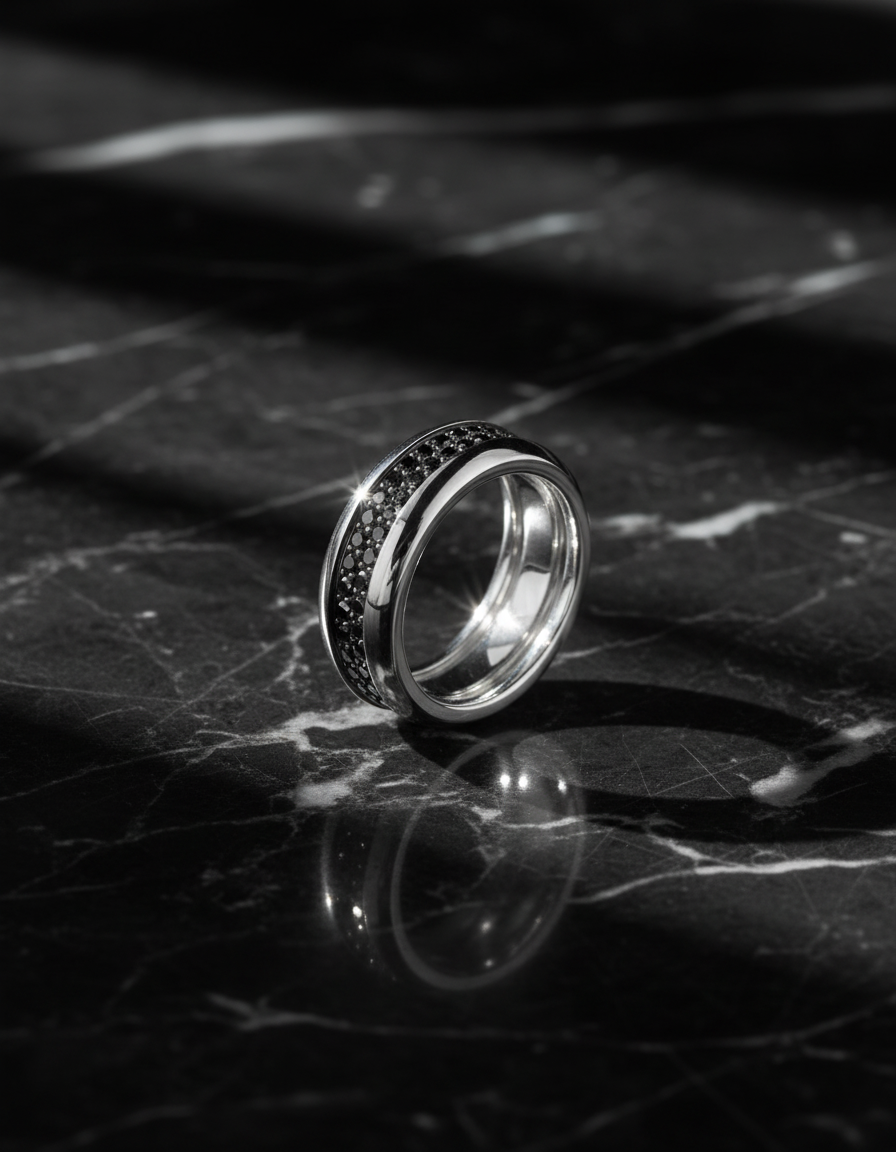
Most engagement ring guides assume a white solitaire, so a couple considering a black centre stone tends to find either product listings or one-line reassurances. The questions that matter are practical ones. Will it survive daily wear on her hand or his? What is the stone, exactly? How will it sit next to the family's expectations at the ring ceremony? And what is a fair price in India? This guide answers those, for whichever of you will wear it.
Is a black diamond a good choice for an engagement ring?
Yes, for a couple who wants something less conventional and is willing to choose the setting with care. A black diamond is crystallised carbon like any diamond, and it scores 10 on the Mohs scale of hardness, so it resists scratches as well as a white diamond does.
Hardness is not the whole story. GIA's guide to black diamonds explains that natural black diamonds owe their colour to countless tiny mineral inclusions such as graphite, and that these internal features can make the stone more brittle and prone to chipping if it is struck sharply. A black diamond will not scratch, but it can chip on a hard edge in a way a clean white diamond is less likely to.
That makes a black diamond a good engagement stone for someone who:
- Wants a ring that looks quieter and more graphic than a white solitaire.
- Will wear it in a setting that guards its edges.
- Prefers a stone that does not show dirt, since a black diamond has no sparkle to cloud over.
It suits less well someone who wants maximum sparkle, or who works with their hands and will not take the ring off.
Natural, treated or lab-grown: what is the black stone in your ring?
Ask this before anything else, because it sets the price and should be written on the invoice. Black diamonds come in three kinds, and they look much alike once set.
| Type | How it gets its colour | How common | What to ask for |
|---|---|---|---|
| Natural-colour black diamond | Dense natural inclusions such as graphite | Rarer | A laboratory report confirming natural colour, for any sizeable stone |
| Treated black diamond | A natural diamond heated or irradiated until it looks black | Far more common than natural colour | The word "treated" on the invoice |
| Lab-grown black diamond | Grown in a laboratory; colour from defects in the crystal | Increasingly available | "Laboratory-grown diamond" written in full on the invoice |
GIA notes that treated black diamonds are far more common and widely available than naturally black ones, and that a laboratory report can confirm whether a black diamond's colour is natural or treated. None of the three is fake: all are diamond. They differ in rarity and price, so the seller should tell you which one you are paying for. Our article on whether black diamonds are real explains the formation and treatments in detail.
Black diamond or a black look-alike?
A real black diamond is a different purchase from a black stone that only looks the part. Black moissanite, black spinel, onyx and black cubic zirconia are all sold in engagement-style rings, often at a small fraction of the price. There is nothing wrong with buying one knowingly. The problem is only when a listing says "black diamond" and the stone is something else. GIA's buying guide gives these hardness figures, and the softer stones show wear sooner on a ring worn every day.
| Stone | What it is | Mohs hardness |
|---|---|---|
| Black diamond | Diamond, natural or lab-grown | 10 |
| Black moissanite | Silicon carbide, a different material | 9.25 |
| Black spinel | A natural gemstone | 8 |
| Black cubic zirconia | A synthetic simulant | About 8 to 8.5 |
| Black onyx | A form of chalcedony, usually dyed | About 6.5 to 7 |
Black diamond engagement ring styles, for her and for him
The most wearable designs protect the black stone's edges and let it contrast with metal or white diamonds. Because a black diamond is opaque, it is judged by its outline, polish and evenness of colour rather than by sparkle, which changes which designs work.
| Style | How it looks | Wear notes |
|---|---|---|
| Bezel-set black solitaire | One black stone held by a metal rim | The most protective setting for a brittle stone |
| Black centre with a white diamond halo | A ring of small white diamonds frames the black stone | High contrast; the white stones add to the price |
| Black and white three-stone | A black centre between two white diamonds, or the reverse | Traditional shape, unconventional colour |
| White centre with black accents | A white solitaire with black stones on the shoulders | A gentle way to add black if family taste is conservative |
| Two-row black diamond band | Small black stones set low across the top | A common men's style; sits flat and survives daily wear |
| Matched pair | Her ring and his band share a black stone or detail | Suits a ring ceremony where both partners exchange rings |
For a woman's engagement ring with a raised centre stone, ask for a bezel, a half bezel, or at least six sturdy prongs rather than four fine ones. For a man's ring, often listed by Indian jewellers as a gents' or male diamond ring, a flush or channel-set row usually works better than any raised stone. Our guide to the black diamond ring for men covers men's band styles in more depth.
Which metal suits a black diamond?
Black stones show strongest against white metals, and that is where most black diamond engagement rings sit.
- White gold or platinum: a crisp, cool contrast. White gold is usually rhodium-plated and needs replating every so often.
- Rose or yellow gold: a warmer, softer look; black against yellow reads as traditional and bold at once.
- 925 sterling silver: the same white contrast at a lower metal cost, best with low settings since silver is softer than gold.
- Black rhodium: a plated finish that darkens white metal around the stones for an all-black look; it wears off with time and needs renewing.
What does a black diamond engagement ring mean?
There is no fixed traditional meaning, and that is part of the appeal. In modern jewellery, a black diamond is usually read as strength, individuality and a commitment that does not need to announce itself. These are recent associations, not ancient doctrine, so the meaning is yours to give.
Two worries come up often in Indian families. The first is that black is unlucky. Nothing supports that for black diamonds in general; the stories come from legends attached to a handful of famous stones. The second is astrological: in the navaratna tradition, diamond is the gem associated with Shukra (Venus), and some families consult an astrologer before anyone wears a diamond. That is a matter of belief and family practice, and views differ between regions and practitioners. Our article on black diamond meaning goes further into both.
How much does a black diamond engagement ring cost in India?
At the time of writing, black diamond engagement rings from Indian online jewellers started at around ₹11,000 to ₹15,000 for a small treated stone and ran to several lakh for larger stones in 18K gold. Treated black diamonds are priced per carat far below natural-colour ones, because GIA notes they are far more common, so a natural-colour black diamond with a laboratory report can cost several times as much per carat as a treated stone of the same size. That gap is the single biggest reason two similar-looking rings are priced so differently.
| Illustration (listings seen in October 2026) | Stone | Listed price |
|---|---|---|
| Small black solitaire, lightest metal option | Treated black diamond | From about ₹11,000 to ₹15,000 |
| About 0.5 ct princess solitaire, 18K yellow gold | Treated black diamond | About ₹65,000 |
| Larger natural-colour centre stones in 18K gold | Natural colour, with report | Several lakh and upwards |
Treat these as illustrations, not a price list. A finished ring's price is built from the same parts as any diamond ring:
- The black stone or stones, priced per carat by type: treated, natural-colour or lab-grown.
- Any white accent diamonds, priced separately, natural or lab-grown.
- The metal, its weight in grams times the day's rate for that metal and purity.
- Making and setting charges, higher for a halo or pavé than for a plain bezel.
- GST at 3% on the full value of the finished ring.
Two practical rules follow. If a ring offers a large "natural black diamond" for the price of a treated one, ask for the laboratory report. And because black diamonds are judged by evenness of colour and polish rather than sparkle, a smaller, well-polished stone often looks better than a larger, grainy one.
How to buy a black diamond engagement ring well
Get the stone, the metal and the setting in writing, and size the setting to the stone's weakness. These steps cover most of what goes wrong.
- Name the stone type. Natural-colour, treated or laboratory-grown diamond, written on the invoice.
- Ask for a report on the centre stone. For a black centre of any size, a laboratory report is the only way to confirm the stone and whether its colour is natural.
- Check the setting. A bezel or six-prong head for a raised stone; a flush, channel or low pavé setting for bands.
- Check the polish. Black diamonds are hard to polish evenly. Under a loupe the facets should be glassy, not pitted or grainy.
- Confirm the metal and hallmark. Gold should carry a BIS hallmark with a six-digit HUID, which you can check in the BIS Care app.
- Ask about care. GIA advises against ultrasonic and steam cleaning for black diamonds; mild soap, warm water and a soft brush are enough.
How AXIOM approaches this
Natural black diamonds are AXIOM's signature stone, set across many of the men's rings in our men's rings and bands, including two-row eternity bands. A woman's black diamond engagement ring, or a matched pair, is made as a bespoke commission: the design starts from the occasion, the stones are chosen with you as natural or lab-grown, and the ring is set in sterling silver or in 14K or 18K gold. Allow about three weeks to make it, plus delivery, and confirm timing before you plan the proposal.
The practical takeaway
A black diamond makes a good engagement ring when the setting protects it and the paperwork describes it. Decide first whether you want a natural-colour, treated or lab-grown stone, because that choice moves the price more than anything else, then choose a bezel or low setting and get every detail on the invoice. If you are still weighing colour against budget, our comparison of black diamond vs white diamond prices shows where the money goes.
