
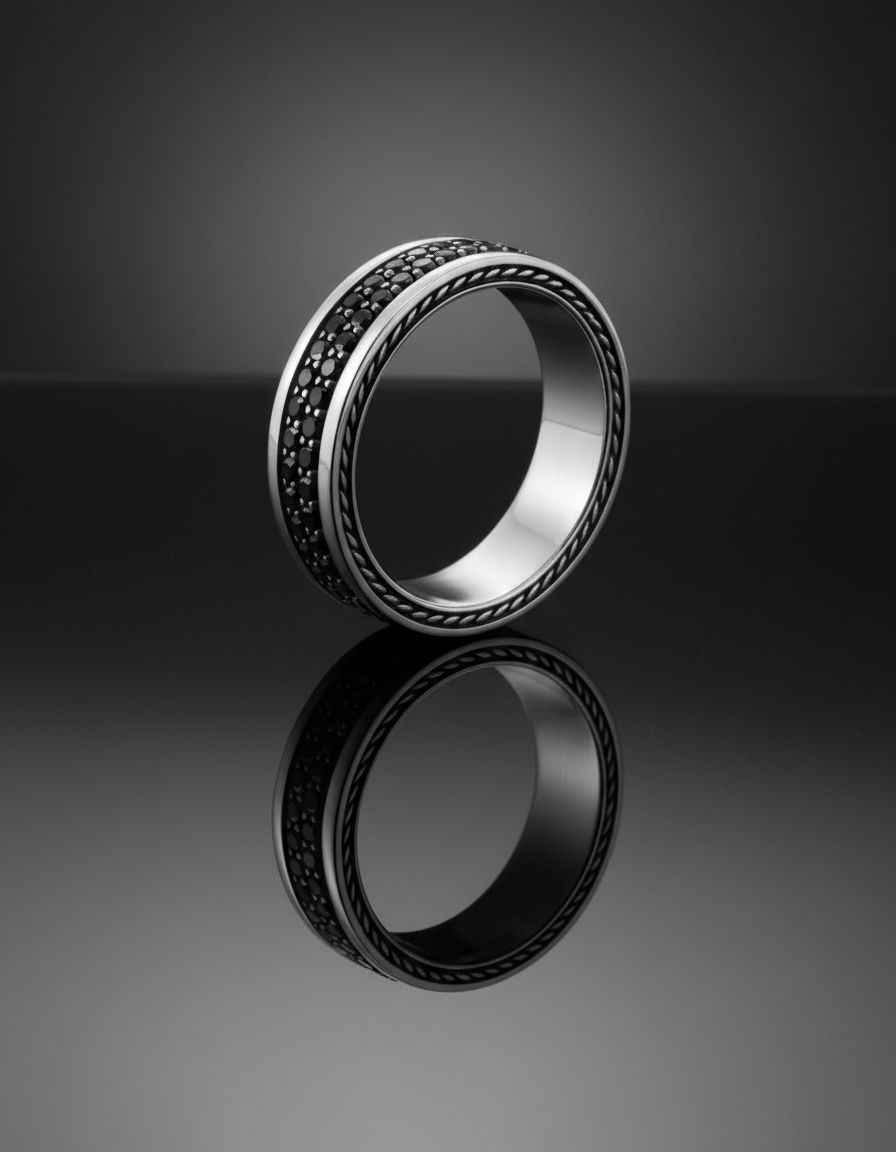
If you have priced a black diamond band against a white diamond one, the gap can look suspicious. It is not a sign that one of them is fake. It comes from what each stone is made of, how each is graded, and how many people want them. This guide explains each price driver, then shows how to compare two quotes fairly. It deliberately gives no live price per carat, because diamond prices move and a number printed today will mislead you next season.
Why are black diamonds cheaper than white diamonds?
Black diamonds cost less mainly because of the raw material, the way they are graded and the size of the market. Each factor is explained below.
1. The starting material is low-grade
A white diamond's price climbs steeply as it approaches colourless and flawless. A black diamond starts from the other end. GIA explains that most natural black diamonds owe their colour to countless tiny mineral inclusions, such as graphite, pyrite or haematite, spread through the stone. GIA also notes that many black diamonds used in jewellery today are treated: heavily included stones are heated, without high pressure, to turn their internal fractures to graphite, or are irradiated to a green so dark it reads as black. Material that would sit at the bottom of the white-diamond price range becomes a uniform black stone.
2. There are no colour or clarity grades to climb
White diamonds are priced across GIA's 23-grade D-to-Z colour scale and 11 clarity grades, and every step between grades changes the price. Black diamonds fall outside that system. GIA describes their colour with a single term, Fancy Black, and does not give them a clarity grade because they are opaque. Without a ladder of rarer and rarer grades, there is much less room for a rarity premium.
3. Demand is smaller
White diamonds carry the weight of the engagement ring tradition in India and worldwide. GIA notes that consumers had little interest in black diamonds until the late twentieth century, when designers began using them in jewellery, often contrasting them with tiny colourless diamonds in pavé settings. A smaller buyer market means lower prices.
4. Cutting and setting are harder, which adds cost back
Here the logic runs the other way. GIA notes that because black diamonds contain so many inclusions and tiny cracks, cutting and polishing them takes special skill and care, they must be set carefully to avoid damage, and the same fractures can make them more brittle and prone to chipping than colourless diamonds. That adds labour and risk to each stone. It narrows the price gap a little but does not close it.
Black diamond vs white diamond price: a comparison table
The table shows how price is built for each kind of stone. It describes method, not today's rupee figures.
| Stone | What sets the price | Grading used | Relative price per carat |
|---|---|---|---|
| Natural white diamond | Cut, colour, clarity, carat; rarity rises steeply at top grades | D to Z colour, FL to I3 clarity | Highest; wide range by grade |
| Laboratory-grown white diamond | Same qualities, plus production cost and supply | Lab-specific; GIA uses Premium or Standard | Usually below natural at similar quality; check current quotes |
| Natural-colour black diamond | Carat, evenness of colour, lustre, polish, and a lab report confirming natural colour | Fancy Black, colour origin stated | Below high-grade white; large documented stones priced individually |
| Treated black diamond | Carat, evenness of colour, polish; starting material is low-grade | Fancy Black, treatment stated | Among the lowest per carat for diamond |
If a black stone is laboratory-grown, the same disclosure rules apply as for white: it must be described as laboratory-grown on the invoice.
Rare natural black diamonds vs everyday black diamonds
Not every black diamond is inexpensive. At the top end sit natural-colour black diamonds large enough to be sold as individual stones with a laboratory report stating that the colour is natural. Famous examples such as the 67.50 carat Black Orlov are priced as named, documented gems, which is a separate market altogether.
The black diamonds in most rings, bands, bracelets and studs are small stones bought in quantity and matched for evenness of colour and lustre. For these, the invoice should tell you the total carat weight and whether the colour is natural or treated. If the seller does not know, that is useful information too.
Black diamond vs black imitation: when cheap is too cheap
A low price is normal for black diamond, but an extremely low one can mean the stone is not diamond at all. GIA notes that both cubic zirconia and moissanite are made in black and used as substitutes for coloured diamonds. Opaque black stones are harder to judge by eye than white ones, because you cannot look into them.
| Black stone | What it is | Hardness (Mohs) | How it is usually sold |
|---|---|---|---|
| Black diamond | Diamond, natural colour or treated | 10 | By carat weight, described as diamond |
| Black moissanite | Silicon carbide | 9.25 | By size, described as moissanite |
| Black cubic zirconia | Zirconium oxide | 8 to 8.5 | By the piece, often in fashion jewellery |
The protection is the same as for white stones: the invoice should name the material, and for diamond it should say whether the colour is natural or treated. A seller of genuine black diamonds will state that in writing without hesitation.
What the price difference means for a buyer
Black gives you more visible diamond per rupee. The same budget that buys a thin row of high-grade white stones can buy a wider band of black ones, or larger individual stones. Because black diamonds are opaque, they show a solid, lustrous face rather than light returning through the stone, which suits a bold, graphic design.
The trade-offs are worth weighing too:
- Durability. Black diamonds are 10 on the Mohs scale for scratch resistance, but GIA notes they are more brittle than white. A protective setting, such as a channel or bezel, helps in a ring that takes knocks.
- Care. GIA advises keeping black diamonds away from steam and ultrasonic cleaners.
- Resale. What any diamond piece fetches later depends on who buys it and on what terms, and black diamonds have a smaller buyer pool than white. Buy a black diamond piece to wear. Our explainer on diamond resale value in India covers how resale actually works.
None of this is investment guidance. Diamonds of any colour are consumer goods first.
How to compare black and white diamond quotes fairly
Compare like with like, in writing. Use these steps:
- Ask for the stone and metal split. A piece's price combines stone value, metal, making charges and tax. A cheaper piece may simply have less metal or a simpler setting.
- Get total carat weight for each piece. Divide the stone value by the total carat weight to see an approximate price per carat.
- Confirm origin and treatment. For white stones: natural or laboratory-grown. For black stones: natural colour or treated. Both should appear on the invoice.
- Match the quality band. Compare white stones at the same colour and clarity range, and black stones at similar evenness and lustre.
- Check the metal and hallmark. Silver, gold and platinum change the price far more than many buyers expect.
Our guide to diamond price per carat in India explains how white diamond grades translate into price, and our piece on whether black diamonds are real covers the gemmology in more depth.
How AXIOM approaches this
Black diamonds suit the way AXIOM designs for men: they give a band or bracelet a strong, graphic presence without white flash, and they let a design carry more stone for the price. That is why natural black diamonds appear in so many pieces across our men's rings and bands and the Strength Collection, set in 925 sterling silver, with select pieces such as the Valor Band also offered in 18K white gold.
The practical takeaway
A lower price on a black diamond reflects the stone, not a trick. Ask whether the black is natural or treated, get the total carat weight and the metal on the invoice, and choose black because you like how it looks on your hand, not because you expect it to hold its price.
