
Per-carat pricing is how the diamond trade talks, and it is the only way to compare two stones fairly. Knowing it helps you read a quote, spot when a jeweller has nudged you toward a threshold weight, and understand why a lab-grown and a natural stone that look identical can be priced so far apart. This is an informational guide, not investment advice.
How is diamond price per carat calculated?
Total price equals the per-carat rate multiplied by the exact carat weight. The rate is set by the stone's weight band and its grade for colour, clarity and cut, and whether it is natural or lab-grown.
A carat is a unit of weight, not size: one carat is 0.2 grams and is divided into 100 points, so a 50-point diamond weighs 0.50 carat (GIA on carat weight). Weight is measured to two decimal places, and each hundredth changes the price.
A worked example with illustrative numbers:
- The stone weighs 1.05 carats.
- The dealer's rate for its size band and grade is ₹3,00,000 per carat.
- Stone price: 1.05 × ₹3,00,000 = ₹3,15,000.
- Set in a ring, the metal, making and setting are added, then GST at 3% on the finished piece.
The rate is the number to compare. Two quotes for "about one carat" can differ by lakhs simply because one stone weighs 0.92 and the other 1.08.
Why does price per carat rise with size?
Because large rough diamonds are rarer than small ones, so the rate per carat climbs as weight increases, and it steps up at round-number thresholds. A 1.00 carat diamond is not priced at twice the rate of a 0.50; it is priced at a higher rate per carat, and then multiplied by twice the weight.
Diamonds are priced in weight bands, and the rate jumps when a stone crosses into a new band, most visibly at 1.00 carat. Buyers pay for the round number. A stone of 0.90 to 0.99 carat can look almost identical once set, but falls in a lower band.
The table below uses invented rates to show the shape of the curve for one grade. It is not a price list.
| Weight | Illustrative rate per carat | Illustrative stone price |
|---|---|---|
| 0.30 ct | ₹1,00,000 | ₹30,000 |
| 0.50 ct | ₹1,50,000 | ₹75,000 |
| 0.90 ct | ₹2,40,000 | ₹2,16,000 |
| 1.00 ct | ₹3,00,000 | ₹3,00,000 |
| 1.50 ct | ₹4,00,000 | ₹6,00,000 |
Notice that 0.90 to 1.00 carat adds 0.10 carat of weight but, in this example, ₹84,000 of price. That jump is why weights just under a threshold are often the best value.
How do the 4Cs change the price per carat?
Colour, clarity and cut each move the rate up or down within a weight band; carat decides which band you are in. For a full explanation of each grade, see the 4Cs of diamonds explained.
| Factor | How it moves the per-carat rate | Where to save |
|---|---|---|
| Carat weight | Sets the band; rate rises with size and at thresholds | Buy just under 0.50, 1.00 or 1.50 |
| Colour (D to Z) | Each grade whiter costs more | G to I look white once set in white metal |
| Clarity (FL to I) | Fewer inclusions cost more | VS and SI1 are often clean to the eye |
| Cut | Better cut costs more but shows more brilliance | Do not compromise here |
| Certificate | Graded stones are priced more confidently | Worth it for any stone above about 0.30 ct |
VVS clarity is a common upsell. VVS inclusions are extremely hard to see even at 10x magnification, so on a man's ring they make no difference you can see. The money is usually better spent on cut.
Natural vs lab-grown vs black diamond: how per-carat pricing differs
The three are priced on different logic: natural by rarity and grade, lab-grown by production cost and a falling market, and black diamonds mostly by size, because most are treated and plentiful.
| Type | What sets the per-carat rate | Direction of prices recently |
|---|---|---|
| Natural colourless | Weight band, colour, clarity, cut, certificate | Wholesale prices below their 2021 peak |
| Lab-grown colourless | Grade and size, but supply keeps growing | Falling steadily since 2022 |
| Black (natural colour or treated) | Mainly size and uniformity; grade matters less | Low per carat compared with colourless |
A news report published on 23 September 2026 put lab-grown diamonds at typically 70 to 85% cheaper than natural stones, with lab-grown wholesale prices down more than 75% since 2022 (IBTimes India). Industry analyst Edahn Golan reported one-carat lab-grown rounds down 15% year on year in the first quarter of 2026 (Edahn Golan Diamond Research).
Black diamonds are compared with white ones in more detail in black diamond vs white diamond price.
How much does a 1 carat diamond cost in India?
At the time of writing, a mainstream 1 carat natural round diamond was reported at about US$3,530 to US$3,860 at retail, and lab-grown stones were typically 70 to 85% cheaper than natural, according to the IBTimes report cited above. Those are indicative figures for a mid-grade stone, not a price list.
For natural stones, the spread across grades is too wide for one honest number: a 1 carat natural stone can cost far more or less than that range depending on colour, clarity and cut, and Indian retail prices also carry GST, the rupee exchange rate and the retailer's costs. For lab-grown, the fall in wholesale prices means any figure quoted more than a few months ago is likely to be out of date, so ask for a current per-carat rate rather than relying on a published one.
What turns a loose-stone price into a retail price:
- The metal, weighed and charged at the day's rate.
- Making and setting charges.
- The retailer's margin, design and certification costs.
- GST at 3% on the finished piece.
If you want to see how those parts add up for a man's ring at different budgets, our guide to men's diamond ring prices in India works through the tiers.
How are small diamonds (melee and pavé) priced?
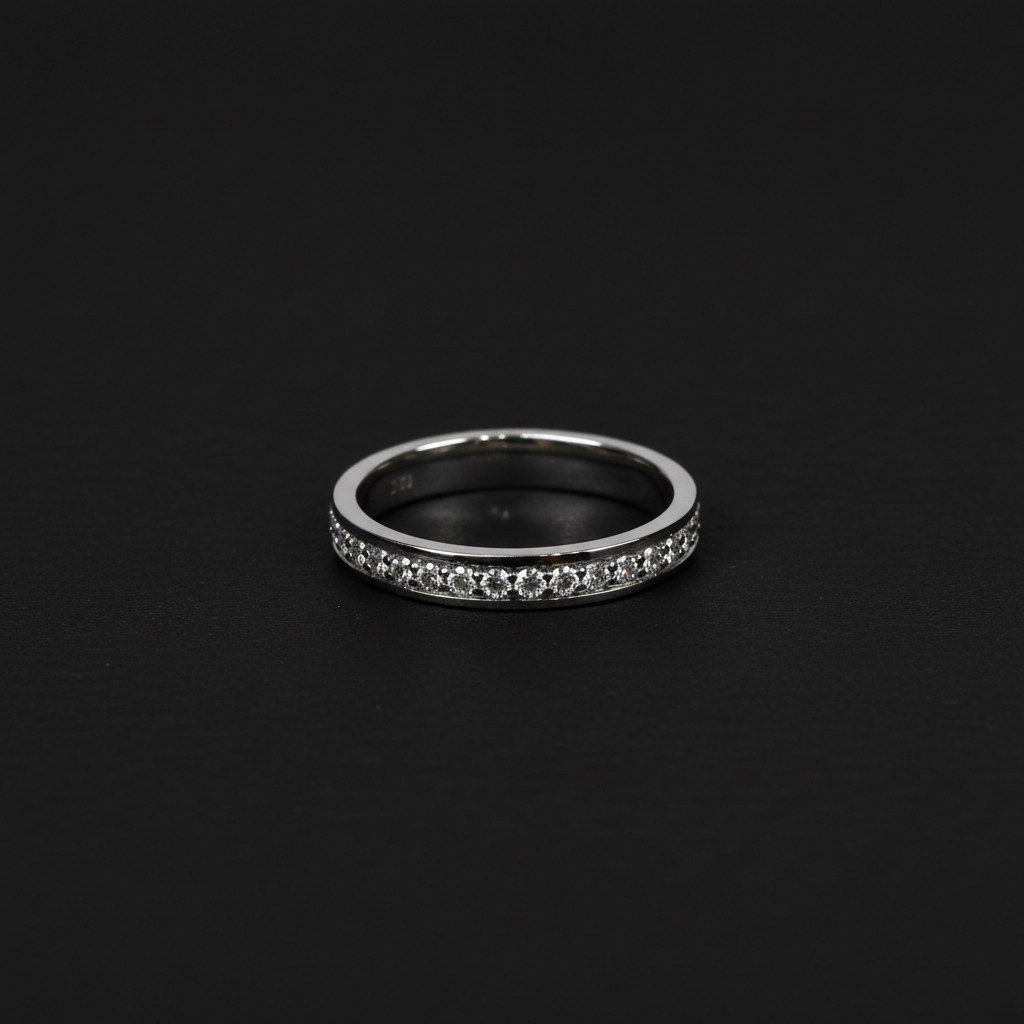
Small diamonds are bought in parcels and priced per carat by size range and quality range, not graded one by one. Most men's bands, eternity rings and pavé pieces use these stones, often from under 1 mm up to about 3 mm across.
A ring with 40 small stones might carry 0.40 carat total weight (often written as ct tw or TCW). That 0.40 carat costs far less than a single 0.40 carat stone of the same colour, because small stones sit in the lowest weight bands. The labour to set them, however, rises with the number of stones, so a pavé piece's price leans more on craftsmanship than on stone weight.
Why do diamond prices per carat change?
Supply, demand and currency. Diamonds are traded internationally in US dollars, so the rupee's exchange rate moves Indian prices even when dollar prices are flat. Natural rough prices follow mining output and global demand; De Beers reported its average rough price down 32% year on year in the first half of 2026, according to the IBTimes report above. Lab-grown prices follow production capacity, which has kept rising.
This is also why a stone's value at resale is not its purchase price, which we explain in diamond resale value in India.
How to compare two diamond quotes
- Ask for the exact carat weight to two decimals and the per-carat rate.
- Check the grading report number against the lab's online database.
- Compare stones of the same weight band; a 0.98 and a 1.01 are not like for like.
- Compare cut grade before colour and clarity.
- Ask for the metal weight, making charges and GST as separate lines on the final bill.
How AXIOM approaches this
Our men's pieces are set mostly with small natural black or lab-grown white diamonds in 925 sterling silver, so each one is priced as a finished piece of jewellery rather than per carat, with certification details on request. You can see how that works across our rings and bands, and you can ask us about sizing, shipping or certification for any piece.
The practical takeaway: ask for the per-carat rate and the exact weight, buy just under a threshold if size matters to you, and put your money into cut before anything else.
