
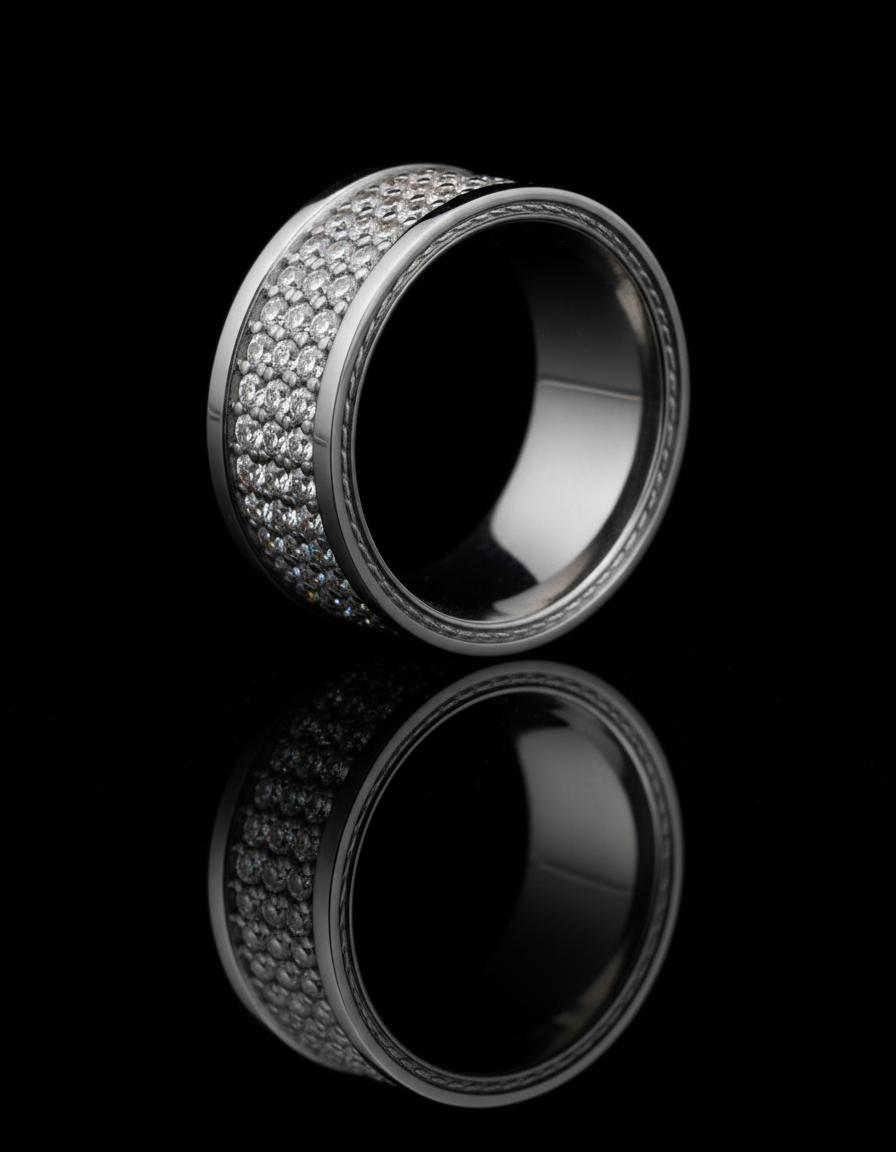
Most guides to the 4Cs are written for a single solitaire in an engagement ring. Men's diamond jewellery is often different: a band with a row of small stones, a bracelet with dozens of them, or a black diamond that sits outside the usual grading scales altogether. This guide explains each C the way the grading laboratories define it, then shows where it matters for the pieces men actually wear.
What are the 4Cs of a diamond?
The 4Cs are cut, colour, clarity and carat weight. GIA founder Robert M. Shipley coined the phrase in the 1940s, and GIA's D-to-Z colour scale followed in 1953, so that diamonds could be described the same way anywhere in the world. Before that, GIA notes, descriptions were inconsistent: a colourless stone might be called "water" and a clean one "without flaws".
| The C | What it measures | Scale | Where you can compromise | Where you should not |
|---|---|---|---|---|
| Cut | How well the stone returns light | Excellent to Poor (round brilliants) | Rarely: it drives appearance | Below Very Good on a centre stone |
| Colour | Absence of yellow or brown tint | D to Z | G to J in most settings | Visible warmth in a white metal setting |
| Clarity | Inclusions and blemishes | FL to I3 (11 grades) | VS and many SI stones look clean | I grades, which can affect durability |
| Carat | Weight | 1 carat = 200 mg = 100 points | Just under a magic size, such as 0.90 ct | Chasing weight at the cost of cut |
Cut: the C that controls sparkle
Cut matters most because it decides how bright and lively a diamond looks. GIA's guide to diamond cut assesses three face-up effects: brightness (white light reflected back), fire (light split into spectral colours) and scintillation (the sparkle and pattern of light and dark as the stone moves). It also looks at weight ratio, durability of the proportions, polish and symmetry.
GIA gives an overall cut grade from Excellent to Poor only for standard round brilliants, because they are the only cut with standardised facets. Princess, emerald, oval and other fancy shapes receive polish and symmetry grades but no overall cut grade, so you judge them by eye and by proportions.
For a man's ring, cut has a second job. A stone cut too shallow to look larger can leak light and look glassy, and one with a very thin girdle is more exposed to chipping in daily knocks. Excellent or Very Good is the sensible target.
Colour: the D-to-Z scale
Diamond colour grading measures how little colour a stone has, from D (colourless) to Z (light yellow or brown). GIA introduced the D-to-Z scale in 1953 and grades colour under controlled lighting by comparing each stone against master stones of known grade.
| Grades | GIA group | What it means in wear |
|---|---|---|
| D, E, F | Colourless | No visible tint; highest price per carat |
| G, H, I, J | Near colourless | Looks white face-up in most settings; the usual value zone |
| K, L, M | Faint colour | Slight warmth, more noticeable in white metal |
| N to R | Very light colour | Visible tint |
| S to Z | Light colour | Clearly tinted |
The metal changes how colour reads. Sterling silver, white gold and platinum sit close to the stone's own colour, so they make a tint easier to see. For a white-metal band, near colourless is the common choice. Diamonds with more colour than Z, or with a colour other than yellow, grey or brown, are graded separately as fancy colour diamonds.
Clarity: FL to I3
Clarity grades how free a diamond is from internal inclusions and surface blemishes, judged at 10x magnification. GIA's clarity scale has six categories and 11 grades, based on the number, size, relief, nature and location of the characteristics.
| Grade | Name | GIA definition, in short |
|---|---|---|
| FL | Flawless | No inclusions and no blemishes visible at 10x |
| IF | Internally Flawless | No inclusions, only blemishes |
| VVS1, VVS2 | Very, Very Slightly Included | Inclusions so slight a skilled grader has difficulty seeing them |
| VS1, VS2 | Very Slightly Included | Inclusions seen with effort, minor |
| SI1, SI2 | Slightly Included | Inclusions noticeable at 10x |
| I1, I2, I3 | Included | Inclusions obvious; may affect transparency, brilliance and durability |
GIA notes that most diamonds in jewellery shops fall between VS and SI, and that many clarity characteristics are not visible to the naked eye.
What is a VVS diamond?
A VVS diamond is one graded VVS1 or VVS2: its inclusions are so small that a trained grader has difficulty finding them even under 10x magnification. VVS1 is the cleaner of the two. The term has become shorthand for "top quality", but it describes clarity only. A VVS stone with a poor cut or strong tint will still look dull.
VVS vs VS vs SI: can you see the difference?
Usually not, once the stone is set and on a hand. The difference between VVS and VS is a matter of how hard an expert must look through a loupe. SI is where it starts to depend on the individual stone: an SI1 with a small white feather near the edge can look clean, while one with a dark crystal under the table may not. For SI stones, ask to see the stone itself or its plot on the grading report.
Carat weight: size by the gram
A carat is a unit of weight, not size. One metric carat weighs 200 milligrams, and each carat is divided into 100 points, so a 0.25 carat stone is a "25-pointer". India's Legal Metrology Act also fixes the carat at 200 milligrams for diamonds and precious stones.
Price rises faster than weight. GIA points out that 1.00, 1.50 and 2.00 carats are "magic sizes" and that a 0.99 carat and a 1.00 carat diamond look almost identical but can differ noticeably in price. Buying just under a magic size is one of the few genuine savings in diamond buying.
Men's bands and bracelets usually state total carat weight, written as ct tw or TCW, which is the combined weight of every stone. A band listed at 0.50 ct tw might carry twenty stones of about 2.5 points each. That is a very different object from a single half-carat stone, and it is priced differently.
Which of the 4Cs matters most?
Cut matters most for how a diamond looks, then colour and clarity to the point where the eye stops noticing, then carat within the budget that is left. A practical order for a man's centre stone:
- Cut: Excellent or Very Good for a round brilliant; good proportions for a fancy shape.
- Colour: G to J in white metal, adjusted by eye.
- Clarity: VS2 or an eye-clean SI1 rather than paying for VVS.
- Carat: whatever the budget allows after the first three, ideally just under a magic size.
For more on applying this to a ring, see our guide on how to choose a men's diamond ring, and for how the grades translate into rupees, our explainer on diamond price per carat in India.
How do the 4Cs work for small stones in men's bands?
Small stones are graded as a group, not one by one. The row of diamonds in an eternity band or the pavé across a bracelet is made of stones that may weigh one to five points each. Jewellers generally buy these in parcels sorted to a colour and clarity range, such as "G to H, VS", and they rarely come with individual grading reports because a report would cost more than the stone.
For these pieces, three things matter more than any single grade:
- Matching. Every stone should look the same colour and brightness side by side. One slightly yellow or dull stone in a row is more visible than a lower grade across the whole row.
- Cut consistency. Small stones that are well cut and calibrated to the same size sit level and catch light evenly.
- Setting. Seats cut cleanly, stones level, and each held securely, because a man's band takes knocks on its top surface.
What you can reasonably ask for in writing: the total carat weight, the colour and clarity range, whether the stones are natural or laboratory-grown, and the metal and its purity. Our guides to IGI vs GIA certification and how to read a diamond certificate explain what a report covers when a stone is large enough to have one.
Do the 4Cs apply to black diamonds?
Only partly. GIA explains that most natural black diamonds owe their colour to countless tiny mineral inclusions, such as graphite, pyrite or haematite, spread through the stone. Because they are typically opaque and heavily included, GIA does not give them a clarity grade, and they fall outside the D-to-Z scale.
GIA describes their colour with a single term, Fancy Black, since black does not vary in tone and saturation the way pink or yellow diamonds do. Its coloured diamond identification and origin report states whether the colour is natural or the result of treatment. Many black diamonds on the market are treated, by heating or irradiation, to produce the colour.
For black stones, judge instead by lustre (a bright, even, almost metallic surface), the quality of the polish and how well the stones are matched. GIA also notes that the many small fractures in black diamonds make them more brittle than colourless ones, so a protective setting matters.
Do lab-grown diamonds use the same 4Cs?
The qualities are the same because a lab-grown diamond is diamond: cut, colour, clarity and carat all describe it just as they describe a mined stone. What differs is how some laboratories report them. Since 1 October 2025, GIA's laboratory-grown service no longer assigns specific colour and clarity grades. It classifies a loose colourless to near-colourless stone of 0.15 carat or more as Premium (D colour, VVS clarity, Excellent polish and symmetry, and Excellent cut for rounds) or Standard (E to J colour, VS clarity, Very Good polish and symmetry, with Good symmetry also accepted on fancy shapes), and inscribes "Laboratory-Grown" with its assessment number on the girdle. Other laboratories use their own formats, so always read the report you are given.
How AXIOM approaches this
Most AXIOM rings and bands use rows of small natural black or lab-grown white diamonds rather than one large stone, so matching, cut consistency and secure setting carry more weight than a single grade. You can see how that looks across our men's rings and bands, and certification details are available on request: contact us about the piece you have in mind.
The practical takeaway
Spend on cut first. Choose colour and clarity by eye rather than by letter, because G to J and VS to SI1 look white and clean on most hands. For bands and bracelets, ask for the total carat weight, the colour and clarity range and the diamond origin in writing, and judge the rest by how evenly the stones match.
