
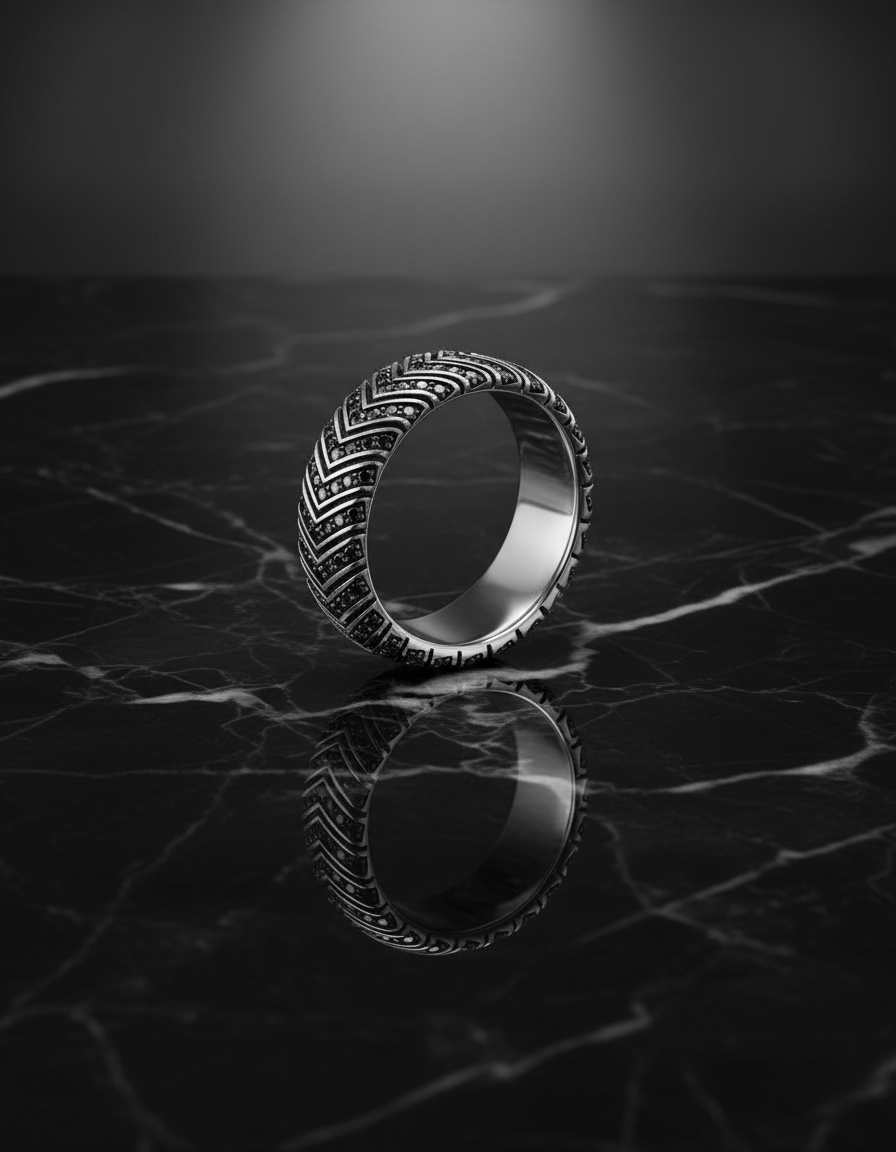
Buying a diamond ring for a man is a different job from buying a solitaire engagement ring. Most men's diamond rings are bands, signets or sculpted designs with rows of small stones, worn every day on a hand that grips steering wheels, dumbbells and door handles. That changes which decisions matter, and in which order. This guide walks through them the way a bench jeweller would, with the trade-offs stated plainly.
In what order should you decide?
Decide the style first and the grading last. Style sets the stone layout, the stone layout decides how much the 4Cs matter, and the metal and setting decide how long the ring survives daily wear.
| Step | Decision | Why it comes here |
|---|---|---|
| 1 | Style: band, eternity, solitaire, signet or statement | Fixes how many stones, how large and how exposed |
| 2 | Stone colour: black, white or both | Drives the look and how visible wear and dirt are |
| 3 | Origin: natural or lab-grown | Moves price more than almost any grade choice |
| 4 | Metal: 925 silver, 18K white gold or other | Sets weight, durability, upkeep and budget |
| 5 | The 4Cs, where they matter | Only critical for larger single stones |
Most regret comes from doing this in reverse: starting with a certificate grade and ending up with a ring that does not suit the hand or the life it lives on.
Which style of men's diamond ring suits you?
Pick the style by how the ring will be worn. A band suits daily wear and weddings, a signet or statement ring suits a man who wants one visible piece, and a solitaire suits proposals and occasions where the stone is the point.
| Style | Stone layout | Everyday wear | Resizing |
|---|---|---|---|
| Plain band with inset stones | A few stones sunk into the metal | Excellent | Usually possible |
| Half eternity band | One or two rows across the top half | Very good | Usually possible |
| Full eternity band | Stones all the way round | Good, but side stones take knocks | Very limited |
| Solitaire | One larger centre stone | Fair, depends on setting | Usually possible |
| Signet or statement | Stones set into a sculpted top | Good | Depends on design |
Width matters as much as style. Men's bands commonly run from about 4 mm to 8 mm wide. A 5 to 6 mm band reads as substantial on most Indian men's hands without feeling heavy, while anything above 7 mm starts to feel like a statement piece.
Black diamonds or white diamonds?
Choose white diamonds if you want brightness and a classic look, and black diamonds if you want contrast and a darker, quieter ring. Many men's designs now mix the two, using black stones for the main line and white stones as accents.
White diamonds show fire and sparkle, and they suit weddings, formal wear and gold or white metals. They also show dirt quickly: a film of soap or skin oil dulls them within days, so they need regular cleaning.
Black diamonds are opaque, so they do not sparkle the way white stones do. Their appeal is a polished, graphic surface that hides everyday grime and pairs well with dark clothing and oxidised or white metals. According to GIA's guide to black diamonds, natural black diamonds get their colour from countless tiny dark mineral inclusions such as graphite, and treated black diamonds are far more common in jewellery than naturally black ones. That does not make them fake, but you are entitled to know which you are buying. Our piece on the black diamond ring for men covers meaning and pricing in more depth.
Natural or lab-grown: which diamond is best for a ring?
Both are real diamonds, so the best choice depends on what you value. Natural diamonds formed in the earth over very long periods; lab-grown diamonds are made in weeks by chemical vapour deposition (CVD) or high pressure, high temperature (HPHT) growth. The US Federal Trade Commission's jewellery advertising guidance notes that lab-grown diamonds have essentially the same optical, physical and chemical properties as mined ones, and they cannot be told apart by eye.
| Factor | Natural diamond | Lab-grown diamond |
|---|---|---|
| Material | Crystalline carbon | Crystalline carbon |
| Hardness and daily durability | Identical | Identical |
| Price for the same size and grade | Higher | Usually much lower |
| Rarity | Finite supply | Can be produced to order |
| Resale | Some resale market exists | Limited resale market today |
| Disclosure to ask for | "Natural" in writing | "Lab-grown" in writing |
The honest summary: if the ring is about the look and you want more stone for your budget, lab-grown makes sense. If rarity and origin matter to you, natural does. What you should never accept is ambiguity. A seller should state in writing, for each stone type in the ring, whether it is natural or lab-grown.
Which metal: silver, white gold or something else?
Choose the metal by budget, weight and upkeep. 925 sterling silver is 92.5 per cent silver and is the most affordable way to wear a substantial diamond design. 18K white gold is 75 per cent gold, harder and heavier, and costs several times more for the same ring. Platinum is heavier and denser again, and priced accordingly.
| Metal | Purity | Feel on the hand | Upkeep |
|---|---|---|---|
| 925 sterling silver | 92.5% silver | Light to medium | Tarnishes; polish occasionally |
| 18K white gold | 75% gold | Medium to heavy | Rhodium finish may need renewing |
| 18K yellow gold | 75% gold | Medium to heavy | Minimal; polish scratches |
| Platinum | Typically 95% platinum | Heaviest | Develops a soft grey patina |
Silver is softer than gold, which is why setting choice matters more in a silver ring. Diamonds are routinely set in silver, and they hold well in channel, bezel and flush settings with enough metal around them. Our explainer on whether diamonds can be set in silver goes into how durable silver settings are. Whatever the metal, ask for the purity stamp and, for gold in India, the BIS hallmark with its HUID number.
Do the 4Cs matter for a men's diamond ring?
The 4Cs (cut, colour, clarity, carat) matter a great deal for a single stone of meaningful size and far less for the small stones set in most men's bands. GIA's 4Cs guide is the standard reference for what each grade means.
Small stones of the kind used in pavé, channel and eternity settings are known in the trade as melee: diamonds under about 0.20 carat (one fifth of a carat) each. At that size, a one-grade difference in clarity or colour is invisible on the hand. What you can see is whether the stones match each other in colour, whether they sit level, and whether any look chipped or loose. For these rings, ask about consistency and setting quality rather than chasing a grade on paper.
For a solitaire or a large centre stone, the order of priority most jewellers give is:
- Cut, because it decides how much light the stone returns.
- Colour, where near-colourless grades look white once set.
- Clarity, where eye-clean is the practical target rather than flawless.
- Carat, which is where the budget goes once the first three are right.
Our 4Cs explainer for men's jewellery walks through each grade with the trade-offs.
Which setting protects diamonds best on a man's hand?
Flush, bezel and channel settings protect diamonds best for daily wear because metal surrounds the stone. Prong settings show the most diamond but leave it exposed to knocks and snagging.
| Setting | How it holds the stone | Protection | Look |
|---|---|---|---|
| Flush (gypsy) | Stone sunk level with the metal surface | Highest | Minimal, understated |
| Bezel | A metal rim around the whole girdle | Very high | Clean, modern |
| Channel | Stones in a row between two metal walls | High | Linear, suits bands |
| Pavé | Many small stones held by tiny beads of metal | Lower; beads wear over time | Surface covered in sparkle |
| Prong (claw) | Metal claws grip the stone from above | Lower; claws snag and bend | Maximum light and height |
If you work with your hands, lift weights or simply forget you are wearing a ring, lean towards flush, bezel or channel. A pavé or prong ring is not a mistake, but plan to have the stones checked for looseness once a year.
How should a men's diamond ring fit?
A men's diamond ring should slide over the knuckle with slight resistance and not spin freely at the base of the finger. Measure in the evening when fingers are at their largest, at room temperature, and not straight after exercise.
Wider bands feel tighter than narrow ones of the same size, so many jewellers suggest going up by about half a size for bands of 6 mm and wider. Comfort-fit bands, rounded on the inside, slip on more easily than flat-inside bands.
Sizing is also where eternity bands need care. Because diamonds run all the way round, a full eternity band usually cannot be resized in the normal way. Changing its size means adding or removing stones, which is costly and not always possible. If your fingers swell in the heat or your weight changes, a half eternity band or a band with a plain section is the safer choice. Measure an existing ring's inside diameter in millimetres and match it to the seller's size chart before ordering.
What drives the price of a men's diamond ring?
Price is driven by four things: the metal and its weight, the total carat weight of the diamonds, whether they are natural or lab-grown, and the labour of making and setting. A silver band with small stones and an 18K gold ring with a solitaire are different purchases, not different grades of the same one.
| Price driver | What moves it up | What to ask |
|---|---|---|
| Metal | Gold over silver, heavier rings | Gross weight in grams and purity |
| Diamonds | Natural over lab-grown, larger stones | Total carat weight and stone count |
| Setting labour | Many small stones, eternity layouts | Number of stones set by hand |
| Finishing | Hand polishing, engraving | What is included in the quoted price |
A fair seller will break a quote into metal, stones and making without being pushed. For budget ranges and what each tier buys, see our guide to men's diamond ring price in India.
Which men's diamond ring for which occasion?
Match the ring to the moment it marks. An engagement or wedding ring will be worn daily for decades, so durability and comfort come first; a milestone or gift ring can be bolder because it may be worn less often.
| Occasion | Sensible style | Stones | Priority |
|---|---|---|---|
| Engagement (ring for the groom) | Half eternity or inset band | White, black or mixed | Fit and setting security |
| Wedding band | Channel or flush-set band | Usually white or black in a row | Comfort for daily wear |
| Milestone or promotion | Signet or statement ring | Mixed black and white | Design and meaning |
| Everyday right-hand ring | Narrow band, 4 to 5 mm | Black hides daily grime | Low maintenance |
| Gift when you do not know his taste | Plain band with a few inset stones | Black or white | Resizable design |
If the ring is a gift, choose a design that can be resized. Eternity bands and some sculpted designs cannot be adjusted easily, and a guessed size is often wrong by half a size or more.
What to check before you pay
Before paying for any men's diamond ring, check these in writing:
- Metal and purity, with the stamp or hallmark visible on the ring.
- Whether each stone type is natural or lab-grown, and whether black stones are natural or treated.
- Total carat weight and number of stones.
- Certification: what grading document, if any, comes with the ring, and whether it is included or on request.
- Size and resizing: whether the design can be resized later.
- Returns and after-sales: the return window, and what servicing is offered.
How AXIOM approaches this
The AXIOM ring catalogue is mostly 925 sterling silver set with natural black diamonds or lab-grown white diamonds, and each product page states which. The Apex Ring and the Valor Band, both set with natural black diamonds, are the two rings also offered in 18K white gold, while The Legacy Ring is 925 sterling silver with lab-grown white diamonds, from ₹59,300 at the time of writing. Certification details are available on request, and every piece is made to order at the Bharat Diamond Bourse in Mumbai. You can compare every design in our men's rings and bands.
The takeaway
Choose the style for the life the ring will live, decide black or white and natural or lab-grown on your own terms, pick a metal you can afford to wear every day, and insist on a protective setting and a correct size. Get every claim about the stones in writing. The 4Cs matter once there is a stone big enough for them to matter.
