
Lab-grown stones have moved from niche to mainstream in engagement rings. In the United States, The Knot Worldwide's 2026 Real Weddings Study found that lab-grown centre stones accounted for 61% of engagement ring purchases among the 10,474 US couples it surveyed, all married in 2025. We found no comparable Indian figure, but Indian jewellers now sell them at every price point. The questions Indian couples ask are less about whether the stone is real and more about price, paperwork and how the families will see it.
Are lab-grown diamonds acceptable for engagement rings?
Yes. A lab-grown diamond is a real diamond and is as suitable for an engagement ring as a mined one. It is crystallised carbon, 10 on the Mohs scale, and according to GIA it has nearly the same chemical, optical and physical properties as a natural diamond. It will take daily wear in exactly the same way.
What differs is origin. A lab-grown diamond is grown in weeks, by either the HPHT method (high pressure and high temperature) or CVD (carbon deposited from a gas onto a diamond seed), where a natural diamond formed deep in the earth. Only specialised screening equipment or a gem laboratory can tell the two apart.
Acceptability in a family is a different question. Some parents and grandparents treat a natural diamond as part of the tradition; others care only that the stone is a real diamond. Talking about it before the ring ceremony, with the facts in hand, avoids a surprise on the day.
How much does a lab-grown diamond engagement ring cost in India?
At the time of writing, 1 carat lab-grown solitaire engagement rings in 14K or 18K gold were listed by Indian online jewellers from about ₹57,000 to ₹90,000, with plainer designs at the lower end and halo or pavé designs at the higher. One seller's guide, updated in October 2026, put a loose 1 carat lab-grown stone of E colour and VVS clarity at around ₹50,000.
| What we observed (October 2026) | Typical listed price |
|---|---|
| Loose 1 ct lab-grown, E colour, VVS clarity | About ₹50,000 |
| 1 ct lab-grown round solitaire, 14K gold | About ₹57,000 |
| 1 ct lab-grown round solitaire, 18K gold | About ₹69,000 |
| 1 ct lab-grown halo or pavé designs, 18K gold | About ₹69,000 to ₹88,000 |
| Loose 1 ct natural diamond, by grade (seller guide) | About ₹2,00,000 to over ₹12,00,000 |
These are sample listings, not a price list, and they move. Trade publication DiamondWorld reported in September 2026 that lab-grown stones are typically priced 70 to 85% below comparable natural stones, and lab-grown prices have fallen year after year. A quote from three months ago may already be high.
The full ring price is built the same way as any diamond ring: the stone, the metal's weight times the day's rate, making and setting charges, and 3% GST on the total. Our guide to how much an engagement ring should cost in India breaks down that stack and what to give up when the budget is fixed.
Lab-grown vs natural diamond for an engagement ring
The two look and wear the same; they differ in price, rarity and resale. For an engagement ring, that makes the choice a question of priorities rather than quality.
| Factor | Lab-grown diamond | Natural diamond |
|---|---|---|
| Material | Diamond | Diamond |
| Hardness and daily wear | Same | Same |
| Look | Identical to the eye | Identical to the eye |
| Price for the same size and grade | A fraction of natural | Several times higher |
| Price direction in recent years | Falling steeply | Falling modestly |
| Resale | Very little | Some, though well below purchase price |
| What it says on a bill in India | "Laboratory-grown diamond" | "Diamond" or "natural diamond" |
For the wider comparison, including how each is graded and how each holds value, read natural vs lab-grown diamonds.
What should the invoice and certificate say?
The invoice should name the stone as a laboratory-grown diamond in full, with its carat weight and quality, and the metal and its purity. This is the gap most seller pages skip, and it is the part that protects you.
India's terminology standard for diamonds, IS 19469:2025, adopts the terms "laboratory-grown diamond" and "laboratory-created diamond". According to the Gem and Jewellery Export Promotion Council's summary, abbreviations such as "lab grown", "lab created", "lab diamond" or "LGD" should not be used, and nor should words such as "fake" or "artificial". Sellers use the short forms in adverts because that is how people search, but the bill should be precise.
For the centre stone, ask for a report from an independent laboratory. Three things to know when you read one:
- GIA is moving lab-grown stones off the colour and clarity grades it developed for natural diamonds. In a June 2025 announcement, GIA said it would replace them with descriptive terms that place a stone in a "premium" or "standard" category, and that existing GIA lab-grown reports remain valid.
- IGI still issues colour and clarity grades for lab-grown stones, which is why most Indian listings quote grades such as E VVS. Our comparison of IGI vs GIA certification explains the difference.
- Look for treatment disclosure. Some lab-grown stones are treated after growth to improve colour. GIA states that its report notes any evidence of post-growth treatment; ask the seller to tell you either way.
The report number should also be laser-inscribed on the stone's girdle, so a jeweller can match stone to paper.
How to choose a lab-grown stone when size is affordable
Spend on cut first, then choose size, because lab-grown pricing makes size easy and cut is what makes the stone bright. Colour and clarity matter less than they do with natural stones, since most lab-grown diamonds on the market fall within a narrow, high range.
- Cut. For a round stone, ask for an excellent or ideal cut grade. A large, poorly cut stone looks glassy.
- Size for the hand. A cheaper carat tempts people to go big. Try sizes on her hand, or on a hand of similar size, before deciding; on a slim finger, a 1 to 1.5 carat stone already looks substantial.
- Shape. Round shows the most brilliance. Oval, pear and marquise look larger per carat and lengthen the finger.
- Setting height. A low setting suits daily wear. A tall setting shows the stone off but catches on fabric.
- Metal. White gold or platinum makes a white stone look whiter; yellow gold warms it. White gold is usually rhodium-plated and needs replating every so often.
Lab-grown diamond, moissanite or American diamond?
These are three different stones. A lab-grown diamond is diamond. Moissanite is silicon carbide, a different material that sparkles with more coloured fire. An American diamond is cubic zirconia, a much softer simulant that clouds and scratches with daily wear. All three are sold in engagement rings, sometimes side by side, so check the invoice. Our comparison of lab-grown diamond vs moissanite goes into the trade-offs.
Does Tanishq sell lab-grown diamonds?
Not under the Tanishq name, at the time of writing. Tanishq's parent, Titan, launched a separate lab-grown brand called beYon, whose first store opened in Mumbai on 29 December 2025. Trade coverage at the launch described beYon as run separately from Tanishq, Mia and Zoya, with its own store, and Titan had until then positioned itself as a natural-diamond business. Tanishq's own range continued to be marketed as natural diamond jewellery, so ask in store if that changes.
Is a lab-grown engagement ring worth it?
It is worth it if you want the most diamond for your budget and see the ring as something to wear for life rather than an asset. The honest trade-offs:
- Resale is very low. Lab-grown stones have little second-hand market, and falling prices make that worse. Do not buy one expecting to recover the money.
- Replacement is cheap. If a stone is lost, replacing it later will very likely cost less than it did.
- Budget goes further. For the price of a modest natural stone, you can choose a larger lab-grown stone, a better metal or a more detailed setting.
- Family views vary. Some families care about natural origin; many do not. Decide together before the ring ceremony.
How AXIOM approaches this
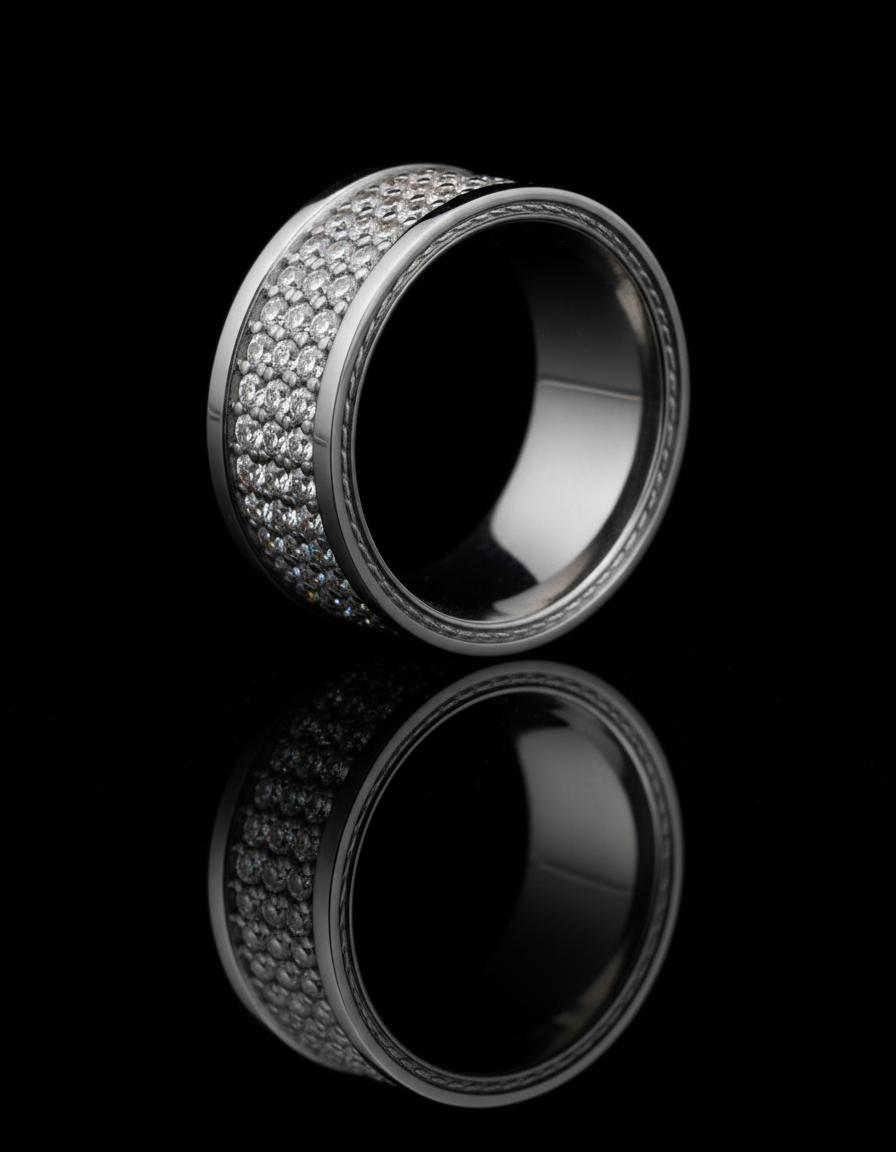
Lab-grown white diamonds are one of the two stones AXIOM sets most, used across rings such as the Trinity Band, a 925 sterling silver band set with lab-grown white diamonds. An engagement ring for either partner is made as a bespoke commission: the design starts from the occasion, and the stones are chosen with you as natural or lab-grown, in sterling silver or in 14K or 18K gold. Allow about three weeks to make it, plus delivery.
The practical takeaway
A lab-grown diamond is a sound engagement stone if you know what you are giving up: resale, and perhaps a conversation with family. Get a current quote, insist on "laboratory-grown diamond" on the invoice, ask for an independent report and any treatment disclosure for the centre stone, and put the savings into cut quality and a secure setting.
