
Most people comparing these three stones are really asking one question: how much of a diamond's look and life can I get for less money? The answer depends on material science more than marketing, so this guide sticks to measured properties, all taken from GIA's published data, and then turns them into practical advice for a ring or band a man will wear every day.
Lab-grown diamond vs moissanite vs cubic zirconia at a glance
Only one of the three is diamond. The table below uses the figures GIA published in Gems & Gemology when it compared diamond with its imitations, in its study of synthetic moissanite as a diamond substitute.
| Property | Lab-grown diamond | Moissanite | Cubic zirconia (American diamond) |
|---|---|---|---|
| Material | Carbon | Silicon carbide | Zirconium oxide |
| Mohs hardness | 10 | 9.25 | 8 to 8.5 |
| Toughness | Good to excellent | Excellent | Good |
| Refractive index (brilliance) | 2.417 | 2.648 and 2.691 | 2.150 to 2.180 |
| Dispersion (fire) | 0.044 | 0.104 | 0.058 to 0.066 |
| Optic character | Singly refractive | Doubly refractive | Singly refractive |
| Specific gravity | 3.52 | 3.22 | 5.56 to 6.00 |
| Graded on the 4Cs by major labs | Yes | No | No |
A lab-grown diamond shares these figures with a natural diamond, because it is the same material. If you are still unsure on that point, our explainer on whether lab-grown diamonds are real covers how they are made.
What is each stone made of?
Lab-grown diamond is pure carbon crystallised in diamond's cubic structure, grown from a seed by the CVD or HPHT method. It is diamond in every physical sense and differs from a mined stone only in origin.
Moissanite is silicon carbide. GIA describes it as a diamond imitation that became popular as a colourless jewellery stone in the late 1990s. Gem moissanite is manufactured, which is why GIA calls it synthetic moissanite. It is a genuine, durable gem material in its own right, but it is not diamond and is never graded as one.
Cubic zirconia (CZ) is zirconium oxide melted and crystallised in a chamber. GIA notes it was introduced in the late 1970s and became the most popular diamond imitation ever made. In India it is widely sold under the name "American diamond" or "AD", a trade nickname rather than a description of what it is.
Which one sparkles more?
Moissanite shows the most fire, diamond the most balanced look, and CZ the least brilliance. Two numbers explain it. Refractive index controls brilliance, the white light returned to your eye. Dispersion controls fire, the flashes of colour.
- Moissanite has a higher refractive index than diamond and a dispersion of 0.104, more than twice diamond's 0.044. GIA says it has slightly more brilliance and more than twice the fire. In stones of one carat and above, that intense colour play can give it away, an effect the trade calls the "disco ball" look.
- Diamond balances strong brilliance with moderate fire. This is the look most people picture when they think of a diamond.
- Cubic zirconia has slightly more fire than diamond but noticeably less brilliance, according to GIA, so it reads a little glassier side by side.
Moissanite is also doubly refractive: light splits in two as it passes through. GIA notes this can make the back facets look doubled and the inside of the stone slightly blurred. In GIA's study, the stones were cut with the optic axis perpendicular to the table, which hides the doubling when you look straight down.
Which lasts longer in a man's ring?
Diamond lasts longest, moissanite comes close, and CZ wears noticeably faster. A man's ring takes knocks from desks, steering wheels, weights and door handles every day, and over years the gap between 8.5 and 10 on the hardness scale shows up on facet edges.
- Lab-grown diamond (Mohs 10). Nothing in daily life scratches it. It can still chip if struck hard on a thin edge, and GIA rates its toughness good to excellent.
- Moissanite (Mohs 9.25). Very scratch resistant, and GIA rates its toughness excellent. A good choice for a hard-wearing band.
- Cubic zirconia (Mohs 8 to 8.5). Hard enough for occasional wear, but facet edges abrade with years of daily use. GIA also notes that CZ will yellow in colour over time and describes it as somewhat brittle.
How to tell moissanite from a lab-grown diamond
You can often spot moissanite with a loupe, but a basic diamond tester will not help. Follow these steps in order:
- Read the paperwork. A lab-grown diamond of any size worth grading will usually have a report from a gemmological laboratory stating laboratory-grown origin. Moissanite is typically sold with a maker's or seller's card rather than a diamond grading report.
- Check the girdle. Look for a laser inscription with a report number and match it to the report.
- Look for doubling with a 10x loupe. View the stone at an angle through the crown facets or the side, not straight down the table. Doubled back facet edges mean moissanite. Diamond shows single, crisp junctions.
- Watch the fire. Strong, rainbow-heavy flashes under a single light suggest moissanite, especially in larger stones. This is a hint, not proof.
- Weigh a loose stone. Moissanite is lighter. GIA calculated that a 6.50 mm round brilliant diamond weighs about 1.00 carat, while a moissanite of the same diameter and cut weighs about 0.91 carat.
- Do not trust a thermal tester alone. GIA found that thermal probes reacted to moissanite as if it were diamond. Testers with a second electrical or ultraviolet check are built to separate them. If money is at stake, a laboratory settles it.
Our guide on how to check a real diamond at home covers which home tests are useful and which are myths.
Is a lab-grown diamond a type of moissanite?
No. The two are often grouped as "lab-made stones", but one is carbon and the other is silicon carbide. A lab-grown diamond passes a thermal diamond tester because it is diamond. Moissanite may pass one because its heat conduction happens to be close.
Moissanite vs American diamond: what is the difference?
Moissanite is harder, lighter and more durable than American diamond, and it costs more. American diamond, cubic zirconia, is the budget stone behind most fashion jewellery sold in India. It looks bright when new and costs very little, but at Mohs 8 to 8.5 it scratches and dulls with daily wear and can yellow over time. For a piece worn once in a while, it does the job. For a ring worn every day for years, moissanite holds up far better.
How are the three priced?
Each is priced by a different logic, so a simple rupee comparison can mislead:
| Stone | What drives the price | What to compare between sellers |
|---|---|---|
| Lab-grown diamond | Carat weight and the 4Cs, backed by a grading report | Price per carat at the same colour, clarity and cut |
| Moissanite | Size in millimetres and the maker's colour and quality grade | Price at the same diameter and grade |
| Cubic zirconia | Mostly the setting and metal; the stone itself is inexpensive | The metal, plating and finish |
Lab-grown diamond prices have moved a great deal as production has grown, so compare quotes taken the same week rather than relying on older articles. Moissanite generally costs less than a lab-grown diamond of the same size, and CZ costs least of all. Because moissanite is lighter than diamond, it is often sold by diameter, such as "6.5 mm", or as a "diamond equivalent" size rather than true carat weight.
Which should you choose?
Match the stone to how long and how hard you will wear it:
| If you want | Choose | Why |
|---|---|---|
| A diamond, with paperwork, for daily wear over decades | Lab-grown diamond | Mohs 10, graded on the 4Cs, identical to diamond in look |
| The largest bright stone for the budget, still durable | Moissanite | Mohs 9.25, excellent toughness, lower cost per millimetre |
| An occasional fashion piece or a trial of a style | Cubic zirconia | Lowest cost; accept wear and possible yellowing |
| A diamond with natural origin and rarity | Natural diamond | See our guide to natural vs lab-grown diamonds |
Whatever you buy, the seller should name the material plainly on the invoice. Our note on fine jewellery vs fashion jewellery explains what else separates the two tiers.
How AXIOM approaches this
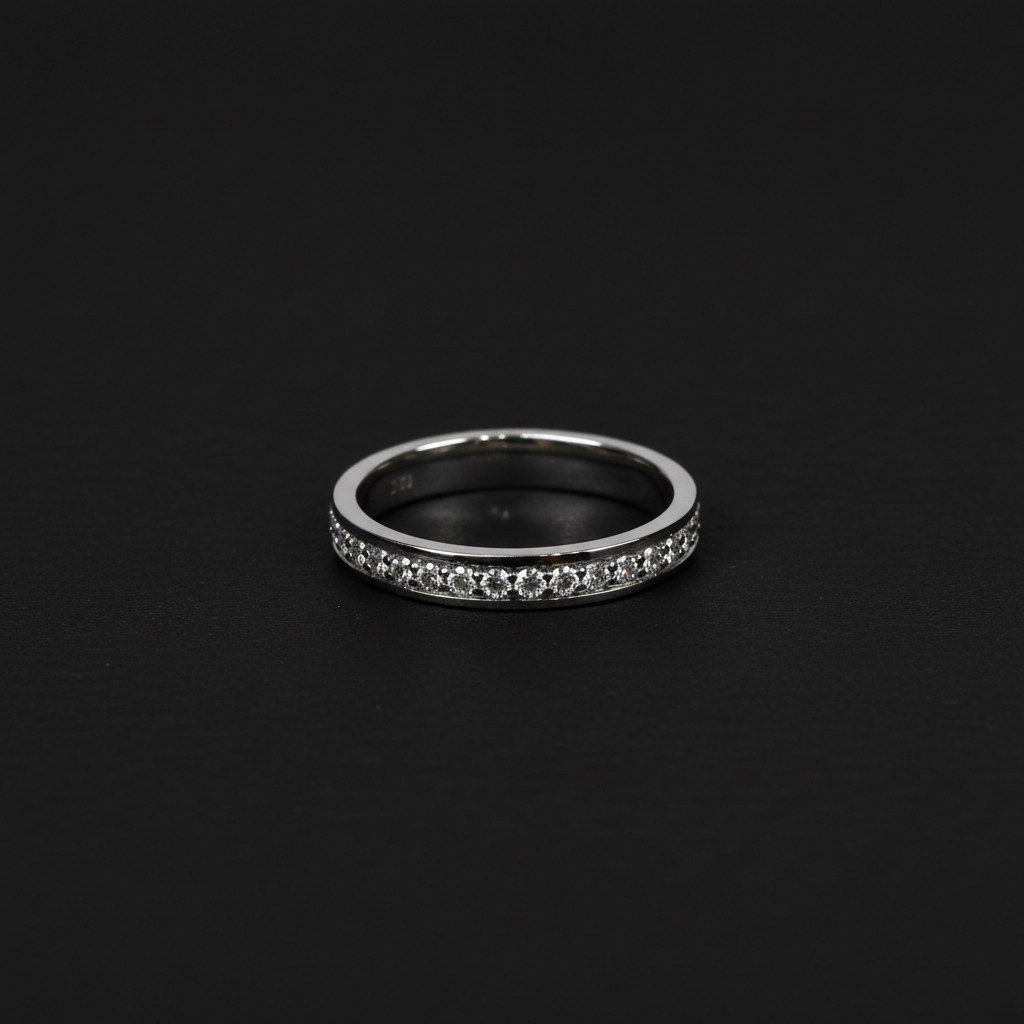
AXIOM sets diamonds, not simulants: natural black diamonds and lab-grown white diamonds, named on each product page, in 925 sterling silver with select 18K white gold options. The white-diamond bands in our men's rings and wedding bands are lab-grown diamond, not moissanite or cubic zirconia, and certification details are available on request. The pieces are made and hand-finished at the Bharat Diamond Bourse in Mumbai, as described on our about page.
The practical takeaway
Decide on material first and size second. If it must be diamond, buy lab-grown or natural with a report and an inscription you can check. If the look matters more than the name, moissanite is an honest, hard-wearing choice as long as it is sold as moissanite. Keep American diamond for pieces you expect to replace.
