
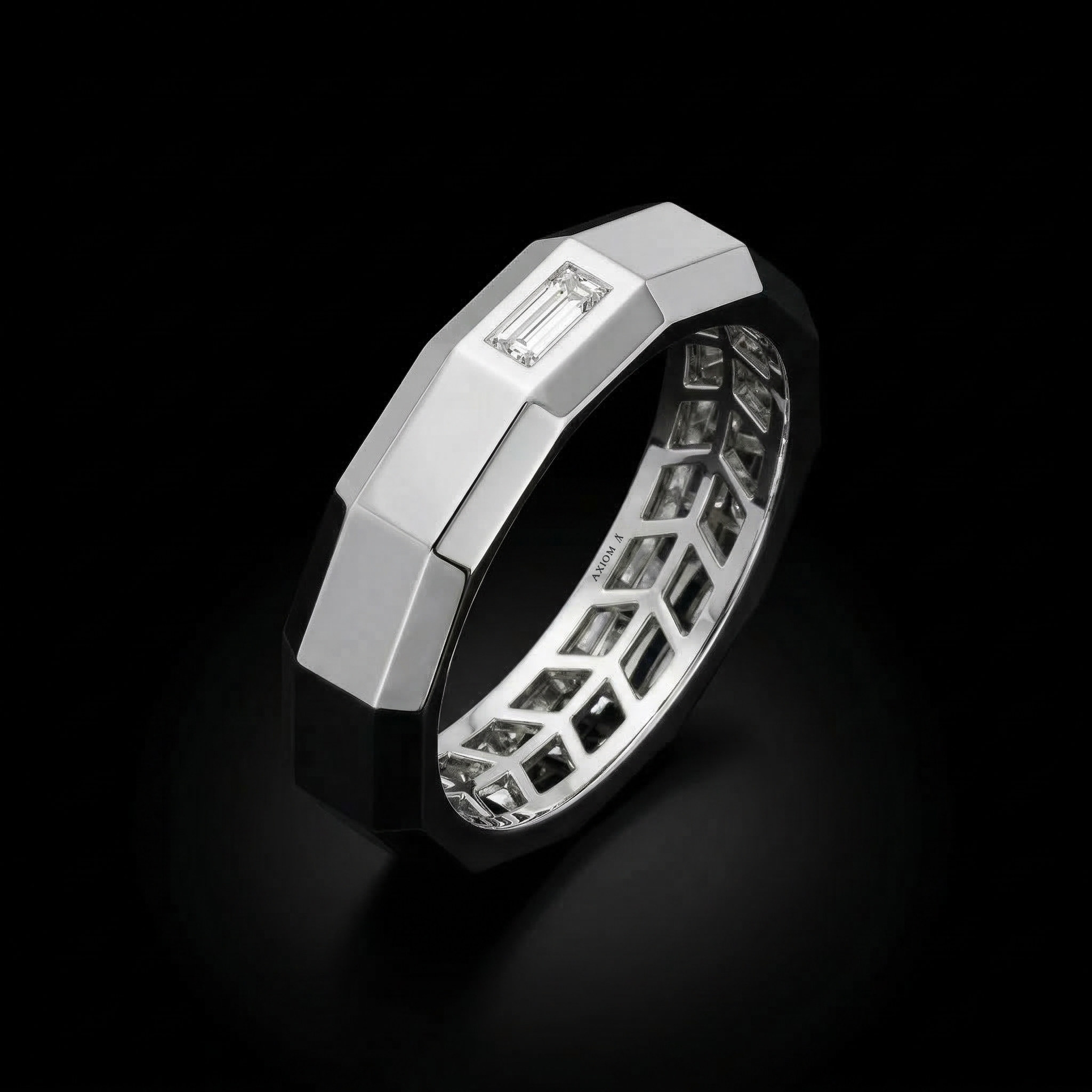
The question matters because the word "real" does two jobs in a jewellery shop. Sometimes it means "is this diamond at all", and sometimes it means "did this come out of the ground". A lab-grown stone passes the first test completely and fails the second by definition. Once you separate those two meanings, most of the confusion, and most of the sales talk on both sides, falls away.
Are lab-grown diamonds real diamonds?
Yes. A lab-grown diamond is made of carbon atoms locked in the same cubic crystal structure as a mined diamond. GIA, the laboratory that created the 4Cs grading system, states that laboratory-grown diamonds have essentially the same chemical composition, crystal structure, optical and physical properties as natural diamonds. It also notes that CVD-grown material is as hard and durable as natural diamond and shows the same brilliance and fire once cut.
Regulators agree on the substance and insist on the label. The US Federal Trade Commission's jewellery guides say terms like "laboratory-grown" or "laboratory-created" may only be used for a product with essentially the same optical, physical and chemical properties as a mined diamond, and that the qualifier must sit immediately before the word "diamond". In other words: it is a diamond, and you must say how it was made.
So the honest one-line answer is this. A lab-grown diamond is a real diamond, but it is not a natural diamond, and anyone selling it must tell you so.
Why do some people call lab-grown diamonds fake?
Mostly because of language, not science. For decades "real diamond" meant "not glass, not a simulant", and the only diamonds in the market were mined. When grown diamonds arrived in jewellery, the old phrase started being used to mean "natural", and a lab-grown stone got lumped in with imitations.
Indian standards now draw the line in words. The Bureau of Indian Standards' IS 15766:2007 already reserved the word "diamond" on its own for natural diamonds, as the Ministry of Consumer Affairs noted in a November 2024 release on diamond terminology. The newer IS 19469:2025, a modified adoption of the international standard ISO 18323, goes further. BIS states that the word "diamond" used without qualification may refer only to a natural diamond, that any laboratory-grown or treated diamond must be disclosed in accurate, unambiguous terms, and that misleading words such as "lab diamond" or "fake diamond", or "natural" for a grown stone, are prohibited. Trade press (Diamond World, 16 January 2026) reported the standard as in force from January 2026, with only two trade names permitted for grown stones, "laboratory-grown diamond" and "laboratory-created diamond", and descriptors such as "cultured", "pure" or "nature's" ruled out.
That is why a careful seller in India will never write just "diamond" on the tag of a grown stone. It is not because the stone is fake. It is because the plain word is legally reserved for natural diamonds.
How are lab-grown diamonds made?
There are two methods, and both start with a small diamond seed. GIA describes them as follows.
HPHT (high pressure, high temperature) copies the conditions deep in the earth. A carbon source dissolves in a molten metal flux of iron, nickel or cobalt inside a press heated to 1,300 to 1,600 °C at pressures above 870,000 pounds per square inch. Carbon migrates to the seed and crystallises over several days to weeks.
CVD (chemical vapour deposition) builds the diamond from gas instead. A seed plate sits in a vacuum chamber at about 900 to 1,200 °C, filled with hydrogen and a carbon-bearing gas such as methane. Microwaves turn the gas into a plasma and carbon atoms settle on the seed in layers. A run takes roughly three to four weeks.
| CVD | HPHT | |
|---|---|---|
| Full form | Chemical vapour deposition | High pressure, high temperature |
| How carbon arrives | From a gas, layer by layer | From molten metal, dissolved carbon |
| Temperature | About 900 to 1,200 °C | 1,300 to 1,600 °C |
| Pressure | Low, in a vacuum chamber | Above 870,000 psi |
| Growth time | About 3 to 4 weeks | Several days to weeks |
| Rough crystal shape | Flat, tabular | Cube and octahedron faces |
GIA's full explanation of both processes is on its page on HPHT and CVD diamond growth.
What does CVD diamond mean, and is a CVD diamond real?
A CVD diamond is simply a diamond grown by chemical vapour deposition. It is real diamond in exactly the sense described above. You will see "CVD" on invoices and customs papers because the Indian customs authority, through CBIC Circular 21/2024, requires traders to declare whether a diamond is natural or lab-grown and, if grown, the production method.
Are CVD diamonds better than HPHT?
Neither method is better in itself. Each can produce a fine stone or a poor one, and the grade on the report tells you more than the growth method does. One detail is worth knowing: GIA notes that most colourless CVD material on the market was probably brown when it came out of the chamber and was then decolourised by HPHT annealing. That is standard practice, not a defect, but it is one more reason to buy on a grading report rather than on a method name.
Lab-grown diamond vs American diamond vs moissanite
These three are often confused and they are entirely different materials. Only one of them is diamond. What Indian shops call "American diamond" or "AD" is usually cubic zirconia, a man-made zirconium oxide. Moissanite is silicon carbide. The figures below come from GIA's comparison table of diamond and its imitations, published in Gems & Gemology.
| Property | Lab-grown diamond | Moissanite | Cubic zirconia (American diamond) |
|---|---|---|---|
| Material | Carbon | Silicon carbide | Zirconium oxide |
| Mohs hardness | 10 | 9.25 | 8 to 8.5 |
| Refractive index | 2.417 | 2.648 and 2.691 (doubly refractive) | 2.150 to 2.180 |
| Dispersion (fire) | 0.044 | 0.104 | 0.058 to 0.066 |
| Specific gravity | 3.52 | 3.22 | 5.56 to 6.00 |
| Diamond tester reading | Diamond | Often "diamond" on a thermal tester | Not diamond |
Two practical consequences follow. First, specific gravity: a cubic zirconia the same size as a diamond weighs roughly 1.6 to 1.7 times as much, so two loose stones of equal size can be separated on a carat scale. Second, dispersion: moissanite has more than twice the fire of diamond, which is visible as strong rainbow flashes. The full side-by-side, including which to buy for which budget, is in our comparison of lab-grown diamond vs moissanite.
Can you tell a lab-grown diamond from a natural one?
Not by eye, and not with a handheld tester. A thermal diamond tester reads both as diamond because both conduct heat the same way. GIA explains that the difference lies in tiny atomic-level irregularities and impurities in the crystal, which record how it grew. Reading them takes spectroscopy and imaging instruments, which is what grading laboratories use.
For a buyer, that means two things:
- The paperwork is your proof of origin. A grading report and the matching laser inscription tell you what the stone is. Your eyes cannot.
- Simple home checks only rule out simulants. Fog tests and scratch tests can flag glass or cubic zirconia; they cannot tell natural from grown. Our guide on how to check a real diamond at home explains which tests are useful and which are myths.
What should the invoice and certificate say?
Disclosure should appear in three places, and all three should agree:
- The invoice. It should describe the stone as "laboratory-grown diamond" or "lab-grown diamond", with total carat weight, alongside the metal and its purity. A bare "diamond" on a grown stone is a red flag.
- The grading report, if the stone has one. Reports from major labs state laboratory-grown origin clearly. GIA's Laboratory-Grown Diamond Report, for example, includes the 4Cs and records that the girdle is laser inscribed with the report number and a statement that the stone is laboratory-grown.
- The stone itself. For a certified centre stone, a jeweller's loupe will show the inscription on the girdle. Check that it matches the report number.
Small stones set in pavé or eternity bands are rarely graded one by one. For those, ask the seller to state the origin, total carat weight and colour and clarity range in writing on the invoice. Our guide on how to read a diamond certificate walks through each field on a report.
Where does India fit in lab-grown diamond production?
India is one of the leading producers of lab-grown diamonds by the CVD method, according to the Ministry of Commerce and Industry. In the Union Budget 2023 to 2024 the government announced a five-year research grant, and in February 2023 it approved the India Centre for Lab-grown Diamond (InCent-LGD) at IIT Madras at an estimated cost of ₹242.96 crore. Its brief is to develop Indian-made CVD and HPHT machinery, seeds and growth recipes, which the industry had been importing.
The same release shows how fast the trade grew. Exports of cut and polished lab-grown diamonds, in US dollars:
| Financial year | Exports (US$ million) |
|---|---|
| 2017 to 2018 | 237.89 |
| 2019 to 2020 | 473.65 |
| 2021 to 2022 | 1,348.24 |
| 2022 to 2023 (April to December only) | 1,387.33 |
How AXIOM approaches this
AXIOM sets lab-grown white diamonds in a number of its pieces and names the stone on each product page rather than folding it into a general "diamond" label. The Union Band, for example, is listed as 925 sterling silver with lab-grown white diamonds, as is the Keystone Keychain. Certification details are available on request.
The practical takeaway
Ask two questions of any diamond, not one. "Is it diamond?" is answered by physics, and a lab-grown stone passes. "Is it natural or laboratory-grown?" is answered by the invoice, the report and the inscription, and all three should say the same thing. If you are weighing which of the two to buy, that is a separate decision about budget and resale, covered in our guide to natural vs lab-grown diamonds.
