
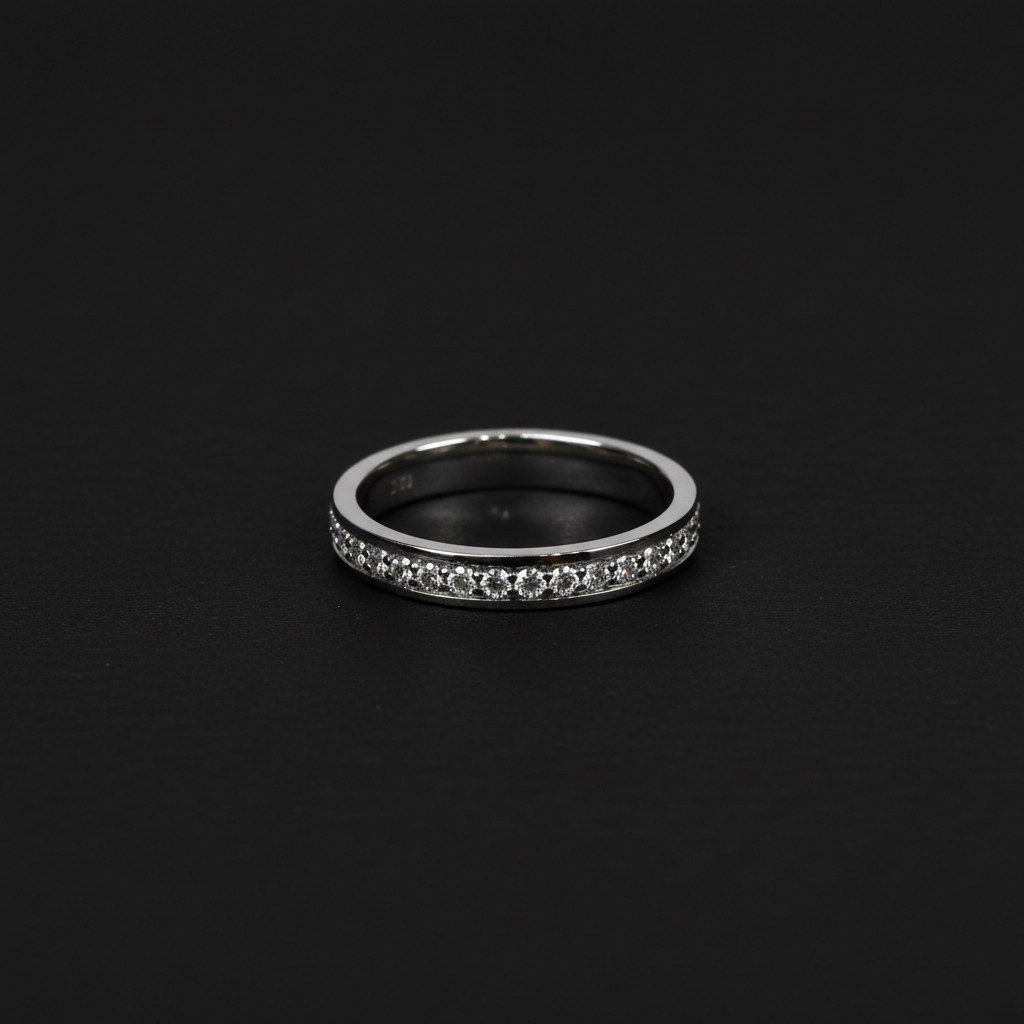
Most men meet this question at a counter, not in a textbook. A salesperson quotes two prices for what looks like the same ring, and the gap is several times over. This guide sets out what is identical, what is not, and what the difference means over the years you will actually own the piece. It is written from the bench: we set both kinds of stone, so we have no reason to sell you on either.
What is the difference between natural and lab-grown diamonds?
The only physical difference is where and how the crystal grew. Both are carbon atoms locked in the same cubic crystal lattice, both score 10 on the Mohs hardness scale, and both bend and split light the same way. GIA's own consumer guide says laboratory-grown diamonds are "real diamonds and not fakes", with essentially the same chemical composition, crystal structure and physical properties as natural ones.
Regulators agree on the material and insist on disclosure. In 2018 the US Federal Trade Commission removed the word "natural" from its definition of diamond in its Jewelry Guides, while still requiring man-made stones to be clearly described as such. India has gone the other way on vocabulary but not on substance, which we cover below.
| Point of comparison | Natural diamond | Laboratory-grown diamond |
|---|---|---|
| Origin | Formed deep in the earth, millions to billions of years ago | Grown in a factory in days or weeks by HPHT or CVD |
| Composition | Carbon, cubic crystal | Carbon, cubic crystal |
| Hardness and durability | 10 on Mohs | 10 on Mohs |
| Look to the eye | Identical at the same grade | Identical at the same grade |
| Price basis | Rarity, grade and trade demand | Production cost, which keeps falling |
| Resale | Some market, usually well below retail | Little to no established market |
| Grading report | Full 4Cs from major labs | Varies by lab (see below) |
| Detection | Needs laboratory equipment | Needs laboratory equipment |
How are lab-grown diamonds made?
Laboratory-grown diamonds are produced by one of two methods, and neither affects how the finished stone looks or wears. HPHT (high pressure, high temperature) squeezes carbon around a small diamond seed in a press that mimics conditions deep underground. CVD (chemical vapour deposition) breaks down carbon-rich gas in a vacuum chamber so that carbon settles, layer by layer, onto flat diamond seed plates.
Natural diamonds formed far below the surface and were carried up by volcanic eruptions, then mined from rock or river gravels. That geological history leaves tiny internal fingerprints: growth patterns, trace nitrogen, mineral inclusions. Lab-grown stones leave different fingerprints, such as metallic flux inclusions in some HPHT stones or strain patterns in CVD stones. Those are what a laboratory reads.
Some CVD stones are also treated after growth to improve colour. That is a normal part of production, and a proper report will say so.
How can you tell natural and lab-grown diamonds apart?
You cannot, and neither can most jewellers without equipment. The hand-held thermal "diamond tester" found in many shops confirms that a stone is diamond rather than cubic zirconia or glass, but it reads natural and lab-grown the same. GIA states that only a gemmological laboratory with advanced testing equipment can authoritatively determine origin.
What you can do as a buyer:
- Ask for the origin in writing on the invoice, not just verbally.
- For a centre stone, ask for a grading report from an independent laboratory and check the report number online on that lab's website.
- Look for a laser inscription on the girdle (the thin outer edge) under a loupe; it should match the report number, and lab-grown stones are often inscribed as such.
- For pavé and small side stones, which rarely carry individual reports, ask how the parcel was screened. Reputable manufacturers run melee (tiny stones) through screening machines.
What India's new diamond terminology standard means for buyers
The Bureau of Indian Standards has published IS 19469:2025, "Jewellery: Consumer confidence in the diamond industry", an Indian adaptation of the international standard ISO 18323. Under it, the unqualified word "diamond" means a natural diamond, and laboratory-grown stones must be described as "laboratory-grown diamond" or "laboratory-created diamond". According to the Gem and Jewellery Export Promotion Council's summary, published on 1 January 2026, abbreviations such as "lab grown", "lab diamond" or "LGD" are not acceptable, and nor are words like "fake" or "artificial".
In practice this protects you. An Indian Standard is a published national reference rather than a law in itself, but it sets what the words on a tag or invoice should mean. If a bill in India says only "diamond", the seller is describing a natural stone; a laboratory-grown stone should be named in full. We use the shorter "lab-grown" in this article because it is how people search, but on a bill you should expect the full term.
Natural vs lab-grown diamond price: why the gap keeps widening
Laboratory-grown diamonds cost a fraction of natural ones at the same grade, and the gap has grown every year. Trade publication DiamondWorld reported on 23 September 2026 that lab-grown stones are typically priced 70 to 85 percent below comparable natural stones, with wholesale lab-grown prices down more than 75 percent since 2022. Natural prices have fallen too, to their lowest in more than two decades, but by far less.
The reason is simple economics. A natural diamond's price rests on a finite supply dug from a limited number of mines. A lab-grown diamond's price rests on the cost of running a reactor, and every improvement in technology and every new factory pushes that cost down. That is good news if you are buying lab-grown today, and it is also why a lab-grown stone bought today will almost certainly cost less to replace next year.
| Buying situation | Natural diamond | Laboratory-grown diamond |
|---|---|---|
| Same budget, one centre stone | Smaller or lower grade | Larger or higher grade |
| Same stone size and grade | Several times the price | A fraction of the price |
| Price direction in recent years | Down, modestly | Down, steeply |
| Replacing a lost stone later | Similar or somewhat lower cost | Very likely lower cost |
We do not quote a rupee figure per carat here because prices move month to month and vary sharply by grade. Compare only like with like: same carat weight, colour, clarity and cut, ideally with reports from the same laboratory.
Are natural or lab-grown diamonds more valuable?
Natural diamonds hold more value, but "hold value" is a generous phrase for either. When you sell a diamond in India, you are selling at a trade buying price, not the retail price you paid. The margin, making charges, GST and design all stay behind. A natural stone with a good report may fetch a meaningful share of its stone value; a lab-grown stone often fetches very little, because there is so little demand for second-hand lab-grown when new ones keep getting cheaper.
Two honest caveats. First, small stones barely count: a band set with forty tiny diamonds will be valued mostly for its metal and a modest parcel price, whatever their origin. Second, no diamond is an investment in the way a financial asset is. If resale matters to you, read our guide to diamond resale value in India before buying, and ask any seller exactly what they would pay you back, in writing.
Are lab-grown diamonds more ethical than natural diamonds?
Both sides make fair points, and both sides overstate them. Here is the case each makes, stated plainly.
The case for laboratory-grown:
- No mining, so no open pits, river dredging or displaced land.
- A traceable production chain from one factory, rather than a stone that may have passed through many hands.
- Lower price, which some buyers see as better value for a stone that looks identical.
The case for natural:
- Mining revenue supports national economies and jobs in producing countries, and in several of them diamonds are a major source of public income.
- Lab-grown production is energy-intensive, and its footprint depends heavily on the power grid where the reactor runs, which buyers are rarely told.
- The Kimberley Process certifies rough diamonds as conflict-free, although critics argue its definition of conflict is narrow.
Neither origin is automatically clean. If ethics matter to you, the useful questions are specific: which country, which producer, what energy source, what paperwork. A vague "eco-friendly" or "ethical" label on its own tells you nothing.
Why stone origin matters more in men's pavé pieces
In men's jewellery, where designs often use rows of small stones rather than one large solitaire, origin changes the price far more than it changes the look. An eternity band or a pavé bracelet can carry dozens of stones. At that size, colour and clarity differences are invisible at arm's length, and the multiplier on origin cost is large.
That is why many designers now use laboratory-grown stones for white pavé: the piece looks the same and costs much less. It is also why the black diamond is a separate case. Natural black diamonds are relatively common and relatively affordable compared with fine white natural stones, so using natural blacks does not carry the same price penalty. They also come with their own questions about formation and treatment, which we cover in are black diamonds real.
Should you buy a lab-grown or natural diamond?
Choose by what you want the stone to do, not by which camp sounds more convincing.
| If this matters most to you | Better fit | Why |
|---|---|---|
| Maximum size and sparkle for the budget | Laboratory-grown | Same look at a fraction of the price |
| Some resale or trade-in possibility | Natural, with a report | An established secondary market exists |
| Heirloom meaning, rarity, geological age | Natural | Origin is the point, not only the look |
| Rows of small white stones in a band | Either; lab-grown saves most | Differences are invisible at this size |
| Everyday wear and durability | Either | Identical hardness |
| Minimal mining footprint | Laboratory-grown, with energy questions asked | No extraction, but power source varies |
If you want more on the science of how the two are grown and separated, are lab-grown diamonds real goes deeper.
How grading reports differ for natural and lab-grown stones
Natural diamonds from major laboratories receive full 4Cs grades: carat weight, colour, clarity and cut. Laboratory-grown stones used to receive the same scale, but that has changed at GIA. On 2 June 2025 GIA announced that it would stop using its natural-diamond colour and clarity nomenclature for lab-grown stones, and from 1 October 2025 its Laboratory-Grown Diamond Quality Assessment describes them as "Premium" or "Standard" instead; a stone that misses the minimum criteria gets no assessment at all. GIA's reasoning is that more than 95 percent of lab-grown stones entering the market fall into a very narrow range of colour and clarity, so a scale built for the full spread of natural diamonds no longer fits them.
Other laboratories still issue colour and clarity grades for lab-grown stones, so reports are no longer directly comparable across labs. When comparing two quotes, check which laboratory issued each report and read the origin line first. Our guide to IGI vs GIA certification explains how the two main labs differ.
How AXIOM approaches this
We use both, and our product pages name the stones. In the live catalogue, AXIOM's black diamonds are natural, most of the white diamonds are laboratory-grown, and one piece uses natural white diamonds. The Virtue Ring, for example, is 925 sterling silver set with lab-grown white diamonds, while the men's rings and bands and bracelets and kadas include several natural black diamond pieces. Certification details are available on request.
The practical takeaway
Decide first whether you are paying for a look or for an origin. If it is the look, laboratory-grown gives you more of it for less. If it is the origin, pay for a natural stone and insist on a report. Either way, get the origin written on your invoice in full, because India's national standard now says exactly which word means which.
