
The question usually comes from a man who likes the idea of a diamond but worries it will look borrowed from someone else's jewellery box. The worry is about the wrong thing. Diamonds are not feminine or masculine; settings and scale are. This guide shows where a diamond looks right on a man, the sizes and settings that work, and how to wear one every day without losing it or looking overdressed.
Should men wear diamonds?
Men should wear diamonds if they want to, and in India the precedent is long. Maharaja Ranjit Singh wore the Koh-i-Noor as an armlet at festivals such as Diwali and Dussehra, according to historians William Dalrymple and Anita Anand. The Patiala Necklace, made by Cartier in 1928 for Maharaja Bhupinder Singh of Patiala, held 2,930 diamonds.
The difference today is scale. Men's diamonds have moved from court jewellery to everyday pieces: one stud, a band with a line of small stones, a pendant on a chain. Our piece on why Indian men wear jewellery traces how that shift happened.
How can men wear diamonds?
A man can wear a diamond in almost any piece, but some formats are easier to start with than others. The table ranks them from easiest to boldest.
| Piece | Typical diamond format | Where it works | Good first piece? |
|---|---|---|---|
| Lapel pin or brooch | Small pavé or a single stone | Jackets, bandhgalas, sherwanis | Yes, no size or piercing needed |
| Single stud | One stone, about 3 to 5 mm across | Daily wear, office, weddings | Yes, if his ears are pierced |
| Band with flush or channel-set stones | A row of small stones level with the metal | Daily wear, wedding band | Yes, if you know his ring size |
| Pendant | A pavé motif or a single bezel-set stone | Under or over a shirt | Yes |
| Bracelet or kada | A row or panel of small stones | Weekends, weddings, festivals | Better as a second piece |
| Solitaire ring | One larger stone | Engagements, milestones | A deliberate statement |
| Diamond chain or tennis bracelet | Stones along the whole length | Evenings, celebrations | Boldest option |
The common thread is that the diamond sits low and is surrounded by metal. A diamond on tall claws, the classic engagement-ring look, is what makes many men feel the stone is not theirs.
Why do guys wear diamond earrings?
Men wear diamond earrings because a single stud is the smallest, most versatile way to wear a real stone. It works with a T-shirt and with a sherwani, it suits most face shapes, and it costs less than most diamond rings because the stone and the setting are small.
Size is what decides whether a stud looks right. For most men a stone of about 3.5 to 5 mm across reads as a clean point of light; much smaller reads as a glint, much larger as a statement. Our guide to diamond studs for men gives sizes by carat and by face.
Is it OK to wear diamond earrings every day?
Yes, if the stud is made for daily wear. Diamond is the hardest gemstone, 10 on the Mohs scale, but GIA notes that a hard blow can still cleave or fracture it. For daily wear:
- Choose a screw back. It is harder to lose than a push back, which relies on friction.
- Choose a bezel or low setting. Metal around the stone protects its edge.
- Take studs out for contact sport, swimming and sleep if they press or catch.
- Check the back and setting every few months.
Are black diamonds masculine?
Black diamonds have become a men's favourite because they look like a dark, polished accent rather than sparkle. A row of black diamonds on a silver band reads as a line from across a room, which suits office wear and men who are new to stones.
Know what you are buying. GIA explains that black diamonds get their colour from dense inclusions such as graphite, that many black diamonds used in jewellery today have been treated, and that heavy inclusions can make them more prone to chipping if struck sharply. Ask the seller whether a stone's colour is natural or treated; our guide to the black diamond ring for men covers the differences in price and care.
White diamonds: natural or lab-grown?
Both are real diamonds. The US Federal Trade Commission's jewellery guides allow a stone to be called a laboratory-grown diamond because it has essentially the same optical, physical and chemical properties as a mined diamond, as the FTC explains, provided the origin is disclosed.
| Natural white diamond | Lab-grown white diamond | |
|---|---|---|
| What it is | Carbon crystal formed in the earth | Carbon crystal grown in a laboratory |
| Hardness | 10 on the Mohs scale | 10 on the Mohs scale |
| Price | Higher | Much lower for the same size and grade |
| Resale value | Some, depending on size and grade | Little |
| Disclosure | Should be stated | Must be stated as lab-grown |
For a man's band or stud set with many small stones, lab-grown white diamonds give the same look at a fraction of the price. For a single larger stone bought partly as an heirloom, many buyers still prefer natural.
How to wear a diamond without a piercing
Most men who ask about diamonds are really asking about earrings, but a stud is only one route. Without a piercing, a diamond can go on the hand, the chest, the wrist or the lapel.
- A band with set stones. The most everyday option; flush or channel-set stones sit level with the metal and need no special care.
- A pendant. Worn under a shirt it is private; over a T-shirt it is visible. A bezel-set stone or a small pavé motif suits a man's chain.
- A bracelet or kada. A short row or panel of small stones on a silver or gold bracelet reads well with a watch on the other wrist.
- A lapel pin or buttons. The easiest diamond for a man who wears jackets, bandhgalas or sherwanis, with no size and no piercing.
Clip-on and magnetic "studs" exist, but most are fashion jewellery with simulant stones rather than diamonds. If you want a real diamond without a piercing, choose one of the pieces above.
Which metal suits a man's diamond?
White metals make white diamonds look brighter and black diamonds look sharper, which is why most men's diamond pieces are in sterling silver, white gold or platinum. Yellow gold suits a man who already wears gold and gives white diamonds a warmer cast.
Sterling silver keeps the cost of a diamond piece down, because the metal costs a fraction of gold, while 18K gold suits a larger stone meant to be handed down. Either can hold a diamond securely if the setting is well made and checked from time to time.
Where does a diamond look right on a man?
The setting and the occasion matter more than the stone. Use this as a rough guide.
| Occasion | Diamond that looks right | What to avoid |
|---|---|---|
| Office | One small stud, a flush-set band, a small pin | More than one diamond piece at once |
| Weekend | A black diamond band, a pendant, a slim bracelet | Large white stones with casual clothes |
| Wedding or festival | A kada, sherwani buttons, a brooch, a bracelet | Mixing many sparkling pieces |
| Gym, sport, manual work | Nothing; take it off | Any raised setting |
| Formal evening | A lapel pin, a stud, a band | A heavy chain over a tie |
Rules for wearing diamonds as a man
- Start with one piece. A stud, a band or a pin. Add a second only when the first feels natural.
- Keep stones low. Flush, bezel and channel settings suit a man's hands and lifestyle.
- Pick black or white deliberately. Black is quieter; white is brighter and more formal.
- Match the metal to what you already wear. White metals pair with steel watches; yellow gold with a gold watch.
- Do not mix too many sparkling pieces. One diamond piece per outfit is the safe limit.
- Know the stone's origin. Natural, lab-grown, or treated black; it should be stated on the invoice.
Is it allowed for religious reasons?
Practice varies by faith and by family. For Muslim men, many scholars discuss diamonds through the metal of the setting rather than the stone itself; our guide on whether Muslim men can wear silver, gold and diamonds sets out the views and where schools differ.
How AXIOM approaches men's diamonds
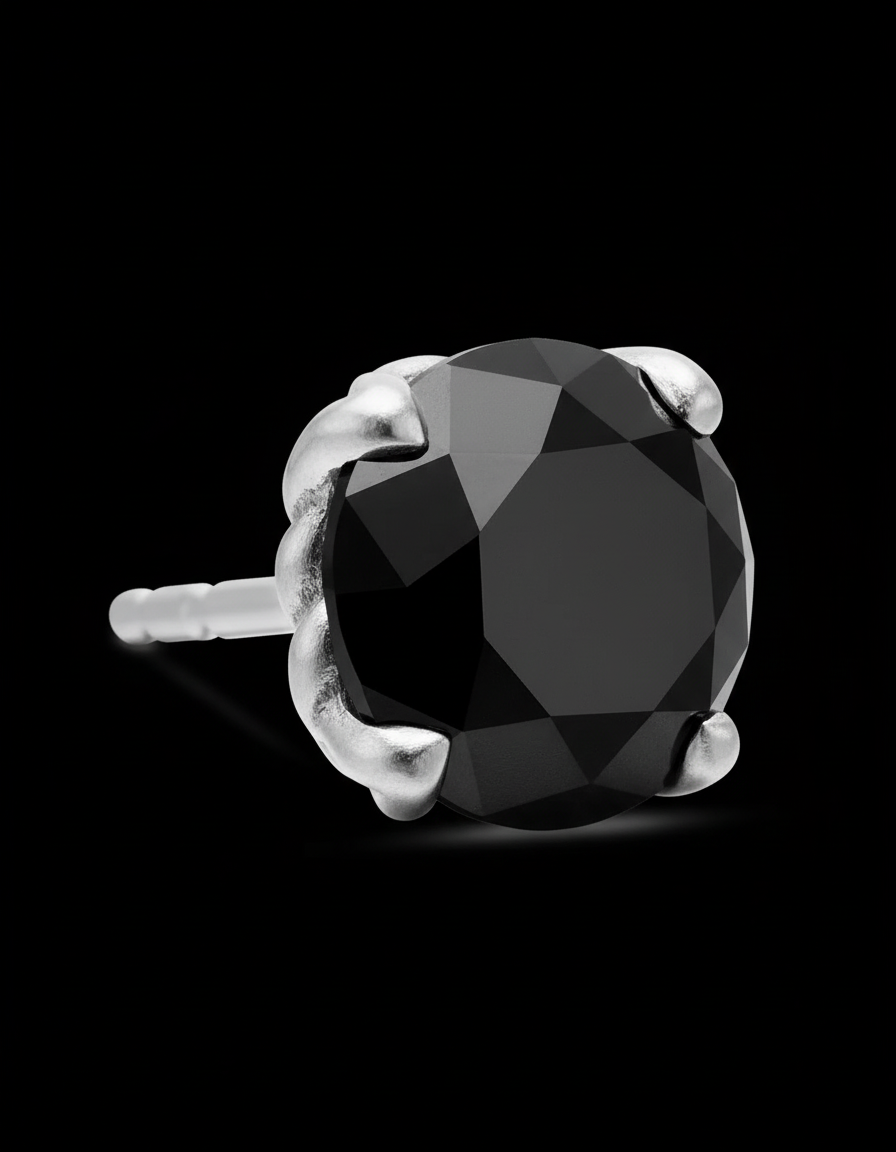
AXIOM sets its diamonds in 925 sterling silver, using natural black diamonds where a piece should read as a dark line and lab-grown white diamonds where it needs brightness. The Stud holds one round natural black diamond in a four-prong sterling silver setting, the bolder end of the stud range in this guide, and the Oath Band sets two rows of small natural black diamonds low in a smooth silver band.
The practical takeaway
If you are unsure, start with one small, low-set diamond in a piece you already understand: a stud if your ears are pierced, a band if you wear a ring, a pin if you wear jackets. Wear it for a month. If you stop noticing it, it is the right size.
