
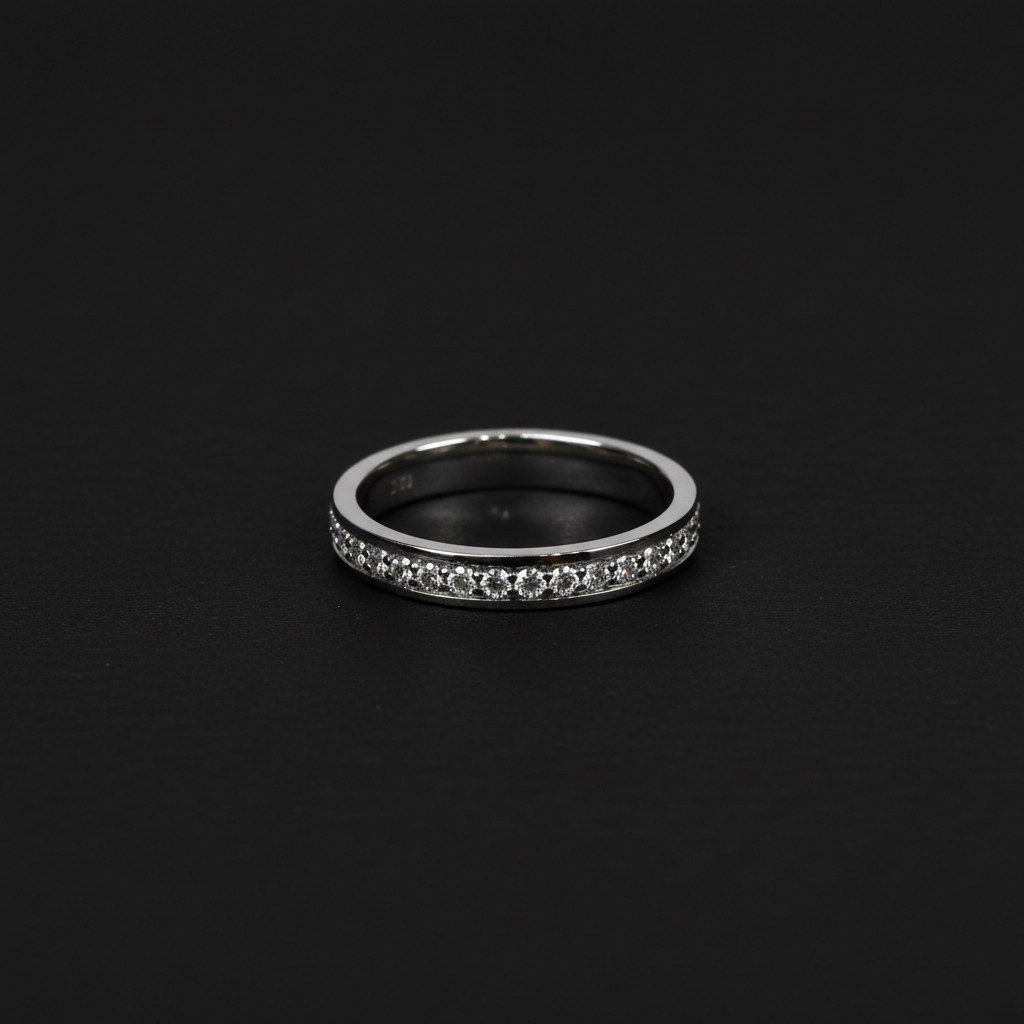
How much you should spend on an engagement ring in India is a budgeting question first and a diamond question second. The published guides mostly come from jewellers listing their own price tiers, and none of them tells you what to give up first when the number is fixed. This article does that, with real prices observed in October 2026, and it accounts for something most guides forget: at an Indian ring ceremony, there are usually two rings to buy. Every figure here is for real diamonds, natural or lab-grown. Rings set with American diamond (cubic zirconia) or other look-alikes cost a small fraction of these prices because they are a different material, which is a fine choice for costume jewellery but not a like-for-like comparison.
How much does a diamond engagement ring cost in India?
At the time of writing, a natural diamond solitaire engagement ring from national jewellers cost roughly ₹46,000 to ₹5 lakh, and a lab-grown solitaire of 1 to 2 carats cost roughly ₹57,000 to ₹1 lakh. The centre stone's size and origin move the price far more than anything else.
| Ring (observed October 2026) | Typical listed price |
|---|---|
| Natural solitaire, 0.20 ct, 14K gold | About ₹46,500 to ₹53,000 |
| Natural solitaire, 0.30 ct, 18K gold | About ₹73,000 to ₹79,000 |
| Natural solitaire, 0.50 ct, 18K gold | About ₹1.15 lakh to ₹1.5 lakh, more for top grades |
| Natural solitaire, 1 ct, 18K gold | About ₹3.6 lakh to ₹5.1 lakh |
| Lab-grown solitaire, 1 ct, 14K or 18K gold | About ₹57,000 to ₹69,000 for a plain solitaire, up to about ₹90,000 with a halo |
| Lab-grown solitaire, 2 ct, 18K gold | About ₹1 lakh |
The natural figures are selling prices on national jewellers' websites, some of them during a seasonal discount, for stones around GH to IJ colour and SI clarity. Prices move with gold rates, offers and grades, so use the table to set expectations, not to judge a single quote. Our guide to diamond price per carat in India explains why the price per carat climbs with size.
Where did the three months' salary rule come from?
From advertising, not tradition. As the BBC reported, the De Beers campaign suggested a single month's salary in the 1930s, and the figure became two months in the US in the 1980s. Japanese men were urged to spend three. None of these was ever financial advice.
A sounder way to set the number:
- Start from savings, not salary. Decide what you can spend in cash after keeping an emergency fund and the wedding costs in view.
- Budget for both rings if both partners will exchange rings at the ceremony.
- Include GST, which is 3% on finished jewellery, and any engraving or resizing.
- Avoid borrowing for the ring. A loan outlasts the excitement of the purchase.
Where does the money go in an engagement ring?
Into four parts: the diamonds, the gold, making charges and GST, and the centre stone is usually the largest. Seeing the split tells you where a saving is possible.
One national jeweller's itemised price for a 0.30 carat natural solitaire in 18K gold, before its seasonal discount, broke down like this:
| Component | Amount listed | Share (rounded) |
|---|---|---|
| Gold, 18K, 2.91 g | ₹32,682 | 35% |
| Diamond | ₹46,343 | 50% |
| Making charges | ₹11,766 | 13% |
| GST at 3% | ₹2,724 | 3% |
| Total | ₹93,515 | 100% |
The 3% rate is listed for jewellery of precious metal, plain or set with stones, under heading 7113 in Schedule IV of CBIC's GST rate notification. If a quote does not let you see this split, ask for it.
What to give up first when the budget is fixed
Give up carat weight at the margins, then colour and clarity grades you cannot see, then metal purity; never give up cut, setting quality or paperwork. This is the order we would follow at the bench.
- A sliver of carat weight. GIA's guide to carat weight notes that a 0.99 carat diamond is difficult to tell from a 1.00 carat by eye, yet the price difference can be significant. GIA calls 1.00, 1.50 and 2.00 carats magic sizes, and a stone just under one of them often costs noticeably less than one that reaches it.
- A colour grade or two. Compare stones side by side in the metal you plan to use. A slightly warmer stone tends to show less in yellow or rose gold than in white, so judge it in the setting you plan.
- Clarity you cannot see. VS and SI grades describe inclusions found under 10x magnification. If you cannot see an inclusion with your own eye at normal distance, you are paying only for the grade.
- Metal purity. 14K gold costs less per gram than 18K, and it is harder, which suits a ring worn daily.
- Extras. A halo or pavé band adds stones and setting labour. A plain shank puts the money into the centre stone.
- Stone origin, if your families are comfortable with it. A lab-grown stone gives you far more size and grade for the money, with very little resale value. Our comparison of natural vs lab-grown diamonds sets out the trade-off.
What not to give up: cut quality, which decides how bright the stone looks; a secure setting with sturdy prongs or a bezel; and a hallmark on gold with a written description of the diamond.
What does the same budget buy, natural or lab-grown?
At the same rupee amount, a lab-grown stone is several times larger than a natural one. The table compares what our October 2026 sample bought at common budgets.
| Budget | Natural diamond solitaire | Lab-grown diamond solitaire |
|---|---|---|
| About ₹50,000 | About 0.20 ct in 14K gold | Close to 1 ct in 14K gold |
| About ₹75,000 | About 0.30 ct in 18K gold | About 1 ct in 18K gold |
| About ₹1 lakh | About 0.30 ct, or several small stones | About 2 ct in 18K gold |
| About ₹1.5 lakh | About 0.50 ct in 18K gold | 2 ct and above |
| About ₹4 to ₹5 lakh | About 1 ct in 18K gold | Rarely needed at this size |
Diamond engagement ring under ₹50,000
Under ₹50,000 you are choosing between a small natural solitaire, a ring with several small diamonds that read larger together, and a lab-grown stone close to 1 carat. At this level, a well-cut small stone in a simple setting usually looks better than a large stone in a thin, cheap mount.
Diamond engagement ring under ₹1 lakh
Under ₹1 lakh, a natural solitaire of about 0.30 carat in 18K gold is within reach, or a lab-grown stone of 1 to 2 carats. A 0.50 carat natural solitaire generally cost more than ₹1 lakh in our sample.
Budgeting for both rings at the ring ceremony
In many Indian families both partners exchange rings at the sagai or ring ceremony, so the budget often covers two rings, not one. Decide early who buys which ring, because customs differ between communities and families.
The groom's ring is usually a band rather than a solitaire, and its cost depends more on the metal's weight and the number of small stones than on one centre diamond. Our guide to men's diamond ring prices in India works through his budget tiers. If the two rings should share a detail, such as a matching metal colour or the same stone type, brief them together.
How to compare two engagement ring quotes
Compare like with like: the same carat weight, grades, metal and setting, with the same items included. Two rings that look alike in photographs can differ by lakhs once you read the details.
| Check | What to ask | Why it matters |
|---|---|---|
| Centre stone | Carat weight, colour, clarity, cut grade and report number | A small change in any grade moves the price |
| Origin | Natural or laboratory-grown diamond, in writing | Lab-grown stones cost a fraction of natural ones |
| Metal | Purity (14K or 18K) and weight in grams | Heavier mounts cost more at the same design |
| Making | Amount or percentage, shown separately | Varies widely between jewellers |
| Price basis | Whether the price includes a discount, GST and the report | Offers and inclusions change the comparison |
If one quote is much cheaper than another for what looks like the same ring, the difference is almost always in the grades, the origin of the stone or the weight of the gold. Ask which, and get it on the invoice.
Costs people forget
- GST at 3%, usually included in the displayed price but worth confirming.
- A laboratory report for the centre stone, if it is not included.
- Engraving inside the band.
- Resizing after the ceremony, if the size was guessed.
- Insurance, for a ring of significant value.
How AXIOM approaches this
A commissioned ring puts the budget where you choose. AXIOM makes engagement rings for either partner as bespoke commissions: the design starts from the occasion, the stones are chosen with you as natural or lab-grown diamonds, and the ring is made in sterling silver or in 14K or 18K gold, so each choice is agreed with you before anything is made. Allow about three weeks to make it, plus delivery. For a groom's band, our men's rings and bands show what ready designs cost. Our guide to the custom engagement ring in India covers the process.
The practical takeaway
Set the number from savings, not a salary rule, and include both rings and GST. Then decide natural or lab-grown, because that sets what the number buys. If you still need to trim, drop just below a round carat weight, relax colour and clarity to what your eye cannot see, and keep every rupee you can in cut quality and a secure setting.
