
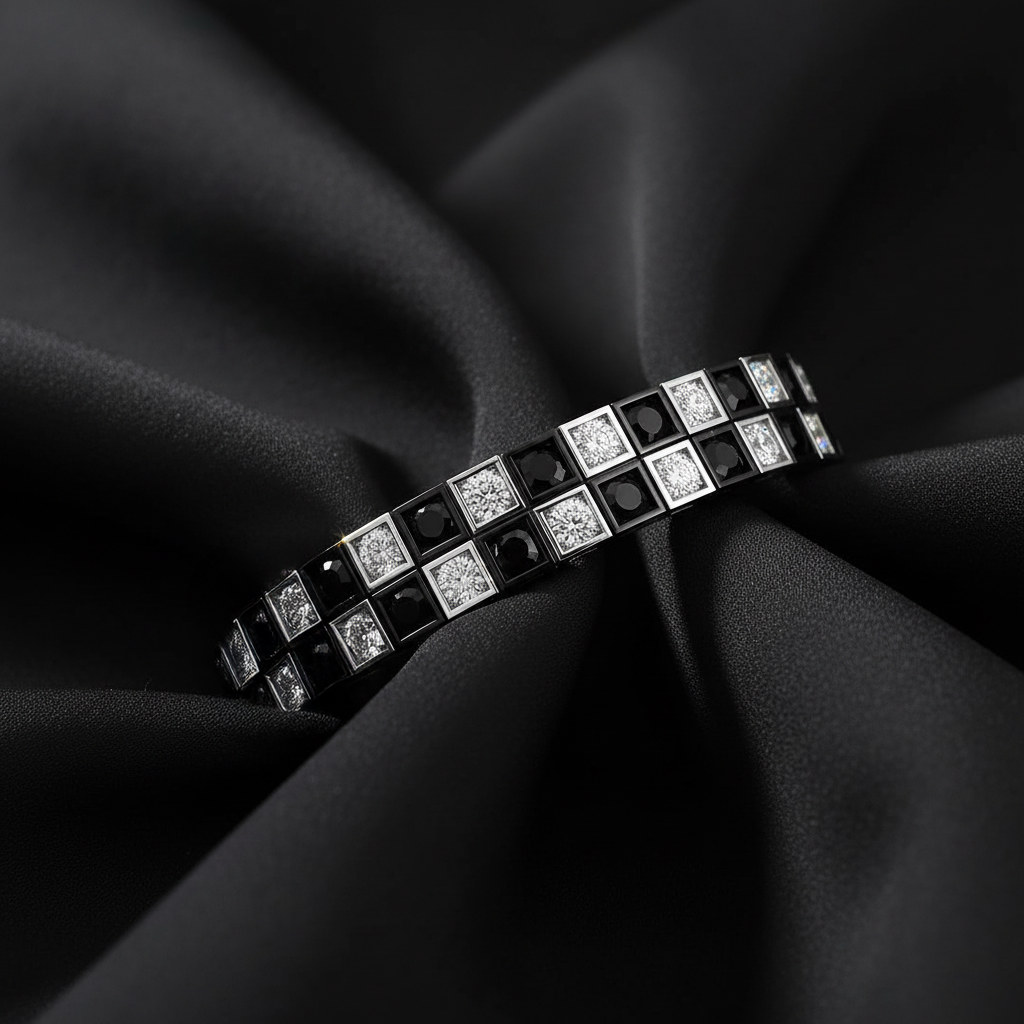
Black diamonds, lab-grown stones and sterling silver settings have widened what a men's diamond bracelet can be and what it can cost. The same words, "diamond bracelet", now cover pieces that differ many times over in price. This guide explains the styles, the settings, the stone choices and what actually drives the price, so you can compare two bracelets properly.
What types of diamond bracelet do men wear?
Men wear four main diamond bracelet styles: link bracelets with set stones, line (tennis) bracelets, rigid cuffs and kadas with stones, and bar or ID-style bracelets with a set panel. Each wears differently on a man's wrist.
| Style | Construction | How it wears | Best for |
|---|---|---|---|
| Link with set stones | Flexible links, some or all set with small diamonds | Moves with the wrist; most comfortable | Daily wear, office |
| Line (tennis) | A continuous row of individually set stones | Flexible, reads as formal; can twist | Weddings, evenings |
| Cuff or kada with stones | Rigid band, stones set along the top | Stays in place; strongest look | Statement wear, festive |
| Bar or ID with set panel | Chain or links with a flat set plate | Subtle; stones on one face only | Understated everyday wear |
For a wider look at non-diamond options, see our guide to types of bracelets for men.
Which diamond setting is most secure?
Bezel and channel settings are the most secure for a man's bracelet; prong and pavé settings show more sparkle but need more care. A bracelet takes more knocks than a ring, so the setting matters more than on almost any other piece.
| Setting | How the stone is held | Security on a bracelet | Look |
|---|---|---|---|
| Bezel | A metal rim wraps the stone's edge | Highest | Clean, modern, less sparkle |
| Channel | Stones sit in a groove between two metal walls | High | Sleek lines, suits men's designs |
| Prong (claw) | Small metal claws grip each stone | Moderate; claws can snag and bend | Maximum light and sparkle |
| Pavé | Many small stones held by tiny beads of metal | Moderate; small stones can loosen over years | Surface covered in sparkle |
Pavé and prong settings are not bad choices. They simply need a jeweller's check once a year, especially on the underside of the wrist, where the bracelet rests on desks and keyboards.
Black or white diamonds: which suits a men's bracelet?
Black diamonds read as darker, graphic and understated; white diamonds read as bright and formal. The choice is mostly about look, but it also affects how you judge quality.
- White diamonds are judged by the 4Cs: cut, colour, clarity and carat weight, as explained in GIA's guide to diamond quality. In a bracelet with dozens of small stones, consistency of colour and brightness across the stones matters more than the grade of any one.
- Black diamonds are opaque, so clarity and brightness grading do not apply in the same way. What matters is an even, deep black across all the stones, a good polish, and knowing exactly what you are buying. Ask whether the stones are natural black diamonds and whether any have been treated, and get the answer in writing.
Black stones also hide everyday wear well, which suits a piece worn daily. Our explainer on whether black diamonds are real diamonds covers simulants and how to spot them.
Natural or lab-grown diamonds in a bracelet?
Both are real diamonds. GIA's diamond entry notes that laboratory-grown counterparts have essentially the same chemical, physical and optical properties as the natural stone, and that diamond rates 10 on the Mohs hardness scale (GIA). The difference is origin, rarity and price.
| Natural diamonds | Lab-grown diamonds | |
|---|---|---|
| Origin | Formed in the earth, mined | Grown in a laboratory |
| Look and hardness | Same | Same |
| Price for the same size and quality | Higher | Usually lower |
| Why people choose them | Rarity, tradition, long-term value | More stone for the budget |
In a bracelet, where the total diamond weight is spread across many small stones, lab-grown stones let the same budget cover a fuller design. Natural stones make more sense when rarity or heirloom value matters to you. For a fuller comparison, see our guide to lab-grown diamond jewellery for men in India.
What decides a men's diamond bracelet price?
Five things decide the price: total diamond weight, stone origin and quality, metal, setting labour and design. Comparing only the final number hides all five.
- Total carat weight (tcw). The combined weight of every stone. One carat is 0.2 grams and is divided into 100 points, so a bracelet with forty 5-point stones carries 2 carats in total.
- Stone type and quality. Natural or lab-grown, white or black, and for white stones, their colour and clarity.
- Metal. 18K gold costs far more per gram than 925 sterling silver, and gold bracelets are usually heavier.
- Setting labour. Every stone is set by hand. A pavé bracelet with a hundred stones takes far longer to set than a bar with five.
- Design and finishing. Articulated links, hidden clasps and hand-finishing add hours.
| If two bracelets look similar but... | The more expensive one probably has... |
|---|---|
| One is much heavier in the hand | More gold or silver, or gold instead of silver |
| One sparkles more evenly | Better-matched, better-cut white stones |
| The stones are larger | Higher total carat weight |
| One uses natural stones | Natural rather than lab-grown diamonds |
| One has many more stones | More setting labour, often more total carat weight |
Because gold and diamond prices move, treat any quoted price as a snapshot and ask for the specification behind it. A seller who will not tell you the total carat weight and metal weight is asking you to compare blind.
How to check a diamond bracelet before you buy
Check the stones, the setting, the clasp and the paperwork. It takes five minutes.
- Listen. Shake the bracelet gently near your ear. Anything that rattles is loose.
- Look from the side. Every stone should sit level, with no daylight under prongs and no raised edges.
- Work the clasp. Open and close it ten times. A box clasp should click firmly, and a safety catch or figure-of-eight latch is worth having on a diamond bracelet.
- Flex it. Links should move freely without kinking; line bracelets should not show gaps between stones when bent.
- Get it in writing. Stone type (natural or lab-grown, black or white), total carat weight, metal and purity, and certification details.
- Check the return window. Made-to-order and bespoke pieces often have short or no return windows, so confirm size before you pay.
How should a diamond bracelet fit?
A diamond bracelet should sit with about a finger's width of room between the bracelet and the wrist. Too tight and the stones on the underside press into the skin and rub on every surface; too loose and the bracelet slides over the hand and takes knocks on the back of the wrist.
- Link and line bracelets: measure your wrist just above the wrist bone, then allow a little extra so one finger slides under the bracelet. Line bracelets need slightly more room than chunky links, because they twist.
- Cuffs: sized to the wrist. The gap at the back should be narrower than the wrist is thick, so the cuff turns on and off sideways.
- Kadas with stones: a closed kada has to pass over the knuckles, so it is sized to the hand, not the wrist.
If you wear a watch, fit the bracelet for the other wrist. Diamonds are harder than any watch case or crystal and will scratch them.
How to look after a men's diamond bracelet
Keep it clean, keep it off during heavy work, and have it checked once a year.
- Take it off for the gym, swimming and anything involving tools. Diamonds are hard but can chip on a sharp knock, and settings can bend.
- Clean it with warm water, a drop of mild soap and a soft brush, then dry it thoroughly. Lotion and soap build up behind stones and dull them.
- Store it on its own, in a pouch or compartment, so the diamonds do not scratch other jewellery.
- Once a year, ask a jeweller to check prongs, beads and the clasp. Tightening a loose stone costs far less than replacing a lost one.
Silver or gold for a diamond bracelet?
Both work; the choice sets the price and the colour. 18K white or yellow gold is harder, holds settings for longer and costs much more. 925 sterling silver is softer, so settings need to be well built and checked, but it lets more of the budget go into stones and design. Our guide to the silver bracelet for men covers silver construction in detail.
How AXIOM approaches this
AXIOM's bracelets are 925 sterling silver set with diamonds, and the stone type is stated on every piece. The Checkmate Bracelet is set with natural black diamonds (from ₹1,80,500 at the time of writing), and the Luminary Link Bracelet with lab-grown white diamonds (from ₹1,93,900). Both are solid silver rather than plated base metal, made to order at the Bharat Diamond Bourse in Mumbai, and come with certification details on request. The full bracelets and kada range lists the metal and stones for every piece.
The practical takeaway
Decide the look first (black or white, flexible or rigid), then choose a setting that suits how hard you are on your wrists. Before paying, get the total carat weight, the stone origin and the metal in writing, and compare bracelets on those numbers rather than on the price tag.
