
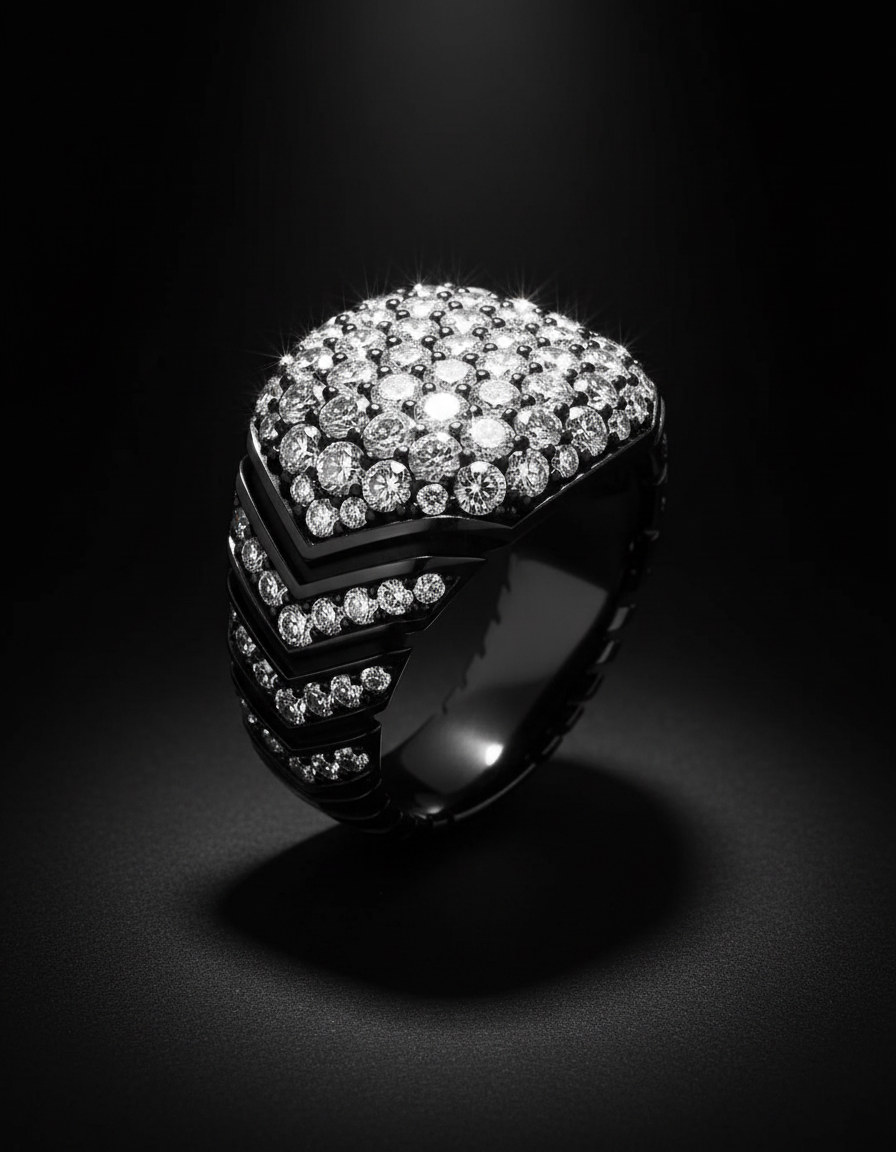
Lab-grown diamonds have changed what a man can buy for a given budget in India. A band that once needed a natural-diamond budget can now be made with lab-grown stones, and a solitaire that was out of reach may not be. That opens the door to sellers who are careful and to sellers who are not. This guide is the checklist we would use ourselves: what the paperwork must say, what to look for in the piece, and how pricing actually works right now.
If you are still deciding whether lab-grown is right for you at all, start with our comparison of natural vs lab-grown diamonds. This page assumes you have decided to buy.
What should a man check before buying lab-grown diamond jewellery in India?
Check five things before you pay: the disclosure, the certificate, the metal, the setting and the terms. Each is explained below.
1. Disclosure on the invoice
The invoice must describe the stones as laboratory-grown diamonds. India's diamond terminology standard, IS 19469:2025 (a modified adoption of ISO 18323), reserves the unqualified word "diamond" for natural stones and requires any laboratory-grown or treated diamond to be disclosed in plain, accurate terms, according to BIS. Trade press (Diamond World, January 2026) reported the standard as in force from January 2026, with "laboratory-grown diamond" and "laboratory-created diamond" the only permitted trade names. A good invoice also states:
- total carat weight of the diamonds
- colour and clarity range for small stones, or grades for a certified centre stone
- the metal and its purity, such as 925 sterling silver or 18K gold
- the gross weight of the piece
2. The certificate, and how to verify it
Any significant centre stone should come with a report from an independent laboratory such as GIA, IGI, SGL or HRD Antwerp. Before paying:
- Type the lab's website address yourself and enter the report number on its verification page.
- Check that the shape, measurements and carat weight on screen match the paper.
- Look for the laser inscription on the girdle with a 10x loupe and match the number.
GIA, for instance, laser inscribes every lab-grown diamond it assesses with "Laboratory-Grown" and its assessment number. Since 1 October 2025 it classifies lab-grown stones as Premium or Standard rather than giving specific colour and clarity grades, while other labs give full grades. Our guide on how to read a diamond certificate covers this in detail, including how the main labs differ.
3. Metal purity and hallmark
Diamonds get the attention, but the metal is what holds them for decades. For gold, selling hallmarked gold jewellery without a six-digit HUID has been prohibited since 1 April 2023, according to BIS. For silver, hallmarking remains voluntary, and silver BIS hallmarked since 1 September 2025 carries an HUID. A "925" stamp on its own is the maker's claim, not a hallmark. Our guide to setting diamonds in silver explains when silver makes sense.
4. Setting quality
A man's ring or bracelet takes more impact than most jewellery. Look at the piece closely, in photos at high zoom if buying online:
- stones sit level and evenly spaced, with no tilted or raised stones in a row
- prongs, channel walls or bezels are even and fully close over each stone
- no visible gaps between stone and metal
- the underside is finished cleanly, which usually signals care on the top
5. Return window and after-sales
Terms vary between sellers. Read the cancellation and return policy before ordering, note how quickly damage must be reported, and ask what happens if a stone comes loose later: who repairs it, at what cost, and how long it takes.
Lab-grown diamond jewellery for men: what to check by piece
Different pieces use stones in different ways, so the checks change with the piece.
| Piece | Typical stone setup | What to check |
|---|---|---|
| Ring or band | A row or rows of small stones, or one centre stone with accents | Total carat weight, matching, band thickness, whether it can be resized |
| Solitaire ring | One larger centre stone | Independent report, inscription, cut grade, secure prongs or bezel |
| Bracelet | Dozens of small stones in links or a line | Clasp strength, link flexibility, every stone secure |
| Studs | One stone per ear | Matched pair, stone size, secure screw backs |
| Pendant | A centre stone or a pavé motif | Bail strength, chain included or not, stone security |
| Cufflinks and pins | Small accents | Mechanism quality, stones set below the working surface |
For bracelets specifically, our diamond bracelet for men guide covers fit and clasp types.
How are lab-grown diamond prices set in India?
A lab-grown diamond piece is priced on three things: the stones, the metal and the making, with 3% GST on the full value of finished jewellery under the rate notification in force since September 2025. The stones are priced by carat weight and quality, the metal by weight and purity, and the making by the complexity of the design and setting.
Lab-grown stone prices have fallen steeply, and that is the single most important thing to understand as a buyer. At the time of writing, The Indian Express reported on 23 September 2026, citing a TradingView analysis, that lab-grown diamonds are typically 70 to 85% cheaper than comparable natural stones and that wholesale lab-grown prices had fallen more than 75% since 2022. Analyst Edahn Golan reported that one-carat lab-grown rounds fell 15% year on year in the first quarter of 2026, and linked the fall to oversupply.
The reason is supply. Lab-grown diamonds can be produced to order, and analysts describe the market as oversupplied. India is one of the leading producers by the CVD method, according to the Ministry of Commerce. That is good news for anyone buying a piece to wear, and it means three practical things:
- Compare current quotes, on the same specification. Price per carat for the same quality can differ between sellers, and older price lists go out of date quickly.
- Look at the whole price, not just the stones. In a silver band with small stones, the metal and craftsmanship can be a large share of the price.
- Do not buy lab-grown as an investment. Falling wholesale prices reduce what anyone will pay later. This is not financial advice, just the price mechanics.
Is it actually lab-grown diamond, or a simulant?
Make sure the stone is diamond before you compare prices. Lab-grown diamond, moissanite and cubic zirconia, sold in India as American diamond, can look alike in a photo, but they are different materials. Lab-grown diamond is carbon at 10 on the Mohs scale; moissanite is silicon carbide at 9.25; cubic zirconia is zirconium oxide at 8 to 8.5. A price that seems far below other lab-grown quotes for the same size is a reason to ask exactly what the stone is and to see it written on the invoice. A loupe, a grading report and a written invoice are how to tell them apart.
Questions to ask the seller before you order
A short message before ordering saves most problems later. Ask these, and keep the replies:
- Are all the diamonds in this piece laboratory-grown, and will the invoice say so?
- What is the total carat weight, and what is the colour and clarity range?
- Does the centre stone, if any, have an independent report, and from which lab?
- What is the metal and purity, and is the piece BIS hallmarked? (Gold must carry an HUID; silver hallmarking is voluntary.)
- What is the gross weight of the piece?
- How long will it take to make or dispatch, and is shipping insured?
- What is the cancellation and return window, and how must damage be reported?
- If a stone loosens or the ring needs resizing later, what do you do and what does it cost?
A seller who answers all eight clearly and in writing is usually a seller worth buying from.
How to care for lab-grown diamond jewellery
Care for it exactly as you would a natural diamond piece, because the stones are the same material. Diamonds attract skin oil and soap, which dull them, so clean them every few weeks with warm water, a drop of mild washing-up liquid and a soft toothbrush, then rinse and dry. Take rings off for the gym, heavy lifting and household chemicals, not to protect the diamond but to protect the setting and the metal. Store each piece separately so diamonds do not scratch other jewellery. Once a year, have a jeweller check that every stone is still tight. Silver pieces also need the occasional polish with a silver cloth.
Which lab-grown diamond pieces suit men best?
Pieces with many small stones in solid settings give the most visual effect per rupee and suit daily wear. A few guidelines:
- Bands with a row of stones set in a channel or flush setting are the most practical daily ring, because the metal protects the stones.
- A single larger stone makes the strongest statement but needs a report, a secure setting and more care.
- Bracelets show off lab-grown stones well but take knocks at the wrist, so clasp and setting quality matter more than stone grade.
- Studs are the simplest entry point and are easy to check.
On metal, 18K gold is the traditional choice for a diamond piece. 925 sterling silver costs far less and is genuine precious metal, 92.5% pure silver, though it tarnishes over time and needs occasional cleaning.
How AXIOM approaches this
Many AXIOM pieces use lab-grown white diamonds, and each product page names the stone and metal. The Legacy Ring, for example, is 925 sterling silver set with lab-grown white diamonds, as is the Facet Bracelet, and more options sit in our men's rings and bands. Every piece is made to order at the Bharat Diamond Bourse in Mumbai, with free insured shipping across India, and certification details are available on request.
The practical takeaway
Buy lab-grown diamonds for how they look and wear, not for what they might be worth later. Insist on the word laboratory-grown on the invoice, verify any report yourself, check the hallmark on the metal, look closely at the setting, and read the return terms before you pay. If all five are in order, a lab-grown piece gives a man real diamonds at a price that was not possible a few years ago.
