
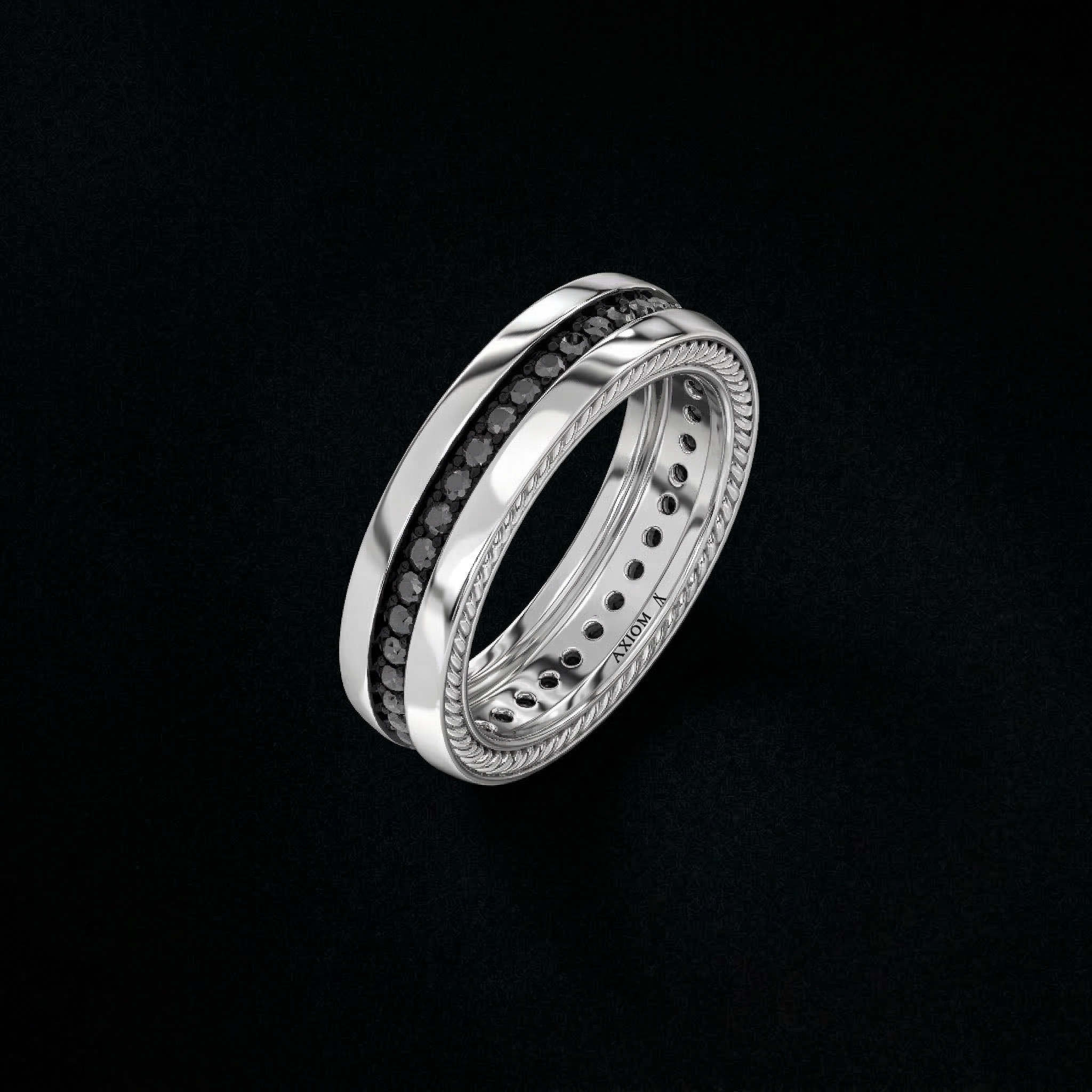
Yes, diamonds can be set in silver, and fine jewellers do it routinely. 925 sterling silver is hard enough to be pushed over a stone's edge and hold it for decades, provided the setting protects the stone: bezel, channel and flush settings suit silver best, and fine claws do not. A diamond in silver ring then needs only a yearly check.
Many men assume that diamonds belong in gold and that silver means costume jewellery. That was mostly true for a long time, but men's fine jewellery has changed: bold rings, bands and bracelets set with rows of diamonds are now commonly made in 925 sterling silver. This article explains why jewellers do it, where silver's limits are, and how to choose a piece that will keep its stones.
Can real diamonds be set in silver?
Yes. A diamond can be set in any metal a jeweller can shape around it, and 925 sterling silver is strong enough for most setting styles. Sterling is 92.5 percent silver hardened with copper, which gives it enough strength to be pushed over the edge of a stone and hold it. Pure silver would be too soft.
The question is not whether silver can hold a diamond, but how well it holds it over years of wear. Silver is softer than gold and platinum, so the design and setting matter more.
| Consideration | Diamond in 925 silver | Diamond in 18K gold |
|---|---|---|
| Metal cost | Low | Many times higher |
| Metal hardness | Softer | Harder |
| Claw wear over years | Faster | Slower |
| Best setting styles | Bezel, channel, flush, sturdy pavé | Any, including fine claws |
| Tarnish around stones | Yes; cleans off | No |
| Where the budget goes | Mostly stones and design | Split between metal and stones |
Why do fine jewellers set diamonds in silver?
Because the metal cost drops so sharply that more of the budget can go into stones, craftsmanship and scale. Men's jewellery tends to be heavier than women's: a wide band, a chunky kada or a solid signet uses many grams of metal. In gold, that weight alone can cost more than all the diamonds. In silver, the same design becomes affordable, and the diamonds carry most of the value.
Silver also gives a bright white backdrop that suits both white and black diamonds, and it is easy to resize, repair and refinish. For whether 925 is the right metal for you more generally, see is 925 sterling silver good for men.
How durable are diamond settings in silver?
Durable enough for daily wear when the setting protects the stone. Silver's softness shows up in three ways: claws (prongs) wear thinner, thin bands can bend out of round, and edges soften with knocks. Each can loosen a stone over time.
Setting styles that surround or recess the stone put less stress on any one thin piece of metal, so they suit silver best.
| Setting style | How it holds the stone | Security in silver | Upkeep |
|---|---|---|---|
| Flush (gypsy) | Stone sunk into the metal surface | Very high | Minimal; check yearly |
| Bezel | A metal rim wraps the stone's edge | Very high | Minimal; check yearly |
| Channel | Stones held between two metal walls | High | Check the walls for bending |
| Pavé | Many small stones held by tiny metal beads | Moderate to high if beads are generous | Check yearly; avoid abrasive polish |
| Claw or prong, sturdy | Four to six thick claws | Moderate | Check claws every six to twelve months |
| Claw or prong, fine | Thin claws on a tall head | Lower | Frequent checks; not ideal in silver |
| Tension | Stone gripped by the metal's spring | Not suitable | Silver lacks the spring strength |
Which diamond settings suit a silver ring for daily wear?
For a man who wears his ring every day and uses his hands, flush, bezel and channel settings are the safest in silver. A row of diamonds across a band, set in a channel or as a half-eternity with protective walls, will take normal knocks without exposing the stones.
A few practical points help:
- Choose a sensible band thickness. A thicker, heavier band holds its shape better, and silver is inexpensive enough that extra weight adds little cost.
- Keep stones low. A stone that sits high catches on clothing and takes knocks first.
- Remove the ring for heavy work. Weights, tools and building work load settings far beyond normal wear.
- Get a yearly check. A jeweller can see a worn claw or a lifted bead long before a stone falls out.
If you are choosing a diamond ring more broadly, our guide on how to choose a men's diamond ring covers stone, cut and fit.
Natural or laboratory-grown diamonds in silver?
Both are set in silver. A laboratory-grown diamond is a real diamond with the same hardness and optics as a mined one, as GIA explains, and many silver pieces use laboratory-grown white diamonds because they suit the same value logic: a precious metal at a sensible cost, holding real diamonds at a sensible cost. Natural black diamonds are also common in silver, because they are relatively affordable compared with fine natural white stones and look striking against white metal. For more on this, see lab-grown diamond jewellery for men in India.
Are silver diamond rings worth anything?
A silver diamond ring is worth its diamonds plus its silver, not what you paid for it in a shop. When you sell any jewellery, you receive a trade price for the materials; design, making charges and taxes are not recovered.
- Natural diamonds with a grading report have a resale market, though usually well below retail.
- Small pavé diamonds fetch little individually, natural or not.
- Laboratory-grown diamonds have very little resale market.
- The silver is valued by weight at the current silver rate, less the buyer's margin.
This is not a reason to avoid silver diamond jewellery. It is a reason to buy it for wearing, not as an investment, and to ask any seller in writing what, if anything, they would pay back.
How to care for diamonds set in silver
Silver tarnishes, and the dark film collects around settings, making stones look duller. The fix is simple: soak in warm water with a drop of mild washing-up liquid, brush gently with a soft toothbrush, rinse and dry with a lint-free cloth. Polish the metal with a silver cloth, keeping it off the stones.
Avoid abrasive pastes on pavé work, which wear down the tiny beads that hold each stone. For step-by-step cleaning, read how to clean a diamond ring at home.
Some people ask about wearing a diamond in silver for astrological reasons. Practice varies by tradition and by astrologer, and it is a matter of belief rather than metallurgy, so we leave that question to those who advise on it.
If you have decided on a silver ring with real diamonds and want to buy one well, the silver ring with diamond buying guide covers settings, stone sizes and what the invoice should say.
How AXIOM approaches this
This is how most AXIOM pieces are made: 925 sterling silver set with natural black diamonds, laboratory-grown white diamonds or both. The Covenant Band sets natural black diamonds in silver, and the Virtue Ring sets a single row of lab-grown white diamonds; more are among our men's rings and bands. Every piece carries a lifetime craftsmanship guarantee that includes servicing, and certification details are available on request.
The practical takeaway
Diamonds in silver make sense when you want real stones and a bold design at a fraction of gold's metal cost. Choose a protective setting and a solid band, have it checked once a year, and buy it to wear rather than to resell.
