
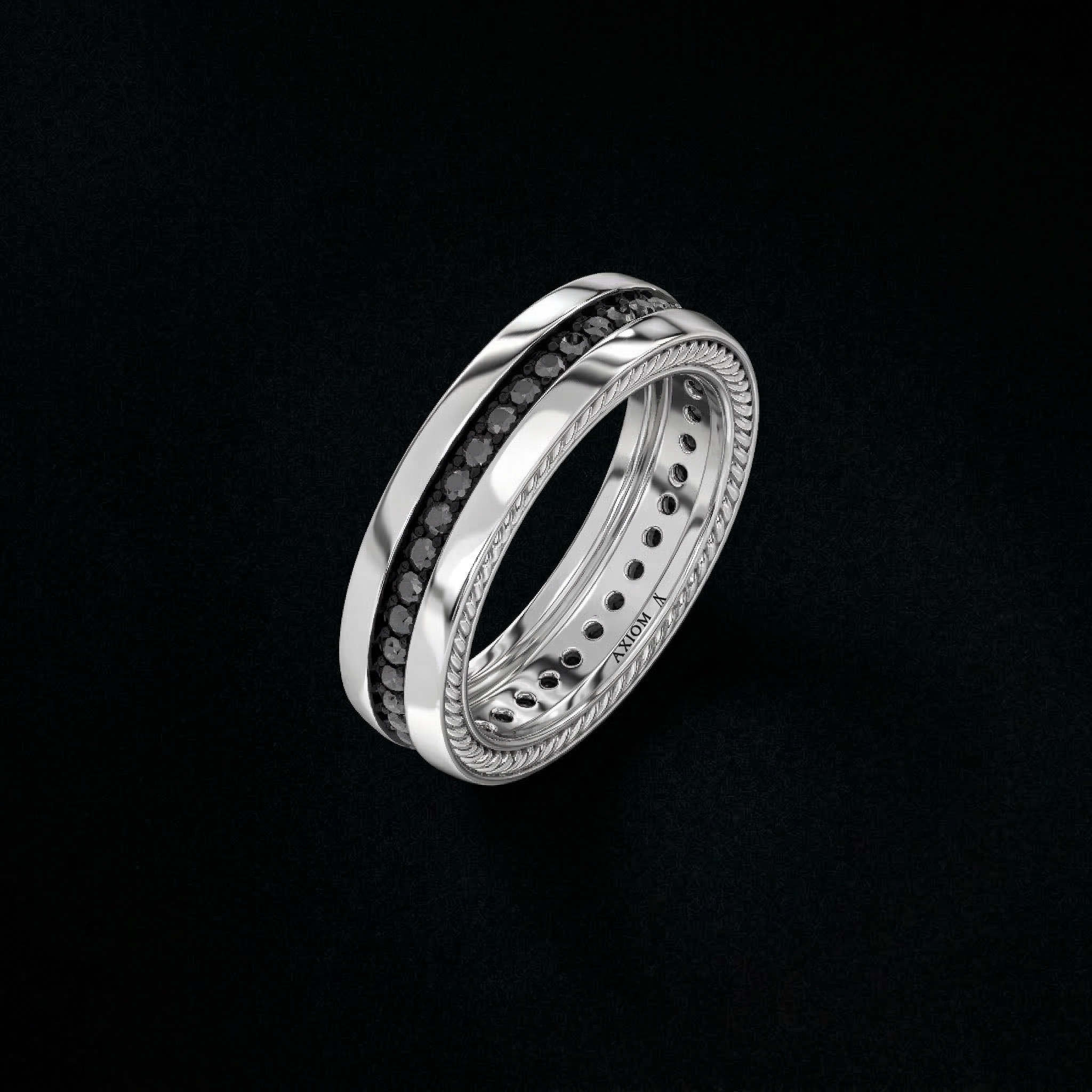
Silver is where most men start with jewellery in India, and for many it is where they stay. The questions are practical: will a 925 ring survive daily use, why is it going dark, and is the "925" stamp on a ₹1,500 chain the same as the one on a ₹50,000 bracelet. This guide answers them from the bench, with the chemistry kept short and the trade-offs stated plainly.
What does 925 silver mean?
925 silver means the metal is 925 parts pure silver per 1,000, or 92.5%. The other 7.5% is a different metal, almost always copper, sometimes with small amounts of zinc or other elements depending on the maker's alloy. "925 silver", "sterling silver" and "92.5 silver" are three names for the same thing.
The copper is there for a reason. Pure silver (999) is soft enough to bend, dent and lose its shape on a finger or wrist. Adding copper makes the alloy harder and springier without changing its white colour, which is why sterling has been the standard for silver jewellery and silverware for centuries.
In India, the Bureau of Indian Standards recognises 925 as one of seven silver purity grades under the revised standard IS 2112:2025: 800, 835, 925, 958, 970, 990 and 999. Grades 958 and 999 were added in the 2025 revision, according to the government's September 2025 announcement.
Is 925 silver good for daily wear?
Yes, solid 925 silver is good for daily wear, with two honest caveats: it scratches more easily than gold or steel, and it tarnishes. Neither is a defect. Both are surface changes that a polishing cloth or a jeweller can reverse, which is not true of plated jewellery.
Here is what daily wear actually does to a sterling piece over time:
- Scratches. Rings on the hand you use most collect fine scratches within weeks. On a brushed or matte finish they blend in; on a high polish they show. A professional polish removes them.
- Tarnish. Sulphur compounds in air and sweat react with silver to form a dark film of silver sulphide. Heat, humidity and perspiration speed this up, which is why pieces darken faster during an Indian monsoon. Our full guide on whether sterling silver tarnishes explains the chemistry and prevention.
- Shape. Thin rings and fine chains can bend or kink. Substantial pieces, a band with real wall thickness or a solid link bracelet, hold their shape for years.
- Stone settings. Silver is softer than gold, so prongs and channels in silver need more metal to grip stones securely. A well-made setting in silver is sound; a skimpy one will loosen sooner. Have settings checked about once a year.
The practical rule: the more substantial the piece, the better sterling wears. Weight and thickness matter more than the number on the stamp.
925 silver vs 999 silver vs silver-plated vs stainless steel
For men's daily-wear jewellery, 925 silver is the best balance of real precious metal, strength and cost. Pure 999 silver is too soft, plated silver wears through, and stainless steel is tough but is a different, non-precious material.
| Factor | 925 sterling silver | 999 fine silver | Silver-plated | Stainless steel |
|---|---|---|---|---|
| What it is | 92.5% silver, 7.5% copper or similar | 99.9% silver | Thin silver layer over brass, copper or another base metal | Iron alloy with chromium, no silver |
| Daily wear strength | Good for rings, chains, bracelets | Too soft, bends and dents easily | Base metal is strong, surface wears through | Very hard, resists scratches |
| Tarnish | Yes, polishable | Slower than sterling, still tarnishes | Tarnishes, then plating wears off | Does not tarnish |
| Can be polished or refinished | Yes, many times | Yes, carefully | No, polishing removes the layer | Can be re-brushed, hard to repair |
| BIS silver hallmark possible | Yes (grade 925) | Yes (grade 999) | No | No |
| Resale value | Silver weight value | Silver weight value | Negligible | Negligible |
Two points that are usually left out. First, "rhodium-plated 925 silver" is still sterling underneath; the rhodium is a thin coating that slows tarnish until it wears, usually first on the inside of a ring. Second, stainless steel's toughness cuts both ways: it resists scratches, but it is difficult to resize, which matters for a ring you plan to wear for twenty years. If you are weighing the two directly, see sterling silver vs stainless steel.
How to tell if 925 silver is real
The most reliable check in India is a BIS hallmark with a HUID code, verified in the BIS Care app. After that, a "925" stamp from a jeweller you trust, then home tests, which can only rule things out rather than prove anything.
The BIS hallmark and HUID
Under IS 2112:2025, a hallmarked silver piece carries three marks: the BIS standard mark with the word "SILVER", the purity grade (for example 925) and a six-character HUID code. HUID-based hallmarking for silver began on 1 September 2025. The silver hallmarking scheme itself remains voluntary, as the government confirmed in December 2025, but silver hallmarked under the new standard carries a HUID. Entering that code in the BIS Care app shows the article type, purity grade, the jeweller who submitted it and the hallmarking centre.
Pieces hallmarked before September 2025 may carry the older four-part mark instead: BIS mark with "SILVER", fineness, the assay centre's mark and the jeweller's mark. That older mark is still genuine. Our guide to the 925 stamp and silver hallmark in India shows what each looks like.
The "925" stamp on its own
A plain "925" or "STERLING" stamp is a maker's claim, not a test result. It is normal on genuine pieces, especially small ones where there is little room to mark, but anyone with a punch can stamp it. Treat it as meaningful only when it comes from a seller who will put the purity in writing on the invoice.
Home tests and their limits
| Test | What real 925 does | What it cannot tell you |
|---|---|---|
| Magnet | Silver is not attracted to a magnet | Copper, brass and many plated fakes are not magnetic either |
| Ice cube | Silver conducts heat fast, so ice melts quickly on it | Copper and aluminium do the same |
| White cloth rub | Tarnished silver leaves a grey-black mark | Other metals can mark cloth too |
| Look at worn edges | Colour is the same all the way through | Only catches plating after it has worn |
If a magnet pulls a piece, it is not solid silver. If it does not, you have learned very little. For anything expensive, the hallmark or an assay centre is the answer.
Is 925 silver worth buying?
925 silver is worth buying when you are paying for design, stones and craftsmanship you will wear, not for metal to store. Silver costs a small fraction of gold per gram, so a silver piece can carry more design, more weight and better stones for the same budget. The trade-off is that it resells largely for its silver content, and it needs more upkeep than gold. If your priority is stored value, or a piece you never want to polish, gold is the better metal for that job.
That makes the buying questions different from gold:
- Is it solid? Ask directly whether the piece is solid 925 or plated, and whether any coating has been added.
- What does it weigh? A heavier piece in the same design has thicker walls and wears longer.
- How are the stones set? Ask about the setting type and whether settings can be checked and tightened later.
- Is purity on the invoice? Written purity, and the HUID where the piece carries one, is your protection.
- What happens when it needs polishing or resizing? A seller who services what they sell is worth more than a small discount.
For how silver compares with gold on durability, colour and value, see our neutral comparison of gold vs sterling silver for men.
Is 925 silver good for sensitive skin?
For most men, yes. Sterling silver does not normally contain nickel, the most common metal allergy, although alloys vary by maker and cheap unhallmarked pieces can contain anything. The copper in sterling can leave a faint green or dark mark on skin in heat and sweat. That mark is harmless and usually stops once the piece and skin are kept clean and dry.
If you have a known metal allergy, ask the seller what the 7.5% alloy is before you buy. A good seller will tell you.
How AXIOM approaches this
Almost everything we make is solid 925 sterling silver, most of it set with natural black diamonds or lab-grown white diamonds, with 18K white gold offered on three designs. Our pieces are solid metal rather than plated base metal, so the silver or gold goes all the way through, and they carry a lifetime craftsmanship guarantee with free servicing, resizing and refinishing. You can see how that plays out in practice across the full collection, from plain bands to diamond-set men's rings and bands, and read more about the bench behind them on our about page.
The practical takeaway
Buy solid 925, buy it heavy enough for the job, and buy it from someone who will put the purity in writing and service the piece later. Wipe it after sweaty days, take it off for the pool and the gym, and expect to polish it now and then. Treated that way, a sterling ring or bracelet is not a starter piece. It is one you keep.
