
Silver or gold for men comes down to the job: 925 sterling silver for everyday style pieces and designs set with stones on a sensible budget, 18K gold for a ring or chain you want to wear for decades with almost no upkeep. This question used to have a default answer in Indian families: gold, because gold was jewellery and savings in one. Men now ask it differently. They want a ring they can wear to work, a chain that survives a Mumbai summer, and something that still looks right in ten years. The answer depends on which of those jobs the piece has to do, so this comparison puts 925 sterling silver, 18K gold and 22K gold side by side on the things that actually change your experience of wearing them.
Gold vs silver for men: the side-by-side comparison
Silver wins on cost and design freedom; gold wins on low maintenance and metal value. 18K sits in the practical middle for men's gold, and 22K is the traditional choice with the trade-off of softness.
| Factor | 925 sterling silver | 18K gold | 22K gold |
|---|---|---|---|
| Precious metal content | 92.5% silver | 75% gold (750) | 91.6% gold (916) |
| Everyday durability | Good; scratches more readily | Very good; hardest of the three | Fair; soft, dents and scratches |
| Tarnish | Tarnishes; polishes back | Does not tarnish in normal wear | Does not tarnish |
| Weight for the same design | Lightest | About 1.5 times silver (yellow) | Heavier than 18K |
| Colour | Bright white | Yellow, white or rose | Deep yellow |
| Holds diamonds securely | Yes, with generous settings | Yes, the usual choice | Less secure; rarely used for diamonds |
| Metal value on resale | Low; silver weight only | High; gold content bought back | Highest per gram |
| BIS hallmark | Voluntary; 925 grade with HUID | Mandatory in notified districts; 18K750 with HUID | Mandatory in notified districts; 22K916 with HUID |
A few of these rows need explaining, because they drive most of the decision.
Which is more durable for daily wear?
18K gold is the most durable of the three for daily wear, then 925 silver, then 22K gold. The alloying metals make 18K hard enough to resist knocks and hold prongs tightly, while 22K, at 91.6% gold, is soft enough to dent and scratch noticeably on a ring worn every day.
Sterling silver is sound for rings, chains and bracelets, but it marks faster than 18K. In practice that means a silver band picks up a soft, scratched patina within months, while an 18K band takes longer. Both can be polished back to a bright finish by a jeweller. Thickness matters as much as metal: a substantial silver band outlasts a thin gold one.
For chains specifically, the link style and gauge matter more than the metal. A fine chain in any metal kinks and snaps; a solid curb or box link in 925 silver or 18K gold holds up to years of daily wear.
Silver vs gold for a ring, a chain and a bracelet
The right metal changes with the piece, because each one is worn and stressed differently.
Rings. A ring takes more knocks than anything else you wear. An 18K gold ring scratches less and holds stones most securely over decades; a solid 925 silver ring wears well too but shows scratches sooner and needs occasional polishing. For a stone-set ring worn daily, both work if the band has real thickness; 22K is best kept for plain bands.
Chains. A chain is a set of small links rubbing against each other all day, so link style and gauge matter as much as metal. Gold chains need less upkeep under a shirt; silver chains are far cheaper at the same visible weight, so you can afford a sturdier link. Avoid very fine chains in either metal for daily wear.
Bracelets and kadas. Wrists meet desks, car doors and keyboards. Large, bold designs are where silver makes the most sense, because the same kada in gold would be heavy and priced mostly on its gold weight. Slim gold bracelets suit men who want one understated piece they never take off.
Does gold or silver need more care?
Silver needs more care, because it tarnishes and gold does not. Sulphur in air and sweat turns silver's surface dark over weeks, faster in heat and humidity. A wipe with a polishing cloth after wearing and dry, airtight storage keep it bright. Our guide to why sterling silver tarnishes covers prevention in detail.
18K and 22K gold do not tarnish in normal wear. They get dull from soap, skin oil and lotion, and a wash in warm soapy water restores them. That lower upkeep is one of the strongest practical reasons to choose gold for a piece you never want to take off, such as a wedding band.
How do they compare on weight and feel?
Gold is noticeably heavier than silver for the same design. Standard trade specific-gravity tables put sterling silver at about 10.4 and 18K yellow gold at about 15.5 (the exact figure varies with the alloy), so a ring that weighs 10 g in silver weighs roughly 15 g in 18K yellow gold. 22K is heavier again because it contains more gold.
Some men like that heft; it reads as substance. Others prefer silver for large pieces like cuffs and chunky bracelets, where the same design in gold would be both heavy on the wrist and very expensive, because gold is priced by weight.
Which looks better on Indian skin tones?
There is no rule, only tendencies. Yellow gold tends to flatter warm undertones and reads as traditional and festive. Silver and white metals tend to suit cooler and deeper complexions and read as modern and understated, and they make black diamonds stand out.
The quickest test is practical: hold a silver piece and a yellow gold piece against the inside of your wrist in daylight. Also think about what you already wear. If your watch is steel, silver will sit alongside it more easily; if your family pieces are yellow gold, a gold ring may feel more at home at weddings.
What does each cost, and which holds value?
Gold costs many times more per gram than silver, and it holds far more of its value when resold. Silver jewellery is priced mainly on design, craftsmanship and stones, and resells largely for its silver weight. That is the honest core of the choice.
The price of any piece has three parts: the metal (weight multiplied by the day's rate for that purity), the making (design, casting, setting, finishing) and any stones. In gold, metal is usually the largest part. In silver, making and stones usually are. So:
- With gold, a large share of what you pay is metal that can be exchanged or sold back against the day's rate, less the jeweller's deductions.
- With silver, most of what you pay is design and work, which you enjoy while wearing it but mostly do not get back on resale.
- With the same budget, silver buys a bolder design, more stones or a heavier piece; gold buys a simpler piece with lasting metal value.
To compare real prices, check that day's gold and silver rates for the purity you are considering, then ask any jeweller to split the quote into metal, making and stones. We explain why the making share can be higher in silver in why 925 silver jewellery costs more than its metal. None of this is investment advice; if you are buying to invest, jewellery is only one of several ways to hold gold.
Can gold and silver rings be resized and repaired?
Both can usually be resized by a size or two when the band is plain or only partly set. Gold solders cleanly and colour-matches easily. Silver can be resized just as well, though it conducts heat so quickly that fine soldering near stones takes more care. Fully set eternity bands in either metal are hard to resize without resetting stones.
Both metals can be polished and refinished many times because the colour runs all the way through. That is the key difference from plated jewellery, where polishing eventually exposes the base metal.
How do hallmarks differ for gold and silver in India?
Gold jewellery hallmarking is mandatory in districts notified by the government, and every hallmarked piece carries three marks: the BIS logo, the purity (such as 18K750 or 22K916) and a six-character HUID. BIS lists six gold grades, from 14K (585) to 24K (995).
Silver hallmarking is voluntary. Since 1 September 2025, silver that is hallmarked carries the BIS mark with the word "SILVER", the grade (such as 925) and a HUID. In both cases the HUID can be checked in the BIS Care app. Look for all three marks on silver before trusting a "925" claim on an expensive piece; silver hallmarked before September 2025 carries an older four-part mark without a HUID, which is still valid.
Should you choose gold or silver? Who each suits
Choose by the job the piece has to do. This table summarises the most common situations we are asked about.
| Situation | Better choice | Why |
|---|---|---|
| First piece of jewellery | 925 silver | Lower cost to learn what you like wearing |
| Wedding band worn every day for life | 18K gold, or silver if you accept upkeep | 18K is hardest and never tarnishes |
| Diamond-set ring | 18K gold or 925 silver | Both hold stones well; 22K is too soft |
| Bold cuff, kada or chunky bracelet | 925 silver | Same design in gold is heavy and very costly |
| Chain worn under a shirt daily | 18K gold or a solid silver link | Gold needs least care; silver needs wiping |
| Heirloom meant to hold value | 22K or 18K gold | Metal value survives generations |
| Pieces worn with a steel watch | 925 silver or white gold | Tones match |
If you are still deciding between gold karats, our 18K vs 22K gold comparison goes deeper, and sterling silver vs white gold covers the two white metals.
How AXIOM approaches this
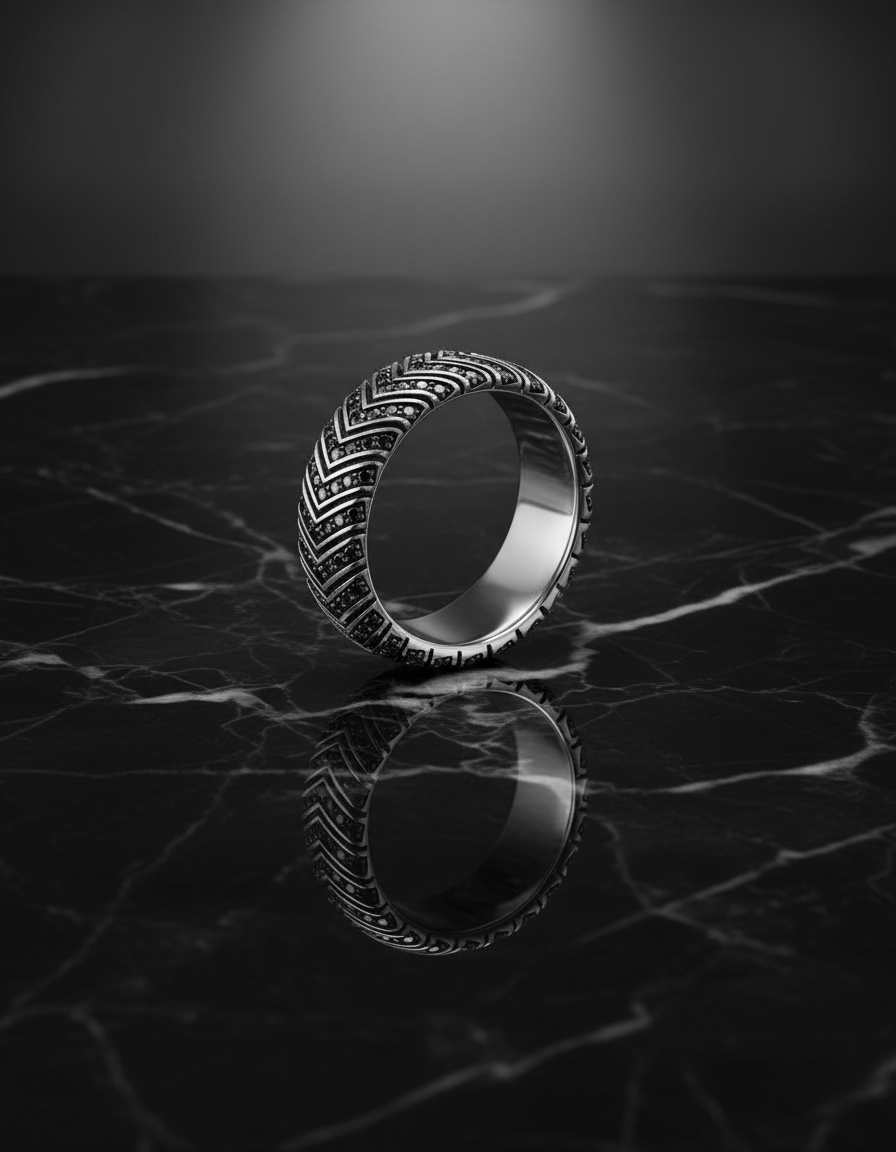
Most of what we make is in 925 sterling silver set with natural black diamonds and lab-grown white diamonds, which is why this comparison does not push you towards gold. Three designs are also offered in 18K white gold, including The Apex Ring, a chevron design set with natural black diamonds and available in either 925 sterling silver or 18K white gold. Every piece is solid metal rather than plated base metal. You can compare metals across our rings and bands or the full collection.
The practical takeaway
If you want one ring you never think about, buy it in 18K gold. If you want a wardrobe of pieces with real design, stones and weight, and you are happy to wipe them after a sweaty day, buy solid 925 silver. Whatever you choose, ask for the metal purity in writing and the price split into metal, making and stones, and you will know exactly what you are paying for.
