
A name, a mantra or a lion's head turns a kada from a bracelet into something that belongs to one man. Search results for this are mostly product listings for laser-marked steel kadas, which tell you the price but not how much text fits, where it should go, or whether it will still be readable in ten years. This guide answers those questions, and treats the religious inscriptions with the care they deserve.
What can be engraved on a men's kada?
Almost anything short: a name, initials, a date, a single mantra, a symbol such as Om or Ik Onkar, or a motif such as a lion. What changes from one to the next is how much space it needs and which method reproduces it well.
| Inscription | Example | Best method | Best position |
|---|---|---|---|
| Name or initials | ARJUN, A.K.M. | Deep machine or hand engraving | Outer face for display, inner face for privacy |
| Date or coordinates | 08.11.2026 | Machine engraving | Inner face |
| Short mantra | Om Namah Shivaya, Jai Shree Ram, Waheguru | Machine or hand engraving | Outer face, one line |
| Symbol | Om, Ik Onkar (ੴ), khanda, trishul | Hand engraving, or cast in relief | Centre of the outer face |
| Long text | Hanuman Chalisa, Mool Mantar | Micro laser engraving | Around a wide band, several rows |
| Motif | Lion, tiger, elephant, evil eye | Cast in relief or sculpted ends | Terminals of an open kada, or a central plaque |
A name can also be cut out as raised letters rather than engraved into the band. Raised letters catch on cuffs and wear at the edges, so for a kada worn every day, letters cut into a solid surface last longer. Our guide to personalised jewellery for men compares engraving methods in detail.
How much text fits on a kada?
One readable line around a men's kada holds roughly 60 to 75 characters, depending on size. The space is the circumference of the band, which you can work out from the size: inner diameter multiplied by 3.14.
Indian kada sizes are written as 2.6, 2.8, 2.10 and so on, where the second number counts sixteenths of an inch. The table converts each size to millimetres and shows the length of one line of text.
| Kada size | Inner diameter | Inner circumference | Characters per line at 3 mm each | Characters per line at 2 mm each |
|---|---|---|---|---|
| 2.6 | 60.3 mm | 189 mm | about 63 | about 94 |
| 2.8 | 63.5 mm | 199 mm | about 66 | about 99 |
| 2.10 | 66.7 mm | 209 mm | about 69 | about 104 |
| 2.12 | 69.9 mm | 220 mm | about 73 | about 109 |
| 2.14 | 73.0 mm | 229 mm | about 76 | about 114 |
The character columns assume each letter plus its spacing takes 3 mm (comfortable to read at arm's length) or 2 mm (readable when the wrist is lifted to the eye). The outer face of a thick kada is a little longer than the inner one, so it fits a few more characters. In practice, a name sits best in the middle third of the outer face rather than running all the way round, and wide bands can take two rows. If you do not yet know the size, our kada size guide shows how to measure the hand.
Can the full Hanuman Chalisa fit?
Only as micro-engraving. The Hanuman Chalisa, written by Tulsidas in Awadhi, has 43 verses: two opening dohas, forty chaupais and a closing doha. In print that is well over 80 lines. At 3 mm per character, a 2.10 kada holds about 69 characters per line, so the full text at a readable size would need dozens of rows. Full-text kadas exist, but they use laser lettering well under a millimetre high across a wide band, and are read with a magnifier rather than at a glance. Many men choose the opening doha, a single chaupai, or simply "Jai Hanuman" instead.
Should the name go inside or outside the kada?
Put it outside if you want it seen, inside if you want it kept, and cut it deep either way. The outer face of a kada rubs against shirt cuffs, desks and steering wheels all day, so it wears faster than any other part. The inner face rests against the wrist and barely wears at all.
| Position | Who sees it | How fast it wears | Suits |
|---|---|---|---|
| Outer face | Everyone | Fastest, especially on silver | Names, short mantras, symbols meant to be seen |
| Inner face | Only the wearer | Slowest | Dates, a private message, a parent's or child's name |
| Ends of an open kada | Everyone | Moderate | Initials, small symbols, sculpted motifs |
A useful compromise: a symbol outside, a name or date inside. The symbol says what he believes; the inscription says who gave it to him.
Om, Ek Onkar, Jai Shree Ram: religious inscriptions on a kada
Religious inscriptions are the most requested kada engravings in India, and they are worth getting exactly right: the correct script, the correct spelling, and a placement the wearer is comfortable with. Practice differs between families, communities and regions, so this section describes what people commonly choose rather than what anyone should do.
- Om (ॐ) and Om Namah Shivaya. Om Namah Shivaya is the five-syllable Panchakshara mantra of Shaivism, a salutation to Shiva. It fits easily on one line in Devanagari. Om alone works as a single central symbol.
- Jai Shree Ram and Jai Hanuman. Short, widely recognised, and easy to engrave legibly in Devanagari on even a slim kada.
- Ik Onkar (ੴ) and Waheguru. Ik Onkar, "One Creator", is the opening of the Mool Mantar and of the Guru Granth Sahib, and is written as a single Gurmukhi symbol. It suits a centred hand engraving or a cast relief.
- Mahamrityunjaya mantra or Gayatri mantra. Longer verses that usually need two rows or a wide band.
Two practical points apply to all of them. Devanagari and Gurmukhi have a headline stroke and fine curves, so they need a slightly larger letter height than English capitals to stay crisp; ask to see the script on a proof at actual size. And send the text yourself, copied from a trusted source, rather than having it retyped, because a single wrong matra changes the word.
A decorative kada and the Sikh kara are different things
For an initiated Sikh, the kara is one of the Five Ks, an article of faith rather than an ornament. The Sikh Rehat Maryada, the code of conduct published by the SGPC, lists it among the five K's as a steel bracelet, adds in a note that it should be of pure steel, and specifies no design. Most karas are plain; some carry a khanda or Ik Onkar. Some Sikhs also avoid putting Gurbani on any item that may be handled or worn in ways they consider disrespectful. Whether a kara should be inscribed, or whether a gold or silver kada carrying Ik Onkar is appropriate, is for the wearer and his sangat to decide, not a jeweller. Our article on the significance of the Sikh kara explains the faith context fully.
Lion, tiger, elephant and evil eye kada designs
Animal motifs are usually cast or sculpted rather than engraved: a lion's face at the centre, or two heads facing each other at the open ends of the kada. Indian bracelets with animal-head ends have a long history: the makara, a mythical water creature, is the traditional terminal on older kadas, and the lion and elephant heads sold today follow the same form.
| Motif | Common meaning in India | Usual form | Wear note |
|---|---|---|---|
| Lion | Courage; Singh, the name Sikh men take, means lion | Face at centre or heads at both ends | Raised manes catch threads; ask for smooth high points |
| Tiger | Strength, often linked to Durga's mount | Heads at the ends of an open kada | Same as lion |
| Elephant | Good fortune, Ganesha | Heads at the ends | Trunks are thin; check they are solid |
| Evil eye (nazar) | Protection from envy | Small enamel or stone eye on a plaque | Enamel can chip on a working wrist |
Relief motifs add height. On a kada worn under a shirt cuff, keep the raised parts low and rounded, or put the motif at the ends of an open kada where it sits on top of the wrist rather than on the side that meets the desk.
Which metal holds engraving best on a kada?
Solid metal holds engraving; plating does not. Most of the cheapest "kada with name" listings are stainless steel with a gold-coloured plating, and a laser mark cuts straight through the plating to show the steel underneath.
| Metal | How engraving behaves | Cost to expect | Best for |
|---|---|---|---|
| Gold-plated stainless steel | Engraving exposes the steel colour; plating wears around it | Low | A short-term or trial piece |
| 925 sterling silver | Takes deep engraving well; outer-face lettering softens over years | Moderate | Names and mantras, ideally cut deep |
| 18K gold | Harder than silver and 22K; fine lettering stays crisp longer | High, moves with gold rate | Fine script and detailed symbols |
| 22K gold | Soft; deep engraving and relief wear faster on exposed faces | Highest gold content, moves with gold rate | Traditional heavy kadas, inner-face inscriptions |
For the weight, purity and price of a silver kada, our guide to silver kadas for men goes further.
How to order an engraved kada without mistakes
- Fix the size first. Measure the hand for a closed kada or the wrist for an open one; engraving cannot be resized away.
- Write the exact text and copy any mantra or Gurbani from a trusted source in the original script.
- Choose the position: outer face, inner face, or ends.
- Choose the method: deep machine or hand engraving for names, relief casting for symbols and animals, micro laser only for long texts.
- Ask for a proof at actual size, in the chosen font, on a drawing or CAD render of the kada.
- Check the return terms. Engraved pieces are made for one person and are usually non-returnable.
How AXIOM approaches this
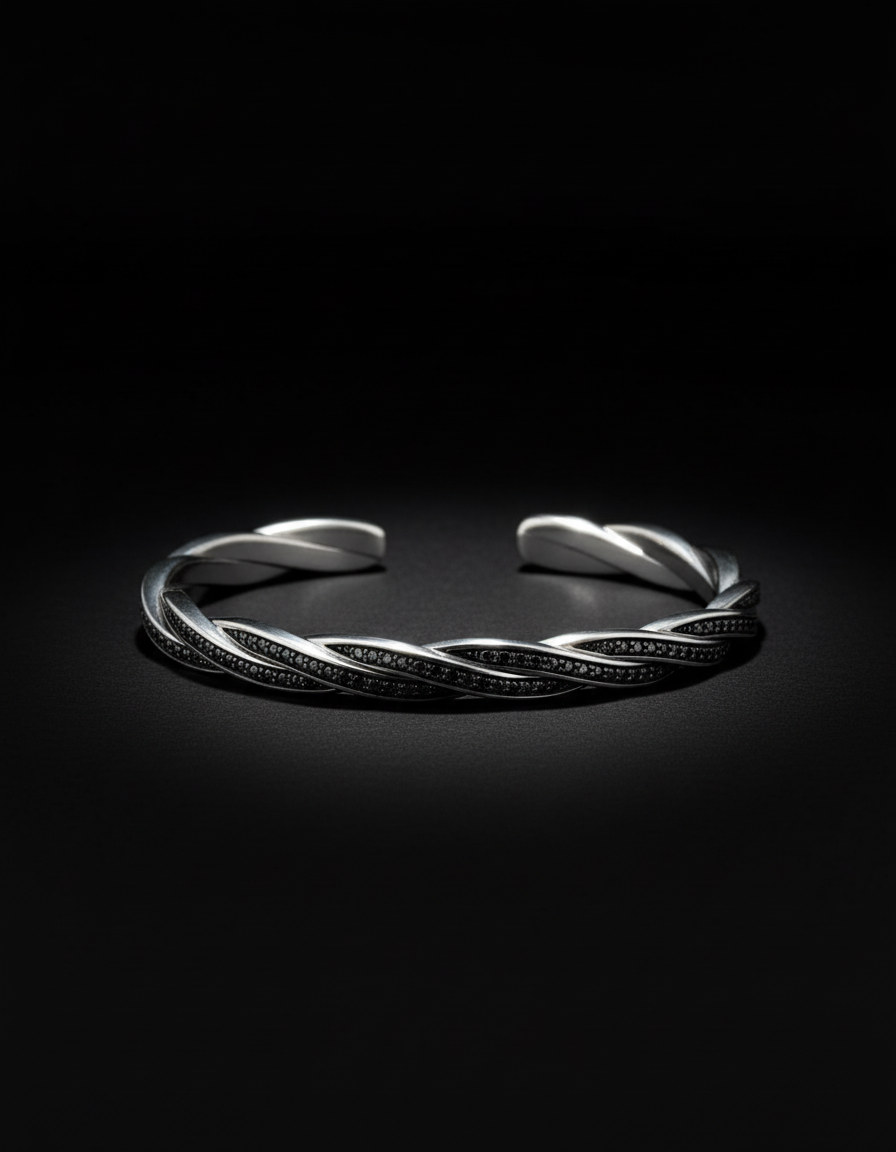
Our kadas, such as the Strength Kada in 925 sterling silver with natural black diamonds, are design pieces, not karas, and are not offered as articles of faith. For a name, a mantra or a motif, the route is a bespoke commission: you share the occasion and the text, the design is refined in sketches and CAD until you sign it off, and only then is it cast and finished by hand at the Bharat Diamond Bourse. Bespoke and engraved commissions are made to order and non-returnable, so the proof stage is where every letter gets checked.
The practical takeaway: keep the words short, cut them deep, put the ones that matter most where they will not wear, and check every letter of the script on a proof before anything is engraved.
