
A kada size chart for men runs from 2.4 to 3.0, and the numbers are inches: 2.8 means 2 and 8/16 inches, an inner diameter of 63.5 mm, while 2.10 is 66.7 mm and 2.12 is 69.9 mm. Most men wear 2.8 to 2.12. The full chart below gives every size in inches, mm and cm, with the hand measurement that fits it.
Most men who order the wrong kada measure their wrist. That works for a bracelet with a clasp, but a closed kada is a solid ring of metal that has to pass over the widest part of the hand first. If it will not clear the knuckles, the wrist measurement is irrelevant. This guide covers both kinds of kada: the closed slip-on style, sized by the hand, and the open or hinged style, sized by the wrist.
How to measure your hand for a closed kada
Measure around the widest part of your hand with the thumb tucked in, then divide by 3.14. The result is the minimum inner diameter your kada needs.
- Relax your hand and bring the tip of your thumb towards the base of your little finger, as if you were about to slip a kada on.
- Wrap a soft tape, or a strip of paper about 1 cm wide, around the widest part of the hand. This is usually across the knuckles at the base of the thumb.
- Keep it snug but not tight. The hand compresses a little as a kada goes on, but do not squeeze.
- Mark or read the length in millimetres. With paper, mark the overlap and measure it on a ruler.
- Divide by 3.14. A hand of 200 mm needs an inner diameter of about 63.7 mm.
- Match the diameter to the chart below. If you fall between two sizes, choose the larger.
Measure twice, once in the morning and once in the evening, and use the larger figure. Hands, like fingers, can be slightly fuller in heat and later in the day.
Kada size chart for men
Indian kada and bangle sizes are written as 2.4, 2.6, 2.8, 2.10, 2.12 and so on. The first number is 2 inches and the second is sixteenths of an inch, so 2.8 means 2 and 8/16 inches of inner diameter. That is why 2.8 is followed by 2.10, not 2.9.
| Kada size | Inner diameter (inches) | Inner diameter (mm) | Inner diameter (cm) | Hand at widest point (cm) |
|---|---|---|---|---|
| 2.4 | 2.25 | 57.2 | 5.7 | about 18.0 |
| 2.6 | 2.375 | 60.3 | 6.0 | about 19.0 |
| 2.8 | 2.5 | 63.5 | 6.4 | about 20.0 |
| 2.10 | 2.625 | 66.7 | 6.7 | about 21.0 |
| 2.12 | 2.75 | 69.9 | 7.0 | about 21.9 |
| 2.14 | 2.875 | 73.0 | 7.3 | about 22.9 |
| 3.0 | 3.0 | 76.2 | 7.6 | about 23.9 |
The millimetre values are exact conversions of the sixteenth-of-an-inch notation (1 inch is 25.4 mm), and the hand column is the inner circumference of each size, which is the largest hand that will pass through with no compression. We checked the notation and the mm values against two published Indian jewellers' bangle charts; they agree to within 1 mm, with the small differences coming from rounding. Jewellers' charts commonly start men's kadas at 2.8; many men land between 2.8 and 2.12, and broad hands need 2.14 or 3.0.
How to check kada size with a kada you already own
If you have a closed kada or bangle that goes on comfortably, measure it instead of your hand. It is quicker and it already accounts for how your knuckles compress.
- Lay the kada flat on a table.
- Measure straight across the inside, from inner edge to inner edge, through the centre, in millimetres.
- Turn it a quarter turn and measure again. Use the average if the two differ.
- Match the result to the chart. A reading of 67 mm is a 2.10.
Measure the inside, not the outside. A kada 8 mm thick is 16 mm wider outside than inside, which is about five sizes on the chart above.
How to size an open, cuff or hinged kada
An open or hinged kada is sized to the wrist, because it never has to pass over the hand. That usually makes it one or two sizes smaller than the closed kada the same man would wear.
- Wrap a paper strip around the wrist, just below the wrist bone where the kada will sit.
- Measure the length in centimetres. This is your wrist size.
- Add a comfort allowance. About 1.5 cm gives a close fit, about 2 cm a regular fit, and about 2.5 cm an easy fit that moves.
- For a hinged kada, compare the total with the inner circumference on the product's size guide.
- For an open cuff, check the stated inner size and the width of the opening. You slide the wrist sideways through the gap at its narrowest point, so the opening should be a little narrower than the side of your wrist; that is what keeps it on.
Do not bend a solid cuff open and closed repeatedly to adjust it. Every bend work-hardens the metal at the same point, and silver and gold cuffs can crack there over time. Adjust once, gently, or ask a jeweller.
Closed vs open kada: which size system applies?
| Kada type | What you measure | Allowance | Typical men's size |
|---|---|---|---|
| Closed, slip-on | Widest part of the hand, thumb tucked | Size up if between | 2.8 to 2.12 |
| Hinged or with a clasp | Wrist below the bone | About 1.5 to 2.5 cm | One to two sizes below closed |
| Open cuff | Wrist, plus the opening | About 1.5 to 2.5 cm | Depends on design |
| Traditional steel or iron kara | Hand, as for a closed kada | Size up if between | 2.8 to 2.12 |
The Sikh kara is almost always a closed ring, so it is sized like any closed kada. For what the kara means and how it differs from a kada worn as jewellery, see what is a kada.
Common kada sizing mistakes
- Measuring the wrist for a closed kada. The wrist is several centimetres smaller than the hand. A kada sized to the wrist will not go on.
- Ignoring thickness. A heavy kada with a flat inside grips more than a thin bangle of the same number. Size up if you are between sizes for a wide piece.
- Measuring the outside of an old kada. Only the inner diameter matters.
- Reading 2.10 as smaller than 2.8. It is larger. The second number is sixteenths of an inch.
- Forcing it on with soap. If it only goes on with soap, it will be hard to remove in an emergency, and a swollen hand in summer can make it painful.
If you are choosing between a kada and a chain or link bracelet, sizing is one of the biggest practical differences; kada vs bracelet compares them, and our men's bracelet size guide covers wrist sizing for link styles in detail.
How AXIOM approaches kada sizing
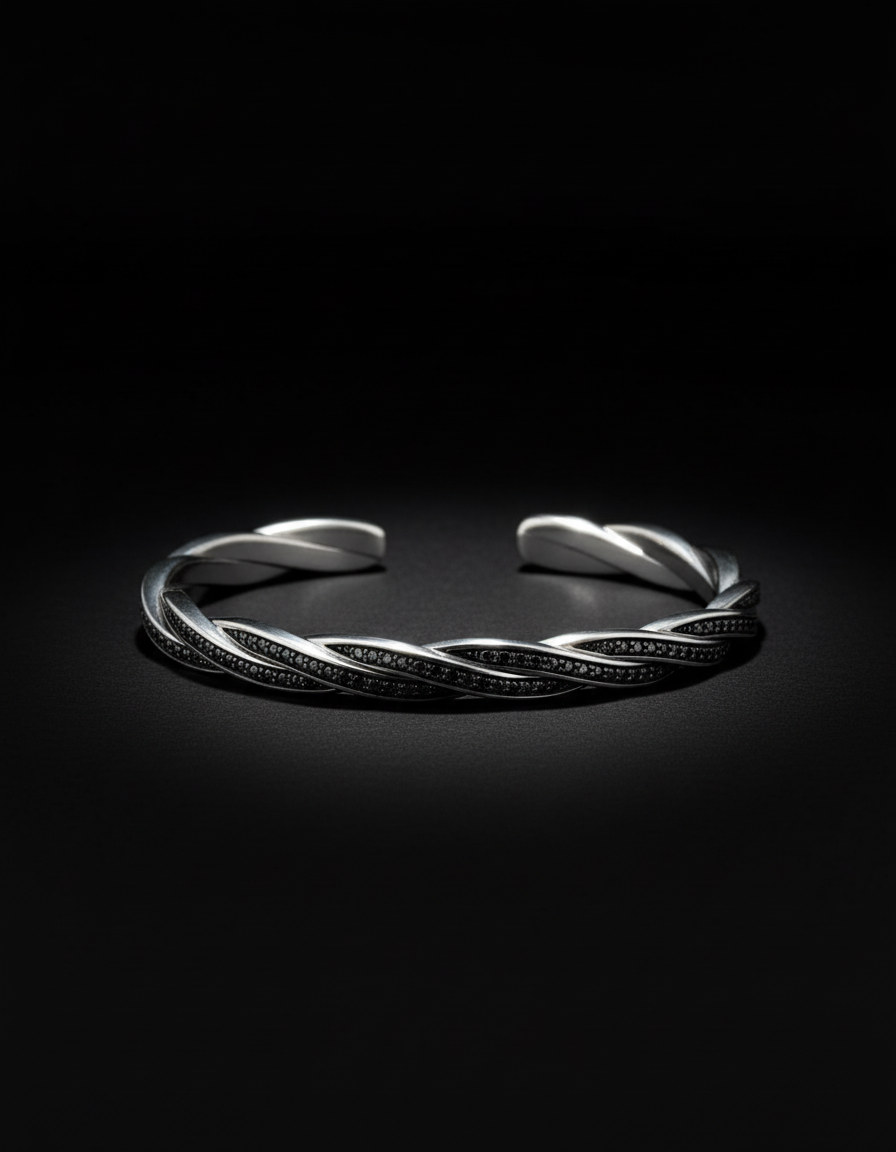
AXIOM's kadas include the Strength Kada, in 925 sterling silver with natural black diamonds, and the Torque Kada, a cable cuff-style piece in the same metal and stones. Each product page has its own size guide, so check the inner measurement stated for that design against the hand or wrist figure you took above, rather than assuming one size number means the same in every style. The full range is under men's bracelets and kadas.
The practical takeaway
For a closed kada, measure the hand with the thumb tucked in and divide by 3.14. For an open or hinged kada, measure the wrist and add 1.5 to 2.5 cm. Write the answer down in millimetres, because "2.10" means nothing to a jeweller abroad, and 66.7 mm means the same thing everywhere.
