
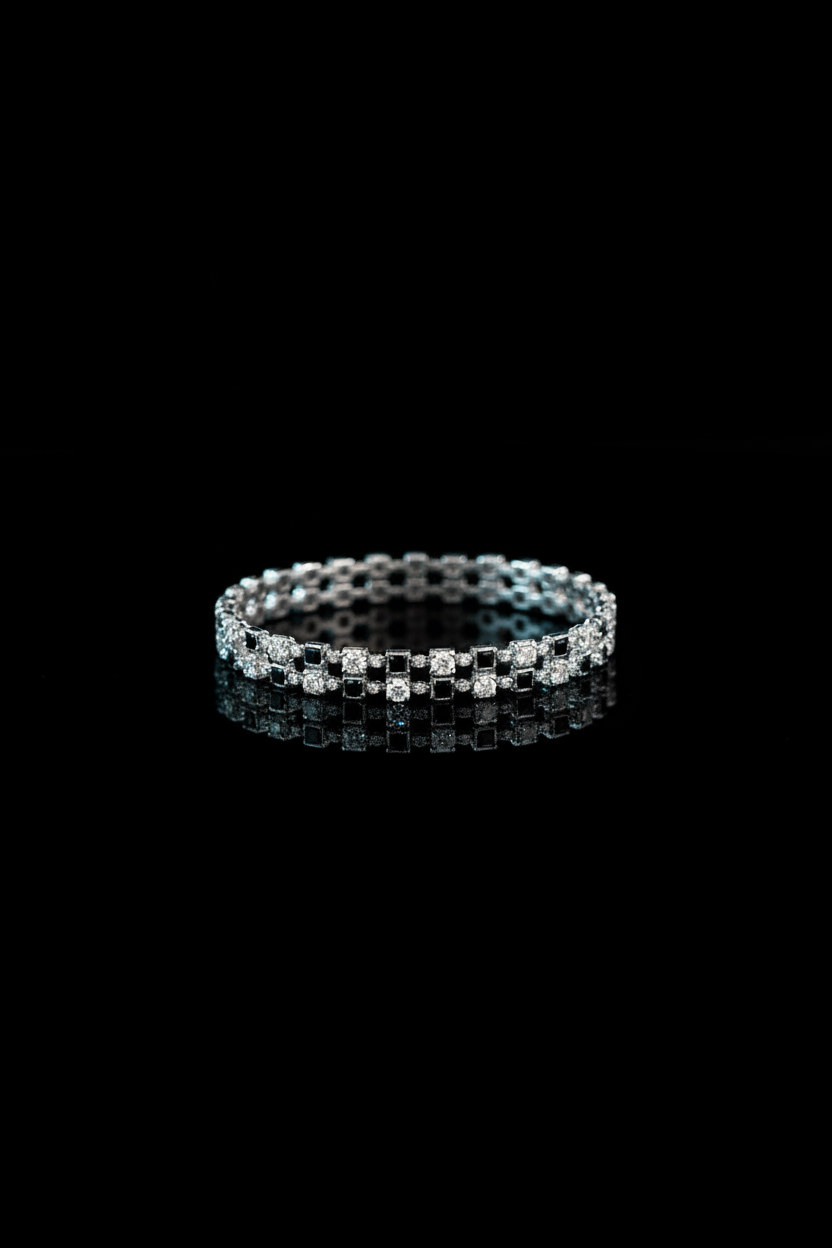
A bracelet that is a centimetre too long slides over the hand and catches on every sleeve. One that is a centimetre too short pinches when it is warm and leaves a mark by evening. For men the margin is smaller than it looks, because men's bracelets tend to have thicker links, heavier clasps and often share the wrist with a watch. The good news: two measurements and one table get it right.
How to measure your wrist for a bracelet
Measure around the wrist just below the wrist bone, where a bracelet actually sits, then add an allowance for fit.
- Cut a strip of paper about 1 cm wide and 25 cm long, or use a soft tailor's tape.
- Wrap it around the wrist just below the round wrist bone on the little-finger side.
- Keep it flat and snug against the skin, without pulling. It should not dent the skin.
- Mark where the paper overlaps, or read the tape.
- Measure the strip against a ruler in centimetres or inches. This is your wrist size, not your bracelet size.
- Repeat once more, and use the larger reading.
- Add the allowance for the fit you want, from the table below.
If you wear a watch, measure the wrist you will wear the bracelet on. A bracelet worn beside a watch usually looks better slightly snug, so it does not slide into the case.
Men's bracelet size chart
Find your wrist size in the first column and read across to the bracelet length for the fit you want. The allowances follow common jewellers' guidance: add about a quarter to half an inch for snug, about half an inch for regular, and up to an inch for loose.
| Wrist (cm) | Wrist (inches) | Snug bracelet | Regular bracelet | Loose bracelet |
|---|---|---|---|---|
| 15.2 | 6.0 | 15.9 cm / 6.25 in | 16.5 cm / 6.5 in | 17.8 cm / 7.0 in |
| 15.9 | 6.25 | 16.5 cm / 6.5 in | 17.1 cm / 6.75 in | 18.4 cm / 7.25 in |
| 16.5 | 6.5 | 17.1 cm / 6.75 in | 17.8 cm / 7.0 in | 19.1 cm / 7.5 in |
| 17.1 | 6.75 | 17.8 cm / 7.0 in | 18.4 cm / 7.25 in | 19.7 cm / 7.75 in |
| 17.8 | 7.0 | 18.4 cm / 7.25 in | 19.1 cm / 7.5 in | 20.3 cm / 8.0 in |
| 18.4 | 7.25 | 19.1 cm / 7.5 in | 19.7 cm / 7.75 in | 21.0 cm / 8.25 in |
| 19.1 | 7.5 | 19.7 cm / 7.75 in | 20.3 cm / 8.0 in | 21.6 cm / 8.5 in |
| 19.7 | 7.75 | 20.3 cm / 8.0 in | 21.0 cm / 8.25 in | 22.2 cm / 8.75 in |
| 20.3 | 8.0 | 21.0 cm / 8.25 in | 21.6 cm / 8.5 in | 22.9 cm / 9.0 in |
To convert yourself: 1 inch is 2.54 cm. If your wrist falls between two rows, use the larger row.
Why chunky links need extra length
A bracelet's length is measured laid flat, end to end. Once it is closed into a loop, the inside of the loop is shorter than that length by about pi times the thickness of the links. For every 1 mm of thickness, the inside loses a little over 3 mm.
| Link thickness | Inside of the loop is shorter by about | What to do |
|---|---|---|
| 3 mm | 0.9 cm | Use the chart as it is |
| 5 mm | 1.6 cm | Add about 0.5 to 1 cm to the chart length |
| 8 mm | 2.5 cm | Add about 1.5 cm to the chart length |
| 10 mm or more | 3.1 cm or more | Add about 2 cm and check the maker's inner measurement |
This is why a heavy curb or link bracelet in your usual length can feel a size small. The chart allowances already absorb a thin chain of about 3 mm; the additions above make up the difference for thicker links, so the inside of the loop ends up with about the same room.
Chain bracelet, cuff or kada: which fit rules apply?
Different bracelet types are sized in different ways, because some hang and some hold their shape.
| Bracelet type | Sized to | Allowance | Notes |
|---|---|---|---|
| Chain or link with a clasp | Wrist | About 1.3 cm (half an inch) regular | Add for thick links |
| Rigid bracelet with a hinge or box clasp | Wrist | About 1.5 to 2 cm | Cannot flex, so avoid snug |
| Open cuff | Wrist, plus the opening | About 1.5 to 2 cm | The gap goes on at the narrow side of the wrist |
| Closed kada or bangle | Widest part of the hand | Size up if between | Must pass over the knuckles |
| Beaded on elastic | Wrist | About 1 cm | Stretches; too tight shortens its life |
A closed kada is sized by the hand, not the wrist, and uses the 2.8, 2.10, 2.12 notation. That has its own page: the kada size guide.
How loose should a men's bracelet be?
For most men a regular fit is right: one finger slides between the bracelet and the wrist, and the bracelet moves a little without dropping over the hand.
- Snug suits bracelets worn next to a watch, and slim chains that could snag.
- Regular suits everyday link bracelets, and is the safest choice for a gift.
- Loose suits heavy chains worn alone, where a little drop towards the hand is the look.
Wearing it with a watch? See how to wear a bracelet with a watch for which wrist and how much space to leave. If you are still choosing the style itself, types of bracelets for men compares chains, cuffs, beads and kadas.
Common bracelet sizing mistakes
- Measuring over the wrist bone. Measure just below it, where the bracelet sits. Over the bone reads large.
- Pulling the tape tight. A tight tape reads small and the bracelet will pinch in heat.
- Using a bracelet length as a wrist size. A bracelet you own already includes an allowance. If you measure one, measure its length end to end and compare lengths, not wrist sizes.
- Forgetting link thickness. A 10 mm curb needs more length than a 3 mm chain for the same fit.
- Guessing between sizes. Go up. A jeweller can usually remove a link or two from a link bracelet; adding length is harder.
How AXIOM approaches bracelet sizing
Every AXIOM product page carries its own Size Guide, with measurements in inches and centimetres, so match your wrist plus allowance to the figure listed for that specific design rather than to a generic size; our FAQ explains the same approach for rings. Link and cuff designs such as the Apex Link Bracelet, in 925 sterling silver with natural black diamonds, sit differently on the wrist, which is why the guide is per product. The full range is under men's bracelets and kadas.
The practical takeaway
Measure your wrist below the bone, add about 1.3 cm for a regular fit, and add a little more for thick links or a rigid bracelet. Write the final figure in centimetres and inches, and compare it with the product's own size guide before you order. For rings, the same measure-in-millimetres rule applies in our Indian ring size chart.
