
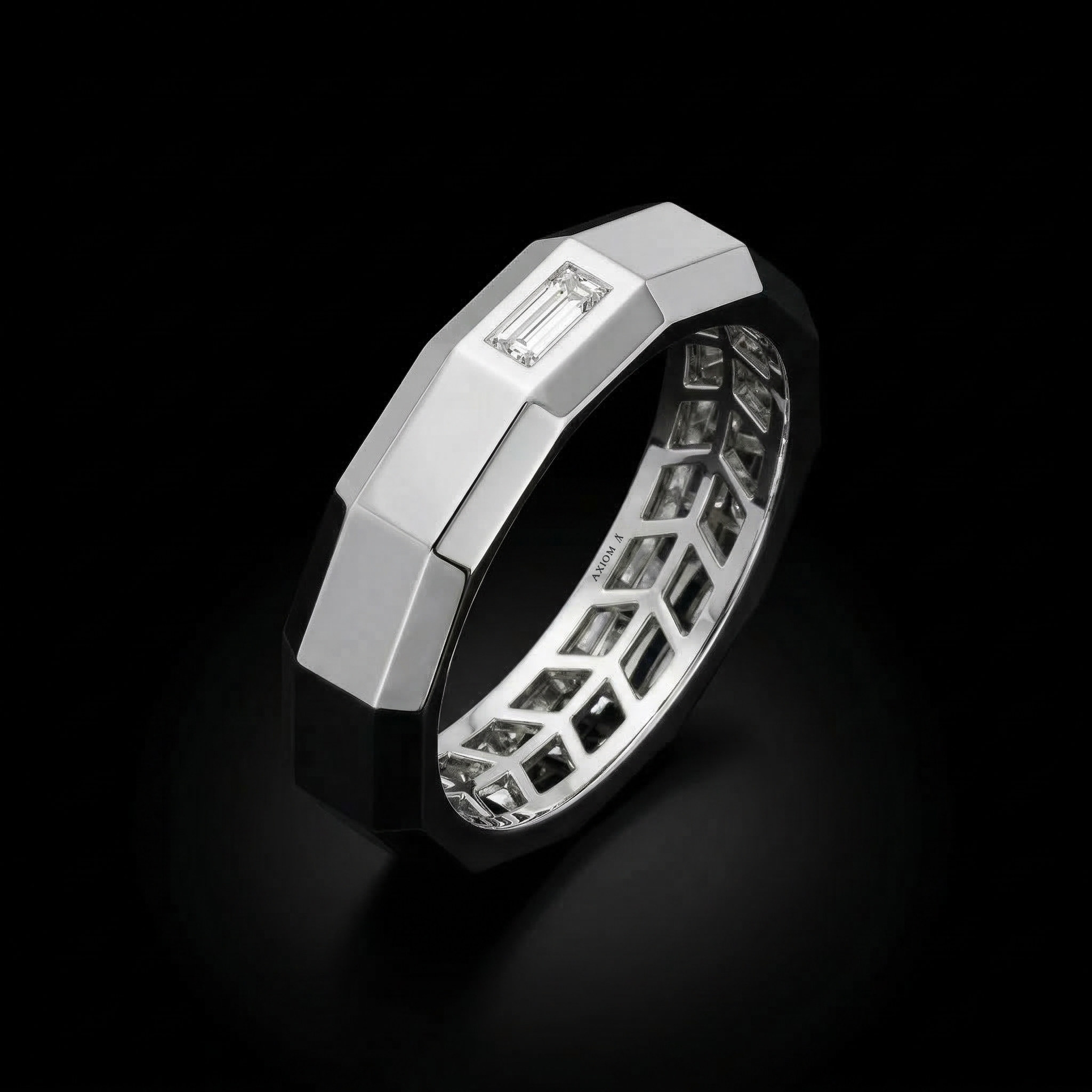
Rings stop fitting for ordinary reasons: a gift bought on a guess, weight gained or lost, fingers that thicken with age, a wedding band sized in winter that pinches in the Indian summer. Resizing is one of the most common jobs at any jeweller's bench, and for most rings it is straightforward. The exceptions are specific and predictable, and knowing them before you buy saves a lot of trouble.
How is a ring resized?
A ring is resized by cutting the band at the back, removing or adding a small piece of matching metal, then soldering, reshaping and polishing it so the seam disappears. A plain band can also be stretched slightly on a mandrel. Stones are protected, or removed and reset, during the work.
The three methods, in order of how often they are used:
- Cut and remove metal (smaller). The jeweller cuts out a small section at the back of the shank, closes the gap, solders it and rounds the ring on a mandrel.
- Cut and add metal (bigger). The band is cut, a small piece of the same metal is soldered in, and the ring is shaped and polished.
- Stretch (bigger, plain bands only). A plain band is worked outward on a stretching mandrel. Jewelers Mutual's resizing guide puts the practical limit at about half a size, because stretching thins the band.
After any of these, the ring should be polished, checked for roundness, and any stones checked for security.
How many sizes can a ring be resized?
As general guidance, about two sizes up or down is the practical limit for most gold and silver rings. Beyond that, the band can distort out of round, the setting can be strained, and the proportions of the design start to change. A jeweller should examine the ring before promising a bigger change.
The limit depends on the ring more than the metal:
- Plain bands handle the largest changes, because there is nothing to protect but the metal.
- Rings with a single stone or a few stones at the top resize well, since the work happens at the back of the shank.
- Rings with stones down the sides can be resized less, because the seam must stay clear of the settings.
- Full eternity bands can barely be resized at all.
Sizes are not universal. India, the US and the UK use different scales, so always compare fit using inside diameter in millimetres. Our Indian ring size chart converts between the systems.
Which rings can and cannot be resized?
Most precious-metal rings can be resized; rings made of very hard metals, rings with stones all the way round and plated rings are the usual exceptions.
| Ring type | Can it be resized? | Notes |
|---|---|---|
| Plain silver band | Yes | Easy up or down; a heavier band resizes more cleanly |
| Plain gold band | Yes | Easiest of all; seams colour-match well |
| Solitaire or top-set diamond ring | Yes, usually | Work happens at the back, away from the stone |
| Pavé or channel-set band (part way round) | Limited | Small changes only; the seam must avoid the stones |
| Full eternity band | Rarely, very little | Stones all the way round leave nowhere to cut; often remade |
| Engraved band | Yes, with care | Engraving on the inside may be interrupted at the seam |
| Tungsten carbide | No | Too hard and brittle to cut and solder |
| Titanium, cobalt, stainless steel | Generally no | Hard metals that most jewellers cannot resize |
| Plated rings | Not worth it | The seam exposes base metal and the whole ring needs re-plating |
| Ceramic rings | No | Brittle; cannot be cut, soldered or stretched |
Why eternity bands are hard to resize
A full eternity band has stones set all the way round, so there is no plain section of metal where the jeweller can cut, add or remove material. Changing the size means changing the spacing of the stones, removing a stone, or adding one, and each option risks loosening the others.
In practice the choices are: a very small adjustment if the jeweller judges it safe, sizing beads or a spring insert to make a slightly large ring fit, or remaking the band in the correct size. That is why eternity bands deserve the most care over sizing before you order. If you are considering one, our guide to the eternity ring for men covers the trade-offs.
Alternatives to resizing
When a ring cannot be resized, or only needs a small correction, a jeweller has other tools:
- Sizing beads: two small metal balls soldered inside the band, for about half a size smaller.
- Spring insert: a flexible metal strip inside the band, which many people find more comfortable than beads and which allows larger reductions.
- Sizing bar: a hinged U-shaped bar fitted inside the band, for large adjustments.
- Remake: for eternity bands and hard metals, a new ring in the right size.
Avoid tape, glue and home-made fixes, which trap moisture and grime against the finger and the metal.
Silver vs gold: does the metal change resizing?
Both silver and gold resize well. Gold is the easiest: it solders cleanly, and a well-matched seam is invisible. Sterling silver resizes just as reliably in skilled hands, with two differences worth knowing.
First, silver conducts heat very quickly, so the whole ring heats up during soldering. That makes work close to stones slower and more careful. Second, silver shows a poorly finished seam more readily, so the final polish matters. Neither is a reason to avoid silver; both are reasons to have silver rings resized by someone who works in silver regularly.
White gold adds one step at many jewellers: if the ring was rhodium-plated, the plating is renewed after resizing so the seam matches.
Is resizing bad for a ring?
A single, well-done resize is not bad for a ring. The seam is soldered with matching metal and, once polished, is as strong as the rest of the band. Problems come from large jumps, stretching a band too far, repeated resizing of the same ring, and work too close to stones.
To keep resizing to a minimum:
- Measure at the end of the day, when fingers are largest, and not straight after a cold shower.
- Measure more than once, on different days.
- Remember that wide bands fit more snugly than narrow ones at the same size.
- If you are between sizes, size up slightly and let a jeweller add beads if needed.
Our guide on how to find your ring size at home walks through each method.
How AXIOM approaches this
Every AXIOM piece carries a lifetime craftsmanship guarantee that includes free servicing, resizing and refinishing, described on our about page. Because full eternity designs are the hardest rings to resize in any workshop, it is worth confirming your size carefully before ordering one of our men's rings and bands; if you are unsure, contact us before you order and a real person will reply, usually the same day.
The practical takeaway
If your ring is gold or silver and not set all the way round, it can almost certainly be resized by a size or two. If it is tungsten, titanium, steel or a full eternity band, plan on getting the size right the first time. Either way, measure carefully, measure twice, and give the job to a jeweller who works with that metal every day. For how to keep a ring in good shape between visits, see our men's jewellery care guide.
