
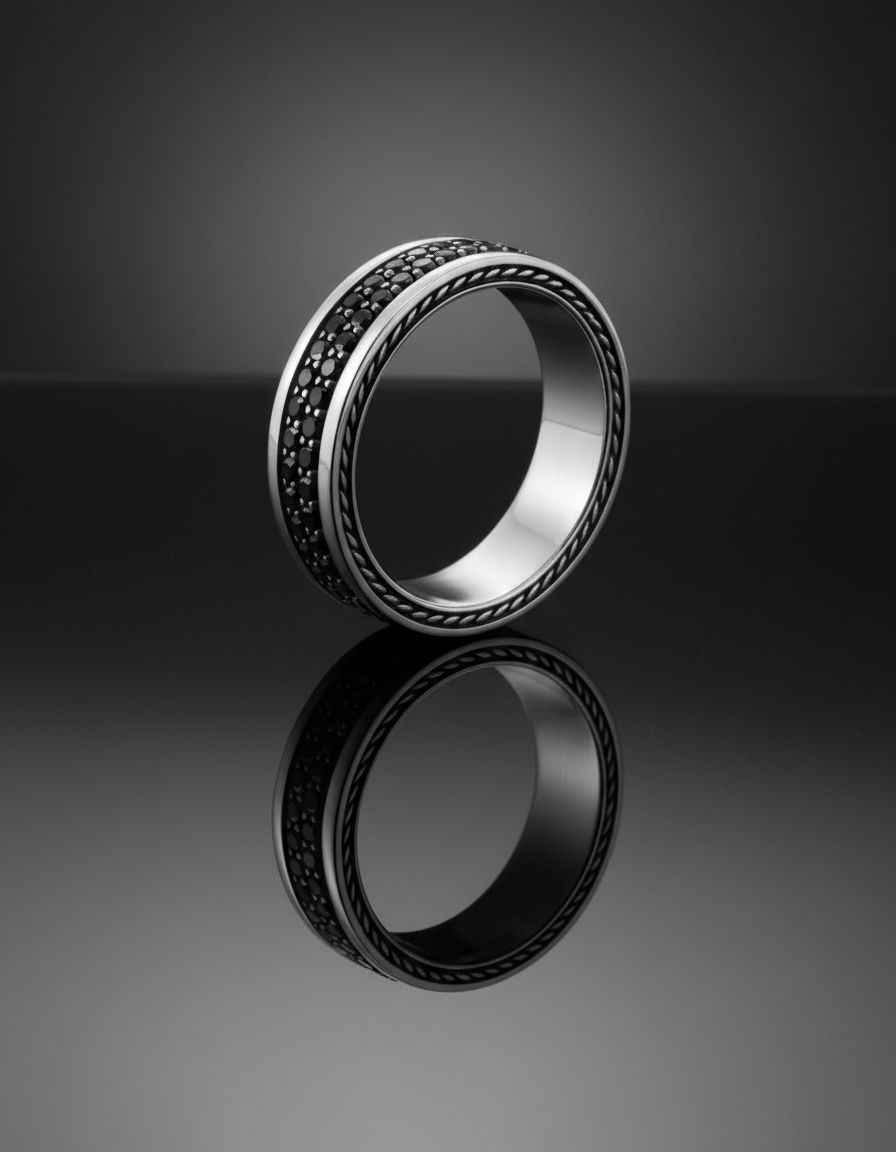
A ring that fits in the shop can pinch by evening, and a ring ordered online in the wrong size costs you a round trip to the jeweller. Men get this wrong more often than women for two simple reasons: broader knuckles, and wider, heavier bands. The four methods below show how to do it with things you already have at home, and each one ends in a number in millimetres, which is the only measurement every ring size chart in India agrees on.
Which method should you use?
Use a ring you already own if one fits the right finger well; it is the most reliable home method. Use a paper strip if you have no ring. Thread and printable sizers work, but each has one trap you need to avoid.
| Method | What you measure | Accuracy at home | Main trap |
|---|---|---|---|
| Existing ring | Inside diameter in mm | High | Using a ring from a different finger |
| Paper strip | Inner circumference in mm | Good | Wrapping too tight or too loose |
| Thread or string | Inner circumference in mm | Fair | Thread stretches and reads small |
| Printable sizer | Diameter or circumference | Good, if printed to scale | Printer shrinks the page |
Method 1: How to measure a ring you already own
Measure the inside diameter of a ring that already fits the finger you want to size. This is the method AXIOM's own sizing FAQ recommends, because a ring you wear comfortably has already passed the knuckle test.
- Pick a plain ring from the same finger on the same hand. A band without stones is easiest.
- Lay it flat on a steel ruler marked in millimetres.
- Measure straight across the inside, from inside edge to inside edge, through the centre. Do not include the metal.
- Turn the ring a quarter turn and measure again. Rings are rarely perfectly round after years of wear; use the average of the two readings.
- Match the diameter to the chart below, or to the Size Guide on the product page you are buying from.
If the ring you are measuring is thin and the new one is a wide band, allow for that (see the mistakes section below).
Method 2: How to measure ring size with a paper strip
Wrap a narrow strip of paper around the base of your finger, mark the overlap and measure the length. That length is your finger's circumference in millimetres.
- Cut a strip about 5 mm wide and 10 cm long from ordinary printer paper.
- Wrap it around the base of the finger, where the ring will sit. It should be snug but not denting the skin.
- Slide the loop towards your knuckle without letting it open. If it will not pass the knuckle, loosen it slightly; the ring has to get over the knuckle too.
- Mark the point where the paper overlaps with a sharp pencil.
- Unroll the strip and measure from the end to the mark in millimetres.
- Repeat twice more, ideally at different times of day, and use the largest reading that still felt snug.
To convert quickly: most Indian charts put size 1 at about 41 mm and add roughly 1 mm of circumference per size. So subtract 40 from your reading for an approximate Indian size. A reading of 60 mm is about size 20.
Method 3: How to measure ring size with thread or string
Thread works the same way as paper, but it stretches, so it tends to read small. Treat it as a backup.
- Use unwaxed cotton sewing thread rather than stretchy string or dental floss.
- Wrap it once around the base of the finger, snug, with no twists.
- Pinch the crossing point firmly and mark it with a pen.
- Lay the thread straight along a ruler, without pulling, and measure to the mark in millimetres.
- Add nothing for comfort, but if your two paper and thread readings differ, trust the paper.
A difference of 1 mm in circumference is roughly one Indian size, so a thread pulled a little too tight is enough to order the wrong ring.
Method 4: How to use a printable ring sizer correctly
A printable sizer is accurate only if it prints at exactly 100 percent scale. Many printers shrink pages to fit the margins, which makes every circle on the page too small.
- Download the sizer and print it with scaling set to "actual size" or 100 percent, never "fit to page".
- Check the calibration line on the sheet with a ruler before you use it. If the sheet has no calibration line, lay a standard bank card on the page: an ID-1 card is 85.6 mm wide under ISO/IEC 7810, so any printed card outline should match it exactly.
- Place a ring that fits over the printed circles and choose the circle whose outer line sits just inside the ring's inner edge. Or cut out the strip version and use it as in Method 2.
- If the scale check fails, do not use the sheet. Measure with paper instead.
Indian ring sizes for men in millimetres
Indian jewellers' charts generally put men's sizes between about 17 and 25. Use the diameter column with Method 1 and the circumference column with Methods 2 to 4. The complete chart from size 1 to 30, with US and UK equivalents and how it was checked, is in our Indian ring size chart.
| Indian size | Inner diameter (mm) | Inner circumference (mm) |
|---|---|---|
| 16 | 17.8 | 56 |
| 17 | 18.1 | 57 |
| 18 | 18.5 | 58 |
| 19 | 18.8 | 59 |
| 20 | 19.1 | 60 |
| 21 | 19.4 | 61 |
| 22 | 19.7 | 62 |
| 23 | 20.1 | 63 |
| 24 | 20.4 | 64 |
| 25 | 20.7 | 65 |
| 26 | 21.0 | 66 |
Indian size charts are not fixed by a national standard, and published charts from different jewellers can disagree by up to one size, especially above size 20. Always give or check the millimetre figure, not just the number.
Common ring sizing mistakes men make
Most sizing errors come from measuring at the wrong moment or ignoring the knuckle. These are the ones that matter.
- Measuring cold fingers. Fingers shrink in the cold and in air conditioning. Measure at room temperature, not straight after a cold shower.
- Measuring first thing in the morning. Fingers are usually a little larger later in the day and in heat. Measure at least three times across a day and lean towards the larger reading.
- Ignoring the knuckle. Many men have knuckles noticeably wider than the base of the finger. The ring must pass the knuckle, so the right size is the smallest one that slides over it with slight resistance.
- Forgetting band width. A band 6 mm or wider feels tighter than a 2 mm band of the same size. Many jewellers suggest going up about half a size for wide bands; ask the maker, because a comfort-fit (domed) inside changes this.
- Measuring the wrong hand. Your left and right ring fingers are often different sizes. Measure the exact finger the ring will live on.
- Pulling the paper tight. Snug means the strip touches all round without pressing. If it leaves a mark on the skin, it is too tight.
If you are buying a wedding band, the fit matters more because you will wear it every day; our men's wedding band guide covers widths and profiles.
What to do if you are still unsure
If two methods give different answers, go with the larger size and check with the jeweller before the ring is made. Most plain metal bands can be adjusted by a size or so later, though eternity bands set with stones all the way round are much harder to resize; see can a ring be resized for what is and is not possible.
How AXIOM approaches ring sizing
AXIOM's ring pages list sizes as S, M and L, each with its own inner diameter in millimetres for that design, so the number to compare is the diameter you measured with Method 1. The steps in our sizing FAQ are the same: find a ring that fits, measure the inside diameter flat in millimetres, match it to the Size Guide on the product page, and size up or ask on WhatsApp if you fall between. Every piece carries a lifetime craftsmanship guarantee that includes free resizing, and if you would rather check a measurement with a person first, you can message the studio before ordering from the men's rings and bands.
The practical takeaway
Measure in millimetres, measure three times, and measure the finger the ring will actually sit on. A ring you already own beats a paper strip, a paper strip beats thread, and a millimetre figure beats any size number on its own. Sizing a bracelet next? The same logic applies in our men's bracelet size guide.
