
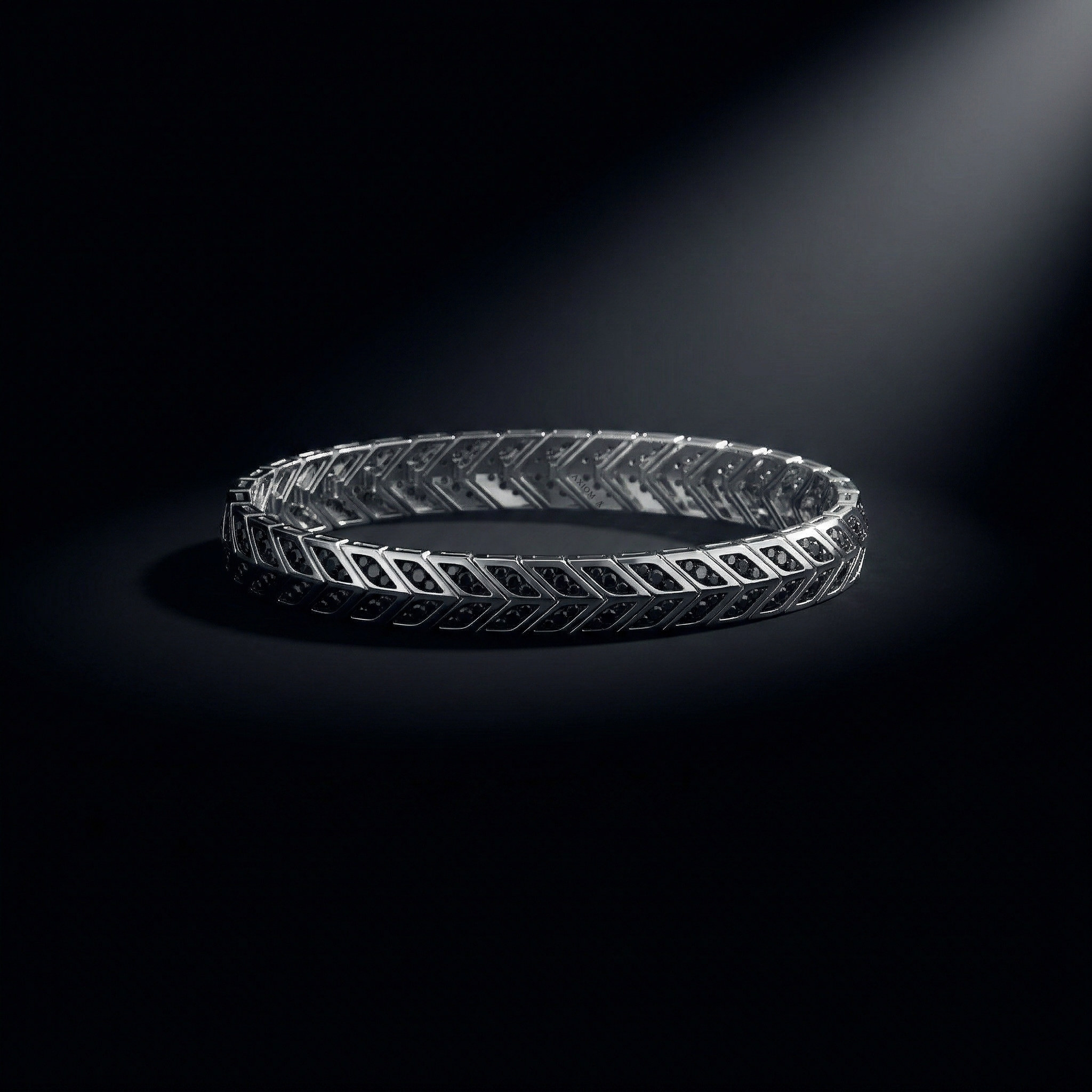
Most men only ever buy one or two bracelets, so the type matters more than the brand. The wrong type ends up in a drawer: a line bracelet that catches on every cuff, a kada that will not pass the knuckles, a leather band that smells after a monsoon. This guide lays out every common type, how it is built and sized, and which one fits which part of your life, with the Indian styles that most international guides leave out.
What are the main types of bracelets for men?
There are nine main types, falling into three families: flexible metal bracelets, rigid metal bracelets, and soft bracelets.
| Type | Look | Formality | How it is sized | Typical metals and materials |
|---|---|---|---|---|
| Chain or link | Flexible links in a repeating pattern | Casual to smart | Wrist length plus allowance | Silver, gold, steel |
| ID bracelet | Chain with a flat plate on top | Casual to smart | Wrist length plus allowance | Silver, gold, steel |
| Diamond line (tennis) | Continuous row of set stones | Smart to formal | Wrist length plus allowance | Gold, platinum, silver |
| Cuff | Rigid band with an opening | Smart, statement | Wrist size | Silver, gold, steel, brass |
| Kada | Rigid closed ring, usually thick | Casual to festive | Inner diameter over the knuckles | Steel, iron, silver, gold |
| Bangle | Rigid closed ring, usually slimmer | Casual | Inner diameter over the knuckles | Silver, gold, steel |
| Beaded | Beads on elastic or cord | Casual | Wrist size, often stretch | Stone, wood, rudraksha |
| Leather | Strap, braid or wrap | Casual | Wrist length, often adjustable | Leather with metal clasp |
| Cord or thread | Woven cord or thread | Casual, ceremonial | Tied or adjustable | Cotton, silk, nylon |
Chain and link bracelets
A chain or link bracelet is the most versatile type a man can own. It moves with the wrist, sits comfortably next to a watch, and comes in patterns from fine to heavy.
The common patterns:
- Curb: flat, twisted, interlocking links that lie flat. The classic men's pattern; heavier versions are often called Cuban.
- Figaro: curb-style links in a pattern of short and long links.
- Box: square links, crisp and geometric.
- Rope: twisted strands that catch the light; formal-looking.
- Cable: simple oval links; light and understated.
- Mariner or anchor: oval links with a bar across each.
A solid link in 925 sterling silver or gold is the durable choice. Hollow links look bold for less money but dent and are hard to repair. In silver, look for a 925 stamp; plated or "German silver" chains contain little or no silver.
ID and bar bracelets
An ID bracelet is a chain with a flat plate on top, originally made for engraving a name. Today the plate is often plain, engraved with initials or a date, or set with a line of small stones.
It is a good gift type, because engraving makes it personal without adding bulk. It reads as smart-casual and sits well under a shirt cuff if the plate is narrow.
Diamond line (tennis) bracelets
A line bracelet is a single continuous row of individually set stones. It is the most formal bracelet a man can wear, and it suits weddings, receptions and evenings more than office days.
Two things matter: the setting and the clasp. Every stone is a potential loose stone, so the settings need checking yearly, and a box clasp with a safety catch is worth insisting on. Black diamonds give the same structure a darker, more understated look. Our men's diamond bracelet guide covers settings, stone choices and price.
Cuffs, kadas and bangles
Rigid bracelets fall into three types, and the difference is construction.
- Cuff: a rigid band with a gap at the back. It slips on sideways over the narrow part of the wrist, so it is sized to the wrist, not the hand.
- Kada: a thick, closed ring, usually worn singly. It has to pass over the knuckles, so it is sized by inner diameter. It has deep roots in India, and for Sikhs the steel kara is one of the Five Ks, an article of faith rather than an ornament (BBC).
- Bangle: a closed ring like a kada, usually slimmer; in India, bangles are more often worn in sets by women, while men tend to wear a single kada.
Rigid bracelets are the most durable type, because there are no links or clasp to fail. They also have the strongest presence on the wrist. For the difference in detail, see kada vs bracelet.
Beaded, leather and cord bracelets
Soft bracelets are casual and inexpensive, and they wear out. They are worth knowing about as context rather than as long-term pieces.
- Beaded: stone, wood or seed beads on elastic or cord. In India this includes the rudraksha bracelet, which carries spiritual meaning for many Hindus.
- Leather: a strap, braid or wrap with a metal clasp. Sweat and water shorten its life, which matters in humid Indian summers.
- Cord and thread: woven bracelets and ceremonial threads, including the rakhi tied at Raksha Bandhan and sacred threads tied at pujas, each with its own meaning.
A leather or bead bracelet can be stacked with a metal chain for contrast, but it will not last like metal.
What type of bracelet is good for a man?
The right type depends on where you will wear it most. Use this as a quick decision guide:
| Where you will wear it most | Best type | Why |
|---|---|---|
| Office, with a watch | Slim chain, ID or thin cuff on the other wrist | Fits under a shirt cuff; does not compete with the watch |
| Everyday, never taken off | Solid kada or steel chain | No clasp to fail; survives water and sweat |
| Gym and sport | Steel kada or nothing | Precious-metal bracelets dent and stones loosen under impact |
| Weddings and festivals | Diamond line bracelet, stone-set cuff or kada | Holds its own with a sherwani or kurta |
| Weekend, casual | Heavier chain, beaded or leather | Room for texture and stacking |
| A gift for a man who does not wear jewellery | Plain silver chain or slim ID bracelet | Easiest first piece to wear |
If you are buying one bracelet to do most of these jobs, choose a medium-weight solid chain or link bracelet in sterling silver or gold. If you prefer a rigid piece, a kada does the same job with more presence.
Which metal should a men's bracelet be?
The metal decides how a bracelet ages, what it costs and whether it can be repaired. For anything you want to keep, choose a solid precious metal over plated base metal.
| Metal | Wear and upkeep | How it is priced | Good for |
|---|---|---|---|
| Stainless steel | Very hard, no tarnish, almost no upkeep | Mostly labour and brand | Gym, water, low budgets |
| 925 sterling silver | Scratches with wear, tarnishes slowly, polishes back | Silver weight plus making | Everyday bracelets with real metal value |
| 18K gold (75% gold) | Hard-wearing for gold, holds detail and settings | Gold weight plus making | Daily-wear gold, diamond settings |
| 22K gold (91.6% gold) | Soft, rich colour, dents more easily | Gold weight plus making | Traditional pieces, occasional wear |
| Gold-plated or "German silver" | Plating wears through; no precious-metal value | Low; mostly labour | Short-term fashion only |
Match the metal to your watch and other jewellery if you wear them together. White metals (silver, white gold, steel) mix easily with each other; yellow gold looks deliberate on its own or with a gold watch.
How should a men's bracelet fit?
Flexible bracelets are sized by length, rigid ones by diameter or wrist size. Getting this right matters more than the design.
- Chain, ID and line bracelets: measure your wrist just below the wrist bone with a soft tape. For a comfortable fit, choose a bracelet roughly 1.5 to 2.5 cm longer than your wrist; for a closer fit, less.
- Cuffs: match the inside circumference to your wrist; the gap lets you adjust slightly.
- Kadas and bangles: measure around the widest part of your hand with the thumb tucked in, then divide by 3.14 to get the inner diameter you need.
Our men's bracelet size guide gives full charts for each type.
How to wear a bracelet with a watch
Wear the bracelet on the other wrist if you can. If you want both together, put the bracelet above the watch, choose a slim and flexible style, and match the metals roughly. Diamonds and hard metals will scratch a watch case, so a diamond bracelet belongs on the free wrist. For more detail, see how to wear a bracelet with a watch.
How AXIOM approaches this
AXIOM's bracelets and kadas are made in 925 sterling silver rather than plated base metal, and each is set with diamonds described exactly on its page. The Apex Link Bracelet is a link bracelet set with natural black diamonds, and the Line Bracelet combines natural black diamonds with lab-grown white diamonds. Cuffs and kadas sit alongside them in our bracelets and kada range.
The practical takeaway
Choose the type before the design. If you want one bracelet for most of life, a solid link bracelet or a kada in a precious metal will outlast any trend. Size it properly, keep it off the watch wrist, and add a second piece only once the first feels like part of you.
