
In India the words kada, bracelet, bangle and kangan are often used loosely, which makes shopping confusing. A "bracelet" on one site is a kada on another, and a cuff is sometimes sold as both. The difference matters, because the two are sized in completely different ways and wear very differently. This guide sets out the definitions, then helps you decide which suits you.
What is the difference between a kada and a bracelet?
A kada is rigid; a bracelet is flexible. That single difference drives everything else: how you put it on, how it is sized, how it sits on the wrist and what can go wrong with it.
| Kada | Bracelet | Bangle | Cuff | |
|---|---|---|---|---|
| Construction | Rigid, usually thick, closed ring | Flexible links or chain | Rigid closed ring, usually slimmer | Rigid band with a gap |
| How it goes on | Slides over the hand | Wraps the wrist, clasp closes | Slides over the hand | Slips on sideways at the wrist |
| How it is sized | Inner diameter, to pass the knuckles | Length, wrist plus allowance | Inner diameter | Wrist size |
| How it sits | Moves up and down the forearm | Drapes and moves with the wrist | Moves freely, often worn in sets | Stays fairly still |
| What can fail | Very little | Clasp, links | Very little | Can bend if prised open often |
| Typical occasions | Everyday, festive, faith | Office, everyday, evening | Everyday, festive | Smart, statement |
So a kada is a type of bangle, and a cuff is a rigid bracelet with an opening. What most people call a "bracelet" in the kada vs bracelet question is the flexible chain or link kind.
Kada vs bangle vs kangan: are they different?
They overlap, and usage varies by region. In everyday Indian usage:
- Kada usually means a heavier, thicker rigid band worn singly, often by men. For Sikhs, the steel kara is an article of faith.
- Bangle (chudi in Hindi) usually means a thinner rigid ring, often worn in sets, mostly by women.
- Kangan is a Hindi word for a wrist ornament; Platts' dictionary defines it as a gold or silver ornament for the wrist, worn by women, and traces it to the Sanskrit kankana. Today it usually suggests a decorative bangle.
None of these words has a strict technical boundary. When buying, ignore the label and check the construction and the size.
Is a kada always religious?
No. The kada has two lives. For Sikhs, the plain steel or iron kara is one of the Five Ks, worn at all times as a reminder of restraint and of the Guru. For many other men across north India, a kada is regional dress, a family gift or simply jewellery, in steel, silver or gold.
The two can look similar, but they are not the same thing. A decorative silver or gold kada is not a kara and does not replace one. For the full context, including the meaning of the word and which wrist is traditional, read what a kada is and what it means.
How is each one sized?
A kada is sized to your hand; a bracelet is sized to your wrist. Mixing these up is the most common reason a kada or bracelet goes back.
Kada (closed). It has to pass over the knuckles. Tuck your thumb across your palm, measure around the widest part of the hand, and divide by 3.14 for the inner diameter you need. Indian sizes are written as 2.6, 2.8, 2.10 and so on, meaning 2 inches plus that many sixteenths: a 2.6 has an inner diameter of 60.3 mm, a 2.8 of 63.5 mm and a 2.10 of 66.7 mm. See our kada size guide.
Bracelet (flexible). Measure the wrist just below the wrist bone and add roughly 1.5 to 2.5 cm for a comfortable fit. See the men's bracelet size guide.
Cuff. Sized to the wrist; the opening lets it adjust a little.
Kada or bracelet: which is better for you?
Neither is better in general. Choose by how you live and what you wear.
| If you... | Choose | Why |
|---|---|---|
| Wear a watch daily | Slim bracelet, or kada on the other wrist | A thick kada knocks against a watch on the same wrist |
| Want something that never comes off | Kada | No clasp to open or break |
| Have large hands and slim wrists | Bracelet or cuff | A closed kada big enough for the knuckles will slide around |
| Wear kurtas and dress for festivals often | Kada | It is the traditional pairing |
| Want to stack pieces | Bracelet | Flexible links layer more easily |
| Work at a keyboard all day | Slim bracelet or slim kada | Heavy pieces rest on the desk edge |
Wrist shape matters more than people expect. A closed kada has to be large enough to clear the knuckles, so on a slim wrist it hangs loose and slides towards the hand. If that bothers you, choose a cuff-style kada or a flexible bracelet instead. For more styles, see types of bracelets for men.
Which lasts longer, a kada or a bracelet?
A solid kada lasts longer, because it has no moving parts. A bracelet's weak points are its clasp and the joints between links, which wear with every flex; a kada is one continuous piece of metal. That is also why kadas are the traditional choice for a band worn day and night.
Each still needs a little care:
- Kada: check the thinnest point, usually where it rests on the wrist bone, once a year. A solid kada can be polished and, within limits, resized.
- Bracelet: check the clasp closes firmly and look for stretched or worn links. Replace a tired clasp before it fails rather than after.
- Both: take precious-metal pieces off for the gym and heavy work, and have stone settings checked yearly.
Hollow versions of either are less durable. A hollow kada dents; hollow links kink and are hard to repair.
How AXIOM approaches this
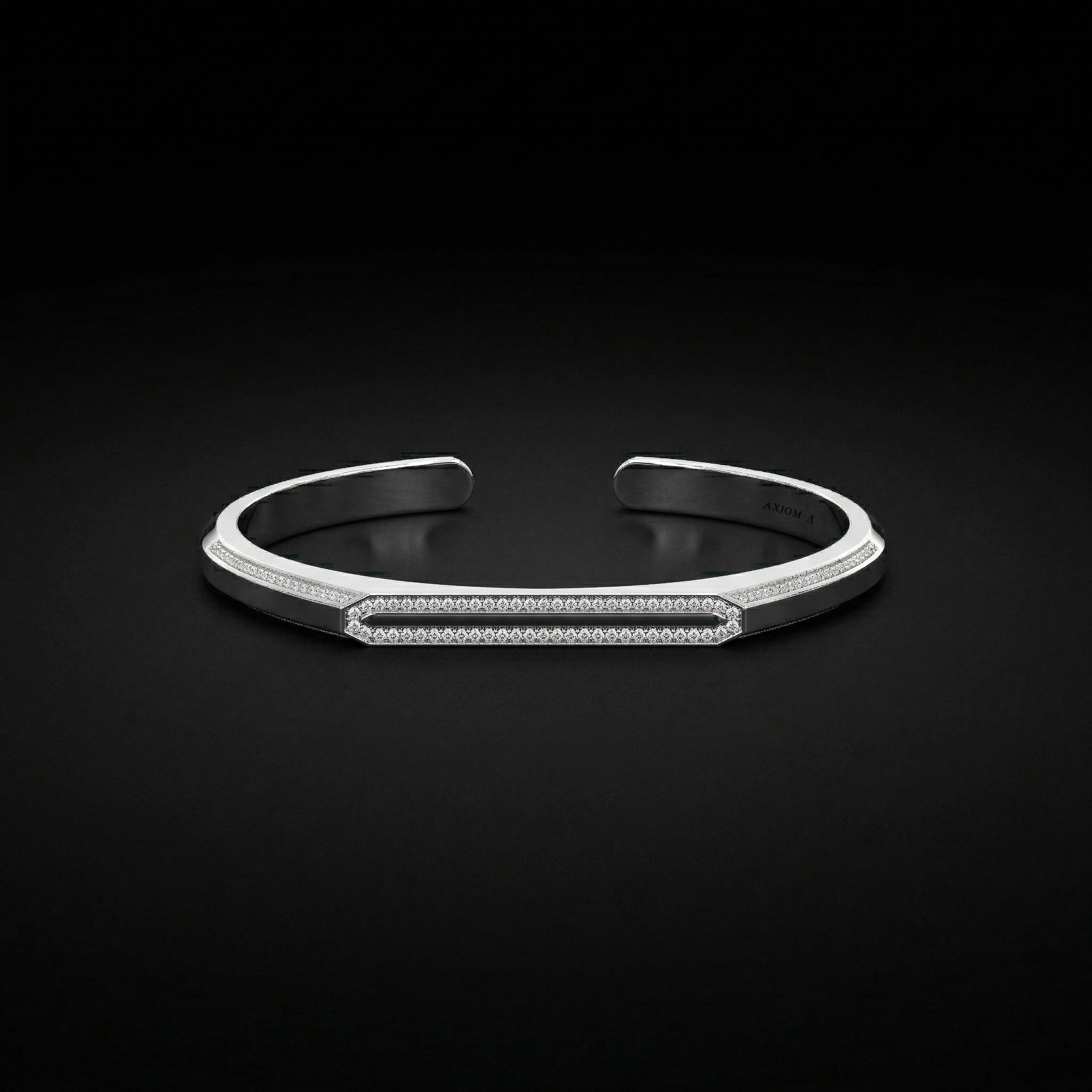
Our bracelets and kada range holds both types side by side, all in 925 sterling silver. The Bastion Cuff is a rigid cuff set with lab-grown white diamonds, while the Strength Kada is set with natural black diamonds; the link bracelets beside them fasten with clasps and are sized by length.
The practical takeaway
Decide rigid or flexible first. If you want one band that never comes off and your hand and wrist are in proportion, choose a kada and size it to your knuckles. If you wear a watch, stack, or have slim wrists, choose a bracelet or a cuff and size it to your wrist.
