
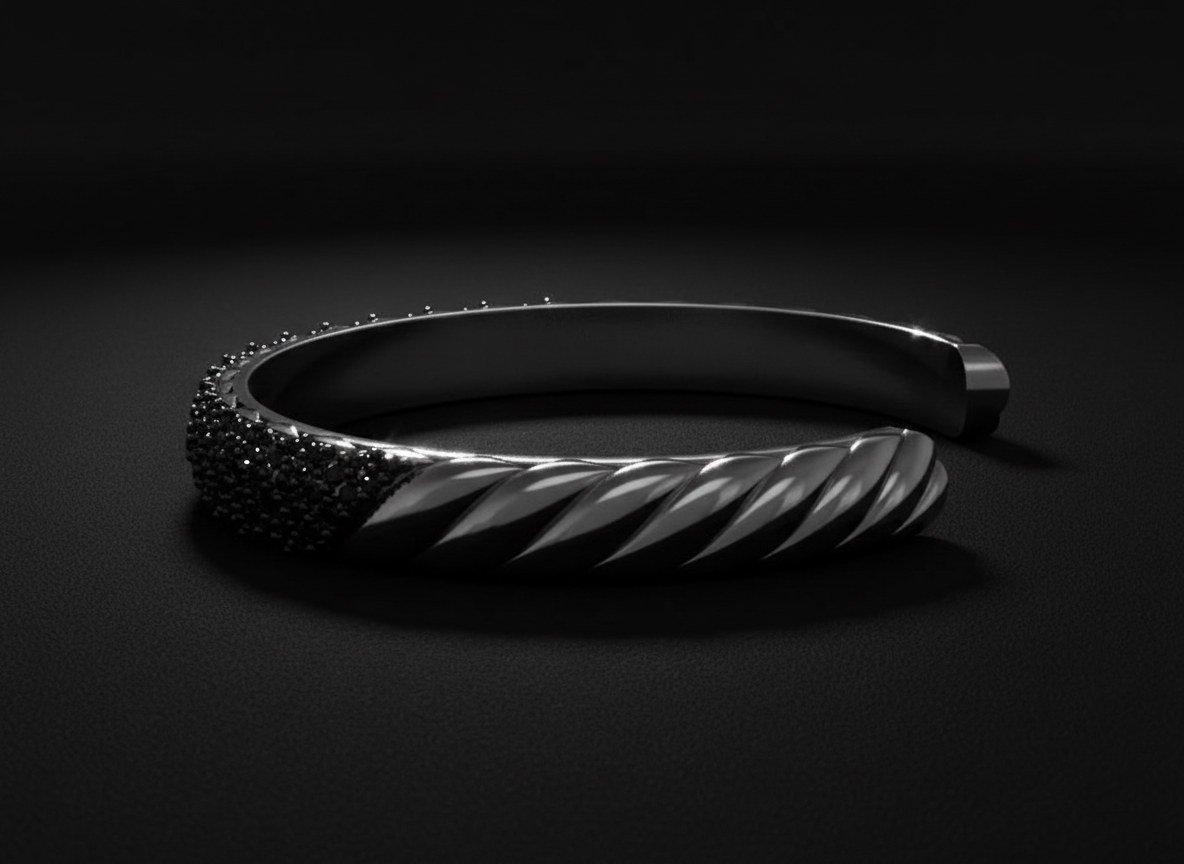
The kada is the piece of jewellery Indian men are most likely to already own, usually in plain silver, steel or gold. A diamond kada for men is the step up: the same rigid band, set with real diamonds. Because a kada is rigid and sits on the wrist bone, it treats stones very differently from a flexible bracelet, and that changes which designs, settings and sizes work.
This guide is about the stone-set kada specifically. For plain silver kadas, see our guide to the silver kada for men; for flexible link and line styles, see the men's diamond bracelet guide.
Diamond-set, diamond-cut or "AD": what are you being sold?
Three very different things are sold as a "diamond kada", and only one of them contains diamonds.
| Label | What it actually is | How to check |
|---|---|---|
| Diamond-set or diamond-studded kada | Real diamonds, natural or lab-grown, set into the kada | Invoice states diamond type and total carat weight |
| Diamond-cut kada | Metal faceted or engraved to sparkle, with no stones | No stones visible under a loupe; plain metal facets |
| American diamond (AD) or CZ kada | Cubic zirconia, an imitation | Low price; stones scratch and dull with wear |
A diamond-cut gold kada can be beautiful, and an AD kada can look bright when new, but neither should be priced as a diamond piece. If the listing says "diamond" without stating carat weight and stone type, ask.
Where do the diamonds sit on a kada?
The best diamond kadas keep stones on the top and sides, away from the underside of the wrist, which rests on desks, tables and car doors. Placement decides comfort, durability and whether the kada can ever be resized.
| Stone placement | Look | Daily wear | Resizing later |
|---|---|---|---|
| A single line along the top | Clean, restrained | Very good | Possible on the plain underside |
| A pavé panel on the front third | Bold from the front, plain from the side | Good | Possible |
| Stones on the ends of an open kada | Traditional terminals, often carved | Good; ends take knocks | Open designs adjust slightly |
| Full eternity, stones all the way round | Strongest look | Underside stones wear and loosen | Effectively not resizable |
| A single larger stone at the centre | Signet-like, minimal | Good if bezel-set | Possible |
Which settings survive a rigid kada?
Flush, channel and bezel settings survive a kada best, because they keep the metal, not the stone, as the highest point. A rigid band cannot flex when it hits a door frame, so the force goes straight to whatever stands proud of the surface.
- Channel: a row of stones in a groove between two metal walls. The natural choice for a line along the top.
- Flush or gypsy: each stone sunk level with the surface. The toughest option, suited to a heavy daily kada.
- Bezel: a rim of metal round each stone. Best for a single larger stone or spaced stones.
- Pavé: many small stones held by beads of metal. Works on the front panel; needs a yearly check.
- Claw or prong: shows the most stone and is the most exposed. Avoid on any surface that faces outwards on the wrist.
Black diamonds need extra care here. They are as hard as white diamonds, but GIA notes that heavily included black diamonds can be prone to chipping if struck sharply. Channel and flush settings protect their edges.
Closed, open or hinged: which suits a diamond kada?
A closed kada must pass over the knuckles, an open kada slips on from the side, and a hinged kada opens and closes around the wrist. Each behaves differently once stones are involved.
- Closed: the classic form. Stones near the edges rub against the knuckles every time it goes on, so keep stones to the centre of the top face.
- Open (cuff-style): sized to the wrist and easy to put on. Do not bend it open and closed repeatedly: flexing a set cuff can loosen stones and work-harden the metal at the same point.
- Hinged with a clasp or screw: never squeezes over the hand, so the size can be closer to the wrist. The hinge and clasp are extra parts to check.
How do you size a diamond kada?
Size a closed kada to the widest part of your hand with the thumb tucked in, using the Indian numbering 2.4, 2.6, 2.8, 2.10 and so on, where the second number counts sixteenths of an inch. Get it right first time, because a stone-set kada is much harder to resize than a plain one.
| Kada size | Inner diameter | Fits a hand of about |
|---|---|---|
| 2.4 | 57.2 mm | 18.0 cm |
| 2.6 | 60.3 mm | 19.0 cm |
| 2.8 | 63.5 mm | 20.0 cm |
| 2.10 | 66.7 mm | 21.0 cm |
| 2.12 | 69.9 mm | 21.9 cm |
| 2.14 | 73.0 mm | 22.9 cm |
Two rules specific to a diamond kada. First, a wide kada with a flat inside feels tighter than a slim one of the same number, so if you are between sizes for a broad design, go up. Second, if your hands swell in summer, consider a hinged or open design, since a set kada cannot simply be stretched. Our kada size guide gives the full measuring method.
Silver or gold for a diamond kada?
Silver keeps a bold diamond kada affordable; gold holds settings longer and costs many times more. The weight difference is large: 18K gold has a density of about 15.4 grams per cubic centimetre, according to the LBMA, against about 10.4 for sterling silver, so the same design weighs roughly one and a half times as much in 18K gold.
| Metal | Same design's weight | Holding stones | Look and use |
|---|---|---|---|
| 925 sterling silver | Lightest | Good with well-built settings; check yearly | Bold daily kada; pairs with black diamonds |
| 14K gold | Between silver and 18K | Hardest of the gold options here | Daily wear in gold at lower cost |
| 18K gold | About 1.5 times silver | Very good | The usual gold choice for a diamond kada |
| 22K gold | Heavier still | Soft; holds small stones less securely | Traditional plain and carved kadas |
India's mandatory gold hallmarking covers 14K, 18K, 20K, 22K, 23K and 24K, so a gold kada with diamonds should carry the BIS mark, the purity grade and a six-character HUID. Silver hallmarking is voluntary.
What does a diamond kada for men cost?
A diamond kada is priced from four parts: metal weight at the day's rate, the diamonds, the setting and finishing labour, and GST at 3% on jewellery, as set by the current GST rate notification. On a silver kada the stones and labour are most of the bill; on a gold kada the metal often is.
Work out the diamond weight yourself. One carat is 0.2 grams and 100 points, so a top line of 30 stones of 2 points each carries 0.6 ct in total, while three 20-point stones also make 0.6 ct but cost more, because larger stones cost more per carat. Then ask:
- Natural or laboratory-grown, white or black? Lab-grown and most black diamonds cost less per carat than natural white diamonds.
- Total carat weight and number of stones? Both, in writing.
- Metal and net weight? In grams, with purity.
- Setting type? Flush and channel take more hours than simple pavé.
Diamond kada designs men choose
The design should suit how often you will wear it. These are the forms most men ask for:
- Single-row channel kada: a line of white or black diamonds along a plain band. The most wearable diamond kada.
- Cable or twisted kada with set ends: a torque-style band with stones at the terminals or along one strand.
- Pavé-panel kada: a flat front panel covered in small stones, plain at the back.
- Black and white kada: black diamonds with a few white stones, or the reverse, for contrast.
- Engraved kada with a diamond accent: a name, date or mantra cut into the band, with one or a few stones.
- Two-tone kada: yellow gold with a white gold or silver set section.
Is a diamond kada the same as a Sikh kara?
No. The Sikh kara is an article of faith, one of the Five Ks, and is traditionally a plain iron or steel bracelet; it is not an ornament and is not set with stones. A diamond kada is a fashion or heritage piece worn by men of many backgrounds. It is not a kara and does not replace one. Our guide to what a kada is explains the difference with care.
How AXIOM approaches this
AXIOM's kadas are stone-set pieces in 925 sterling silver. The Strength Kada is set with natural black diamonds, from ₹82,500 at the time of writing; The Torque Kada, a cable cuff-style kada, carries natural black diamonds from ₹1,14,600; and the Bastion Cuff is set with lab-grown white diamonds from ₹75,500. Any kada can also be commissioned in 14K or 18K gold, with natural or lab-grown diamonds chosen with you, through bespoke commissions; allow about three weeks to make, plus delivery.
The practical takeaway
Decide placement and setting before style: stones on the top, held flush, in a channel or in bezels. Measure your hand and write the size down in millimetres, choose silver for a bold daily kada or gold for a lifetime piece, and do not pay until the invoice states the diamond type, total carat weight and metal weight.
