
Most men who start wearing a bracelet already wear a watch, and the first question is where the two go. The second question, usually a few weeks later, is why the watch case has picked up fine scratches it never had before. Both have straightforward answers once you know how hard each material is.
This guide covers the practical rules: same wrist or opposite, the order and spacing if you share a wrist, how snug the bracelet should be, which materials scratch which, and how to match a bracelet to a steel, gold or black watch. It also covers the kada, which most Indian men wear on the wrist without the watch, and why that habit makes sense.
Should you wear a bracelet on the same wrist as your watch?
The opposite wrist is the simpler and safer choice, and it is what most men do. Watch on the non-dominant wrist, bracelet on the other. Each piece gets its own space, nothing rubs, and the look stays balanced.
Sharing a wrist works when the bracelet is slim, flexible and plain, and when you are careful with it. It is a style choice, not a mistake, but it asks more of you:
- Choose flexible over rigid. A chain or bead bracelet moves with the wrist; a cuff or kada swings into the case.
- Choose plain metal over stones. Diamond-set bracelets will scratch the watch (see below).
- Wear one bracelet only on the watch wrist.
How to wear a bracelet and watch on the same wrist
- Put the watch on first, in its usual position just above the wrist bone.
- Put the bracelet on above the watch, on the forearm side, towards the elbow. The forearm widens there, so a snug bracelet stays put.
- Leave a small gap of about a finger's width between the bracelet and the watch case, so they do not rest against each other.
- Check with your arm hanging down. If the bracelet slides onto the watch, it is too loose for this wrist.
Wearing the bracelet between the watch and the hand looks awkward and guarantees contact every time you bend the wrist. Above the watch is the convention for good reason.
How tight should the bracelet be?
On the watch wrist, the bracelet should be snugger than usual, about 1 to 1.5 cm larger than the wrist measured just above the watch. That keeps it from sliding down. On a free wrist, the usual 1.3 to 2.5 cm of ease is fine, because there is nothing for it to hit. Our men's bracelet size guide shows how to measure.
Which scratches which: diamonds, sapphire, steel and silver
The harder material always scratches the softer one. On the Mohs scale of scratch hardness, diamond is 10, the top of the scale, and according to GIA diamond can only be scratched by another diamond. Sapphire, the crystal on most quality watches, is corundum at 9. Gold and silver sit at about 2.5. Glass is around 5.5, and stainless steel sits in the middle of the scale, well above gold and silver and close to glass.
| Material | Mohs hardness (approx.) | Scratches | Is scratched by |
|---|---|---|---|
| Diamond | 10 | Everything below, including sapphire | Only another diamond |
| Sapphire crystal (corundum) | 9 | Steel, glass, gold, silver | Diamond |
| Mineral glass crystal | About 5.5 | Gold, silver | Diamond, sapphire, grit |
| Stainless steel case | Middle of the scale | Gold, silver | Diamond, sapphire, grit |
| Sterling silver or gold | About 2.5 | Very little | Almost everything above |
What this means on your wrist:
- A diamond-set bracelet will scratch any watch, including the sapphire crystal, the steel case and a gold case. Keep it on the other wrist.
- A plain silver or gold bracelet is softer than the steel case, so the bracelet usually takes the marks. It can still leave scuffs on a polished case, and it will pick up scratches itself.
- Grit is the hidden culprit. Dust and sand trapped between two pieces scratch both, whatever they are made of. Wipe both after a day outdoors.
How to match a bracelet with a steel, gold or black watch
Match the bracelet to the watch case, not the strap. The case is the metal the eye connects to the bracelet.
| Watch | Bracelet that pairs well | What to avoid |
|---|---|---|
| Steel case, any dial | Sterling silver, white gold, black diamonds, dark beads | A heavy yellow-gold bracelet |
| Yellow-gold case | Yellow gold, leather, warm beads | Bright white metal next to it |
| Two-tone steel and gold | Either metal, or a two-tone bracelet | Nothing; two-tone bridges both |
| Black or PVD-coated case | Black diamonds, black leather, dark metal | Shiny white diamonds that fight the black |
| Smart watch or sports watch | Leather, beads, a plain silver chain | Fine jewellery with stones, on the same wrist |
If your watch is on a leather strap, a leather or bead bracelet on the other wrist is an easy match. If it is on a steel bracelet, a metal bracelet on the other wrist keeps the look consistent.
Can you wear a kada with a watch?
Yes, but on the other wrist. A kada is rigid, usually heavier than a chain bracelet, and it rotates and slides as you move. On the watch wrist it knocks against the case with every gesture, and a metal kada against a watch is a reliable way to mark both.
For Sikh men the kara is an article of faith, usually worn on the right wrist, and the watch then goes on the left as a matter of course. For a fashion kada the same practical logic applies. Our comparison of kada vs bracelet covers the difference in fit and weight.
Bracelet and watch at the office, weddings and festivals
At the office, keep it to the watch plus one bracelet on the free wrist, and check that both fit under a shirt cuff. A bracelet that stops a cuff from closing, or a French cuff from sitting straight over a cufflink, is too big for work. Our guide to men's jewellery for the office covers dress codes.
At weddings and festivals, sleeves change the rules. A sherwani or kurta sleeve often ends at or over the wrist, so a kada on the free wrist shows while a slim bracelet on the watch wrist disappears. With a bandhgala, a single kada or bracelet opposite the watch is the cleanest look.
Stacking bracelets with a watch
On the free wrist, two or three bracelets can stack if they differ: a fine chain beside a rigid kada, or a leather cord beside a metal link. Identical bracelets side by side blur into one band. On the watch wrist, one bracelet is the limit.
Keep the whole look in proportion. A large watch and a heavy stack on the other wrist can overload a slim forearm. Our guide to how much jewellery a man should wear sets out limits by occasion.
How AXIOM approaches this
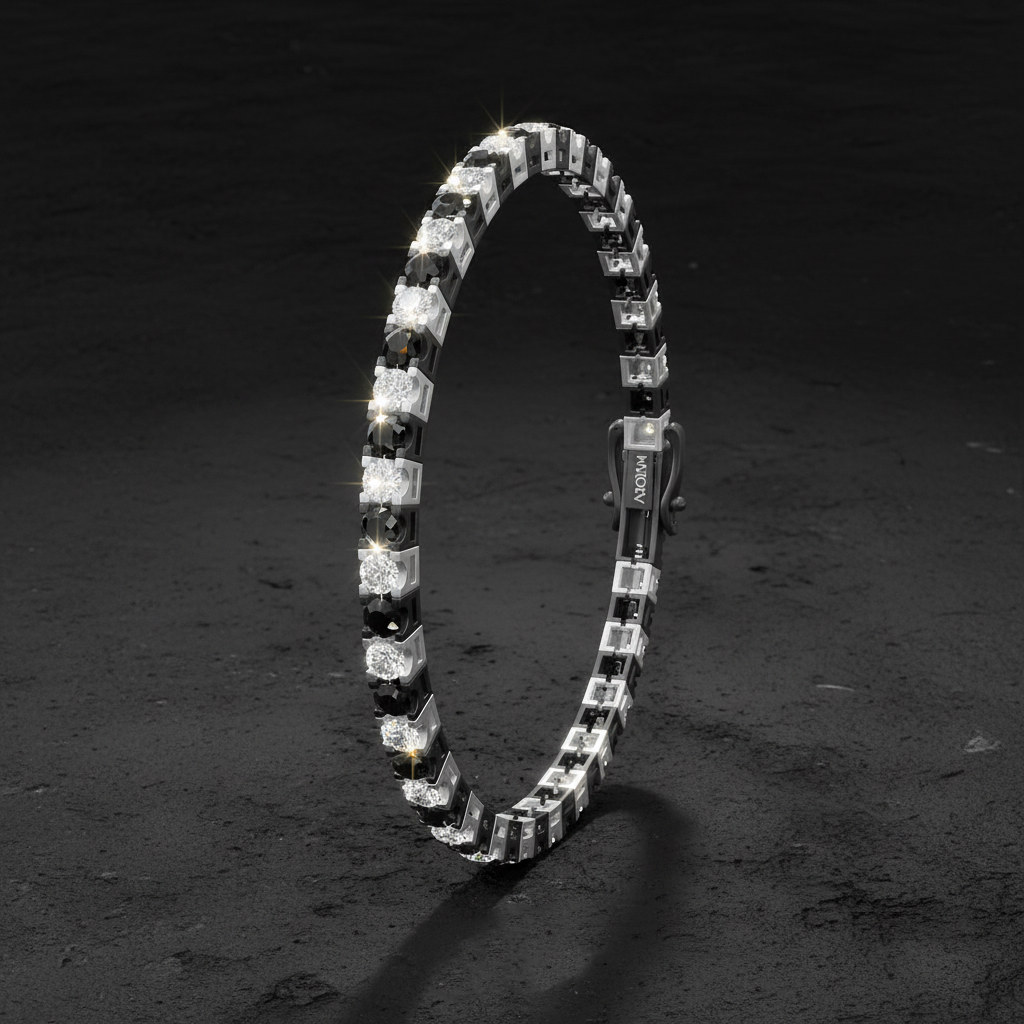
Because diamond scratches every watch material, we suggest wearing our diamond-set bracelets on the wrist without the watch. The Line Bracelet, for example, is 925 sterling silver with natural black and lab-grown white diamonds, and sits naturally opposite a steel watch in the same white-metal family. The rest of the range, from link bracelets to kadas, is in our bracelets and kadas category.
The practical takeaway
Watch on one wrist, bracelet on the other, and you avoid almost every problem. If you share a wrist, use one slim, plain, snug bracelet above the watch, and never a diamond-set piece. Match the bracelet to the watch case, and wipe both after a dusty day.
