
There is no official limit on how much jewellery a man should wear, and anyone who gives you a hard number is giving you their taste. What does exist is a set of conventions that most well-dressed men follow, because they work: one focal point, one metal colour, pieces scaled to the body wearing them.
This guide turns those conventions into usable rules for rings, chains, bracelets and watches, with a table of sensible maximums for the office, the weekend, a wedding, a puja and the gym. It is for the man who owns a few pieces and is not sure whether wearing them all at once is too much. Usually the answer is not "fewer pieces" but "fewer pieces competing".
How much jewellery is too much for a man?
It is too much when two or more pieces compete for attention at the same time. A heavy chain, a large pendant and a thick bracelet each work alone; together they fight. Three quiet pieces can look restrained while two loud ones look crowded, so count focal points, not items.
A shorthand many style guides use is three pieces, spread across two zones (neck, hands, wrists), with one piece as the focus. Three rules of thumb cover most situations:
- One focal point. Choose one piece to be seen first: a pendant, a statement ring or a bracelet. Keep everything else quieter.
- One metal family. Silver, white gold, platinum and steel read as one colour; yellow gold is another. Stay inside one unless you are mixing on purpose.
- Scale to your build. A man with a 16 cm wrist and slim fingers looks overloaded sooner than a man with a 20 cm wrist and broad hands. Widths and weights should grow with the frame.
How many pieces should a man wear by occasion?
| Setting | Sensible maximum | What usually works |
|---|---|---|
| Conservative office | 2 to 3, including the watch | Band, watch, cufflinks or a tie bar |
| Relaxed office | 3 to 4 | Band, watch, slim bracelet, chain under the shirt |
| Weekend | 4 to 5 | Two rings, one chain, watch, one bracelet |
| Wedding guest | 3 to 5 | Band, buttons or cufflinks, watch, one ring or kada |
| Festival or puja | 3 to 4 | Kada, pendant over the kurta, one ring |
| Gym and sport | 0 to 1 | A plain band at most; remove chains and bracelets |
Treat these as ceilings, not targets. Many men look their best at the lower end of each range. For workplace detail, see our guide to men's jewellery for the office.
How many rings should a man wear?
One to three rings is the comfortable range, and two is the most common: a wedding or daily band on one hand, a signet or fashion ring on the other. Beyond three, rings stop reading as individual pieces and start reading as a look, which is fine if that is what you want and odd if it is not.
Practical guidance for placing them:
- Spread across both hands. Two rings on one hand and none on the other feels lopsided unless one is a wedding band.
- Skip neighbouring fingers. A ring on the ring finger and the little finger of the same hand works; adding the middle finger crowds the hand.
- Keep the thumb for one bold piece. A thumb ring is a statement in itself and rarely needs company on that hand.
- Mind the ring finger. Indian tradition puts a man's wedding ring on the right hand and many men now wear it on the left, so a fashion ring on the fourth finger of either hand can send a message you may not mean.
Our guide on which finger to wear a ring on covers what each finger signals.
How to stack a band with a signet ring
Stacking two rings on one finger works best when one is plain and one is detailed. The classic pairing is a signet with a slim plain band on the little finger, or a wedding band worn next to a signet on the same hand.
- Keep the band slimmer than the signet's face, so the signet stays the focal point.
- Keep the combined width manageable. As a working limit, if the two rings together are wider than about 10 to 12 mm, the finger will not bend comfortably.
- Match the metal colour of the two rings.
- Size the lower ring slightly snug, so the upper ring does not spin it round.
How many chains can a man wear?
One chain for daily wear, two for a deliberate layered look, three as an outer limit for evenings. Past that, chains merge into a single tangle.
If you wear two, separate their lengths by at least 5 cm (roughly 2 inches), for example a 50 cm chain with a 55 cm chain carrying a pendant. Vary the thickness: a finer chain above a heavier one looks intended, two identical chains look like a mistake. Only one chain should carry a pendant.
Should a chain be worn inside or outside the shirt?
Inside for work and formal wear, outside for casual wear and festive kurtas. The collar decides it: a chain over a buttoned formal collar looks out of place, while a chain over a T-shirt or an open collar looks natural.
| Neckline | Chain inside or out | Why |
|---|---|---|
| Buttoned formal shirt and tie | Inside | Nothing should sit over the tie or placket |
| Open-collar shirt | Either | A 50 cm chain shows naturally at the collar |
| T-shirt or polo | Outside | The chain is part of the look |
| Kurta | Outside, over the placket | A pendant sits well against the fabric |
| Bandhgala or sherwani | Inside, or skip | The closed collar has no room for a chain |
How many bracelets with a watch?
With a watch, one bracelet is the easy number, worn on the other wrist. Two or three bracelets can stack on the free wrist if they differ in texture and width, for example a slim chain bracelet beside a rigid kada.
On the watch wrist, a single slim bracelet worn above the watch, towards the elbow, is the most you want. Diamonds can scratch even a sapphire crystal, and any metal bracelet will mark a polished case. Our guide on how to wear a bracelet with a watch goes through spacing and scratch risk.
Can men mix metals and black and white diamonds?
Yes, if it looks intended. The easiest way is a bridge piece, something that contains both colours, such as a two-tone ring or a watch with a gold bezel on steel. Without a bridge, mix by zone: yellow gold at the neck, white metal at the wrists, rather than alternating piece by piece.
Stones follow the same logic. Black diamonds read as darker, quieter and more graphic; white diamonds read as bright. A set of pieces all in black diamonds is calm and cohesive. Mixing black and white across different pieces works best when at least one piece already combines both, so the eye has a reason to connect them.
Is it feminine for men to wear jewellery?
No. Indian men have worn kadas, rings, chains, earrings and jewelled buttons for centuries, and in many communities rings and chains mark marriage, faith or family status. The question of whether a piece looks masculine is mostly one of scale, weight and design, not of wearing jewellery at all.
If you feel self-conscious, start with one piece that fits the setting, such as a plain band, and let the habit form. The six men's jewellery essentials is a good starting order.
How AXIOM approaches this
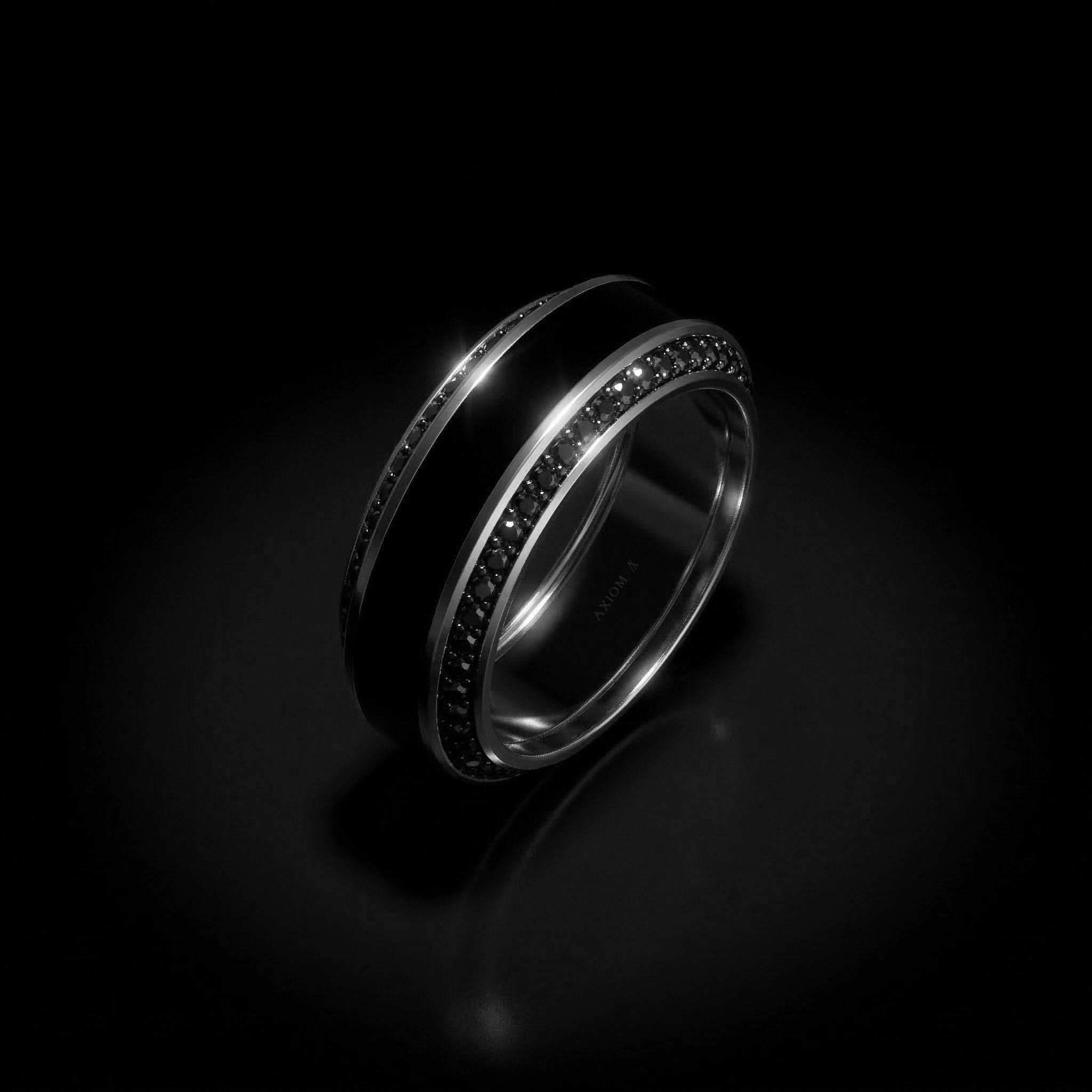
We design pieces to be worn together, which is why a single stone type and metal can carry a whole kit. One example from our men's jewellery categories: the Vow Noir Band on the hand, the Sentinel Pendant at the neck and the Strength Kada at the wrist are all 925 sterling silver with natural black diamonds, so three pieces read as one decision rather than three. For the ring half of any kit, see our men's rings and bands.
The practical takeaway
Before you leave the house, find the piece you want seen first. If you cannot choose, you are wearing too much. Keep one metal colour, scale to your frame, and let the setting set the ceiling: two or three pieces for the office, four or five at most for the weekend.
