
"Designer" is one of the most stretched words in Indian jewellery retail. It is printed on a ₹500 steel chain and on a hand-set diamond ring costing a hundred times more. Men who search for designer jewellery usually want two answers: whose design they are paying for, and whether it is worth more than a well-made piece from a good jeweller. This guide answers both, and shows how to judge a designed piece with your own eyes.
What does designer jewellery actually mean?
Designer jewellery means the design is the main thing you are paying for. In practice the word covers four quite different kinds of piece, and the difference matters more than any label.
| Kind | Who designs it | Typical materials | Where the value sits |
|---|---|---|---|
| Fashion-label jewellery | A clothing or accessories label | Often brass or base metal, plated | The label and the look |
| Jewellery-house signature design | A jewellery brand's in-house team | Gold, platinum or silver, with stones | A recognisable house style plus materials |
| Independent designer or atelier | A designer-maker, often one small team | Gold or 925 silver, with real stones | The designer's eye and the handwork |
| Bespoke commission | The atelier, designed with you | Chosen per piece | A one-of-one design for one man |
The first kind can look striking and costs relatively little, but the metal may be plated and the stones may be imitations. The last three are fine jewellery, where the design sits on top of materials that last. Our guide to fine jewellery vs fashion jewellery explains how to tell the two apart.
Designer vs branded: not the same thing
A brand is a name; design is a decision. Large brands sell many plain, generic designs, and small ateliers can produce strongly designed pieces under a name you have never heard. The two overlap, but one does not guarantee the other.
The useful question is not "who made it?" but "what was decided here, and why?" A designed ring has a reason for its width, its profile and where its stones sit. A generic ring has a stock profile with stones added where they fit. Once you have seen the difference, you see it everywhere.
How to judge a well-designed men's piece
Look at five things: proportion, balance, setting, finish and the back. None of them needs a loupe or a certificate, and together they separate a designer piece from one that only has a designer price.
| What to check | What good looks like | Red flag |
|---|---|---|
| Proportion | Width and size suit his hand, wrist or build | A woman's design scaled up, or one size for everyone |
| Balance | A pendant hangs straight; a ring does not spin to one side | Heavy at one end, tilting on the chain |
| Setting | Stones sit level, evenly spaced, held flush or in tight channels | Raised claws that snag, uneven gaps, loose stones |
| Finish | Smooth edges, a comfort-fit inside on rings, consistent polish | Sharp edges, casting marks, rough insides |
| The back | Finished as carefully as the front | Hollow, unpolished or crudely closed backs |
Proportion is where men's jewellery most often fails. Most men's bands sit at 5 to 6 mm wide, with 3 to 4 mm suiting slim fingers and 7 to 8 mm suiting large hands. A designer who works in men's jewellery draws for those hands from the start. The GIA's jewellery design course teaches balance, negative space and modelling to scale and proportion; those are the words to use when you question a design.
Real diamonds and solid metal: the materials test
A designer piece should be made of what it appears to be made of. Before you weigh up the design, confirm three things in writing: the metal and its purity, whether the white stones are diamonds, and whether those diamonds are natural or lab-grown.
Natural and lab-grown diamonds are both real diamonds. GIA states that lab-grown diamonds have essentially the same chemical composition, crystal structure and physical properties as natural ones; natural stones are rarer and cost more. Imitations such as cubic zirconia, sold in India as "American diamond", are a different material that only looks like diamond.
Many fashion-label pieces are plated, which is fine for occasional wear and a trend. If the piece is meant to be worn daily for years, solid metal and real stones are what make the design worth paying for.
Designer rings for men: what sets them apart
A designer ring for a man is drawn around his hand and his day, then given one idea that makes it his. Indian buyers also search for gents, boys and male diamond rings, and the same principles apply to all of them.
- A profile with a reason: a flat top, a bevel, a step, or a face that changes as the hand turns.
- Stones set into the metal, not on it: flush or channel settings sit safely under a steering wheel or a laptop.
- Black and white diamonds together: a contrast that lets the design draw a line or a pattern.
- A signet face drawn for him: an initial or emblem designed as his own mark.
- Weight that feels deliberate: substantial enough to notice, comfortable enough to forget.
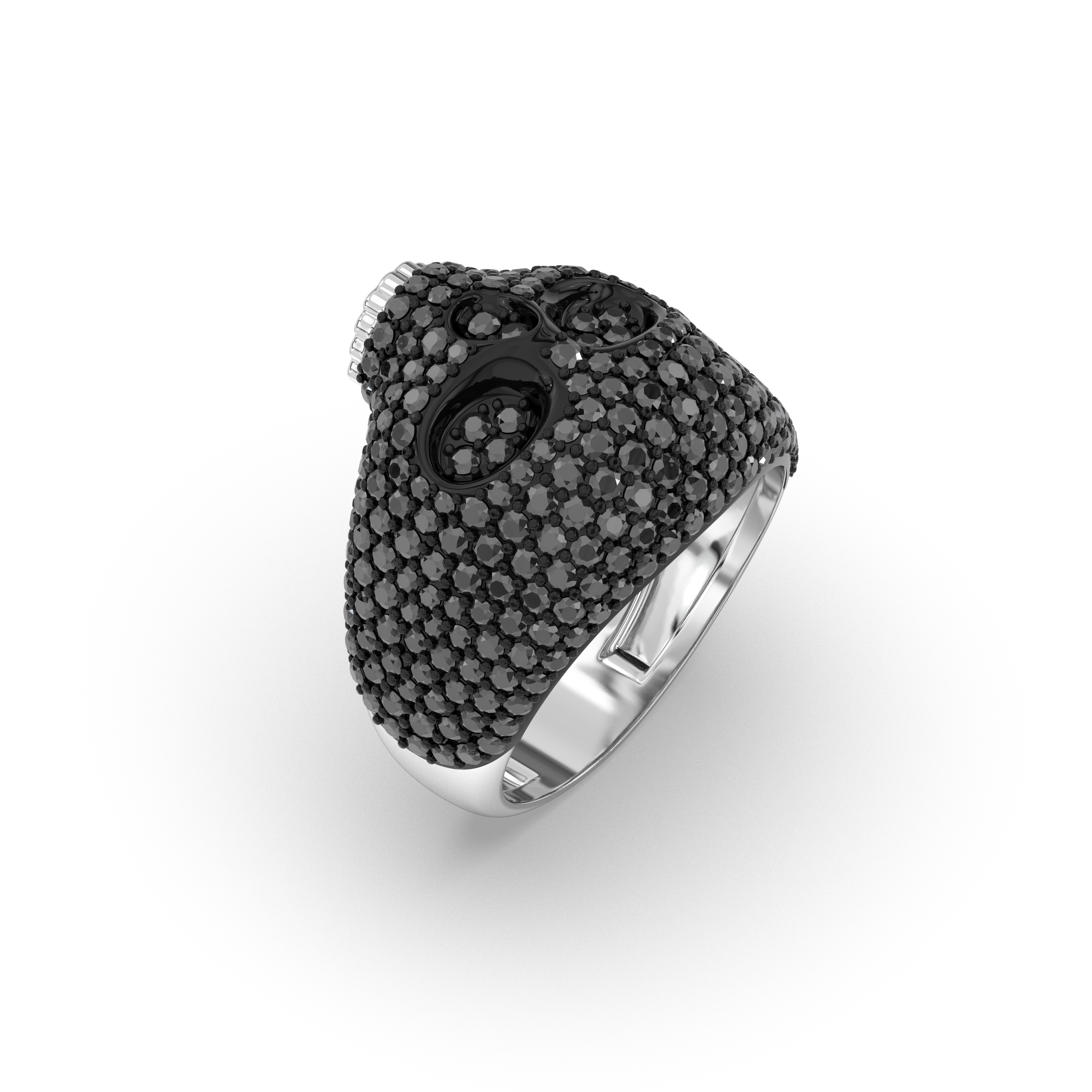
The Revenant Ring, for example, is a ring from AXIOM's Strength Collection in 925 sterling silver with natural black diamonds, ₹67,900 at the time of writing.
Luxury designer jewellery for men in India: where to look
There are five routes, and each suits a different buyer. Our comparison of men's jewellery brands in India describes individual brands from their own sites; the table below compares the routes.
| Route | Design depth | Can you change the design? | Best for |
|---|---|---|---|
| National gold and diamond houses | Broad men's lines, conservative styles | Limited, usually size and metal | Gold, exchange policies, store visits |
| Online diamond brands | Many designs, some men's ranges | Some customisation | Comparing many designs quickly |
| International luxury labels | Strong house signatures | Rarely | A recognisable international style |
| Men-only fine jewellery houses | Designed for men from the start | Often, plus bespoke work | Men who want design-led pieces with diamonds |
| Independent ateliers | One designer's eye | Yes, usually bespoke | One-of-one pieces |
Mumbai's jewellery trade is concentrated in a few districts, including Zaveri Bazaar and the Bharat Diamond Bourse in BKC, where some ateliers both design and make. Our guide to where to buy men's jewellery in Mumbai covers each district.
Silver designer jewellery for men
925 sterling silver is a serious material for designer jewellery when it is set with real stones. Because silver costs far less per gram than gold, more of a designer piece's price goes into the design, the diamonds and the setting work.
Sterling silver is 92.5% silver. In India silver hallmarking is voluntary; under IS 2112:2025 the BIS recognises seven silver grades, including 925, and a hallmarked piece carries a six-character HUID. Silver tarnishes slowly but polishes back, and a well-made silver piece can be resized and refinished. If he wants a warm colour or a harder metal, the same design can usually be made in 14K or 18K gold.
What you pay for in a designer piece
Every designer piece is priced from the same parts; the label decides how much is added on top. Seeing the parts makes it easier to tell a design premium from a name premium.
| Part | How it is priced | Visible on the piece? |
|---|---|---|
| Metal | Weight in grams times the rate for that metal and purity | Yes |
| Stones | Per stone or per carat, by type and grade | Yes |
| Setting and finishing | Bench time, more for many small stones | Yes, in the quality |
| Design | Concept, CAD and revisions | Yes, in the idea |
| Brand premium | Marketing, retail and the name | No |
| GST | 3% on jewellery | On the invoice |
A design premium shows up on the piece every time he wears it. A name premium does not. Neither is wrong, but you should know which one you are paying.
This matches the wider shift. As our look at men's jewellery trends in India for 2026 notes, Indian men are moving from occasion-only jewellery towards a ring or chain worn every day, which rewards design that holds up to daily wear.
Questions to ask before you buy a designer piece
Six questions tell you more than any label. Ask them in writing, and keep the answers with the invoice.
- What is the metal, and what is its purity? Solid 925 silver, 14K or 18K gold, or plated base metal.
- Are the stones diamonds, and are they natural or lab-grown? Ask for the number of stones and their total carat weight.
- Who designed it, and can it be changed? Width, metal and stones are often adjustable even on a catalogue design.
- Is certification available for the diamonds? For larger stones, ask which lab and whether the report comes with the piece or on request.
- What happens after the sale? Resizing, refinishing and repairs, and whether they are free.
- What is the return policy? Made-to-order and bespoke pieces are usually non-returnable, so confirm the size and design first.
How AXIOM approaches this
AXIOM designs and finishes its men's pieces at the Bharat Diamond Bourse in Mumbai, and also designs one-of-one pieces as commissions. A commission starts from the occasion, the stones are chosen with the client, natural or lab-grown diamonds, and the piece is made in 925 sterling silver or in 14K or 18K gold, taking about three weeks to make before delivery. The bespoke commissions page explains how a design is agreed through sketches and CAD before anything is cast.
The practical takeaway
Treat "designer" as a claim to check, not a reason to buy. Confirm the metal and the stones, then judge the proportion, setting, finish and back with your own eyes. If the design holds up on all five, it is designer jewellery in the sense that matters.
