
Search for unique jewellery for men and most of what comes back falls into two groups: fashion pieces made unusual by their material, such as leather, steel, wood or beads, and gift lists of things anyone can order in a click. Neither explains why one piece still feels like his ten years later while another goes in a drawer. This guide is for the man, or the person buying for him, who wants something nobody else at the table is wearing, set with real stones and made to last.
What makes men's jewellery genuinely unique?
Three things, in this order: an idea that belongs to the wearer, stones chosen to serve that idea, and proportions drawn for his body. A piece that gets all three right is unique even if it is quiet. A piece that gets none of them is ordinary, however strange it looks.
Material novelty is the weakest kind of uniqueness, because the next man can buy the same cuff in the same metal. Uniqueness that lasts comes from decisions made for one person. The table shows how much of that you get at each level of jewellery.
| Level | How many exist | What you decide | Trade-off |
|---|---|---|---|
| Mass-produced design | Thousands | Size only | Easy to find, easy to see on someone else |
| Small-batch or limited | Dozens to hundreds | Size, sometimes finish | Rarer, but still a shared design |
| Made to order from a catalogue design | One at a time, same design | Size, sometimes metal | Better made, still recognisable |
| Customised | A catalogue design changed for you | Metal, stones, engraving | Personal details on a familiar shape |
| Bespoke, one of one | One | The whole design | Needs time, a clear brief and a maker you trust |
Our guide to bespoke vs custom jewellery explains where the line between the last two levels sits.
Unique or just unusual?
Unusual jewellery surprises on first sight; unique jewellery still means something on the hundredth. A skull ring or a spiked bracelet is unusual, and plenty of men enjoy them. The design, though, was drawn for everyone who likes skulls.
A unique piece answers a specific question: what is this for, and who is it for? A band whose line of black diamonds follows the date of a wedding, a pendant drawn from a symbol his family uses, a lapel pin made for one occasion and then worn for years. The test is simple. If you can explain the piece in one sentence that only applies to him, it is unique.
Where uniqueness actually comes from
The design idea
A one-of-one piece starts with an occasion or a story, not a catalogue page. The designer turns that brief into sketches, then a CAD model, and the client signs off before any metal is cast. The idea should be simple enough to survive being made small.
Good jewellery design uses the same principles as any other design discipline. The GIA's jewellery design course teaches texture, shape, form, balance and negative space, and builds models to scale and proportion. Those words are useful when you brief a maker: say what should feel heavy, what should feel open, and where the eye should land.
The stones
Stone choices change the character of a piece more than almost any other decision. The same ring reads differently in each of these:
- Natural black diamonds: dark, matte-to-glossy, quiet. They suit men who want presence without sparkle.
- White diamonds, natural or lab-grown: catch light across a room. Small stones set in a line read as a detail; a single larger stone reads as a statement.
- Black and white together: a contrast that lets the design draw a pattern, such as a white line through a black field.
- Shape: round stones soften a design, while baguettes, princess cuts and marquise shapes add direction and edges.
- Coloured gemstones: possible on commission when the story calls for a colour.
Natural and lab-grown diamonds are both real diamonds. GIA states that lab-grown diamonds have essentially the same chemical composition, crystal structure and physical properties as natural ones. Natural stones are rarer and cost more; lab-grown stones let the same budget buy larger or more stones.
The proportions
A unique piece is drawn for his body, not scaled from a standard size. Most men's bands sit at 5 to 6 mm wide, with 3 to 4 mm suiting slim fingers and 7 to 8 mm suiting large hands. Pendants usually look right at 2 to 3 cm on a slim frame and 3.5 to 5 cm on a tall or broad one.
The details that make a piece feel considered are often invisible from across the room: a comfort-fit inside, eased edges that do not catch on a cuff, a bail sized to the chain, and a back finished as carefully as the front.
Unique jewellery ideas for men, by piece
Choose the piece he will wear most, then make that piece singular. The ideas below all depend on design and stone choice rather than on unusual materials.
| Piece | What makes it singular | Stone idea | Suits |
|---|---|---|---|
| Ring | A face or profile drawn for him, not a standard band | Flush-set black diamonds along one edge | Daily wear, a first piece |
| Pendant | A symbol or initial redrawn as his own mark | A single white diamond as the focal point | Men who wear a chain already |
| Bracelet or kada | A repeating pattern with a break that means something | Black and white diamonds in sequence | Men who wear a watch on the other wrist |
| Lapel pin or brooch | A small sculpture for the jacket | Pavé black diamonds with a white accent | Weddings, formal dinners, sherwanis |
| Buttons or cufflinks | A matched set designed for one outfit, then reused | Black diamonds in silver | Grooms and formal dressers |
| Earring | One stud rather than a pair | A single natural black diamond | Men with a pierced ear |
Wearable art: lapel pins, brooches and buttons
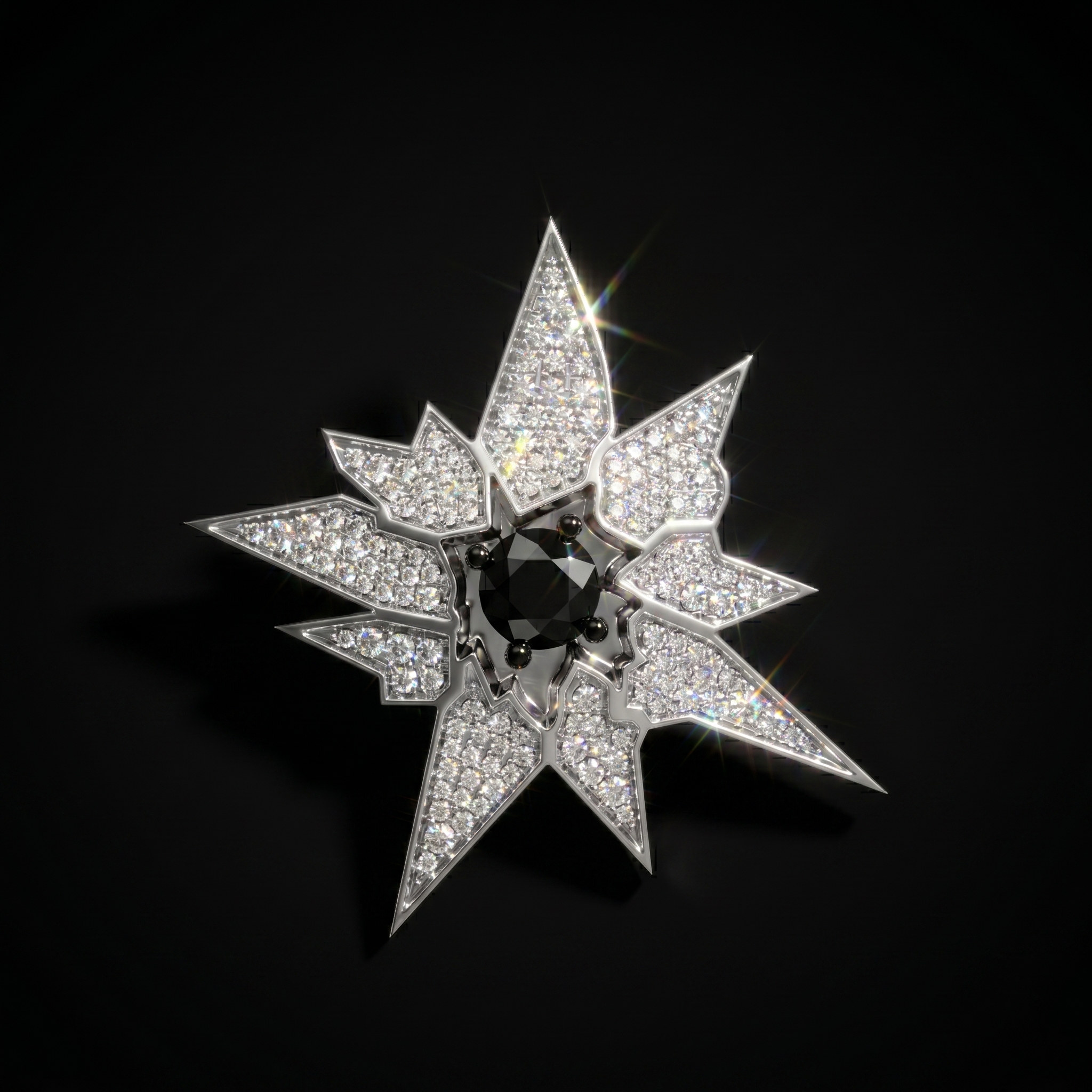
Lapel pins and buttons are where men's jewellery comes closest to wearable art. They sit flat against cloth, so they can take shapes a ring cannot: a star, a crest, an animal, an abstract line. AXIOM's Midnight Star, for example, is in 925 sterling silver with natural black diamonds and lab-grown white diamonds, from ₹67,500 at the time of writing. The Aegis Lapel Pin uses the same black and white pairing in sterling silver.
Unique gold or silver jewellery for men: does the metal matter?
The metal changes colour, weight and cost, but it does not make a piece unique. What it does decide is how far a budget goes on design and stones.
| Metal | Purity | Colour | What it means for a unique piece |
|---|---|---|---|
| 925 sterling silver | 92.5% silver | Bright white | Lower metal cost, so more of the budget goes to design and diamonds |
| 14K gold | 58.5% gold | Yellow, white or rose | Harder than 18K, warm colour, costs much more than silver |
| 18K gold | 75% gold | Yellow, white or rose | Richer colour, the classic fine jewellery standard |
Silver suits a design-led piece with diamonds very well; it takes fine detail and holds settings securely when it is cut to a sensible thickness. Gold suits a man who wants a warm colour or plans to wear the piece hard for decades.
Real diamonds or imitations: why it matters more for a unique piece
A piece designed for one person carries real design and setting labour, so it deserves stones that will look the same in twenty years. Imitations such as cubic zirconia, often sold in India as "American diamond", are a different material that only looks like diamond. GIA describes simulants as having very different composition and properties from the gems they imitate.
There is nothing wrong with costume jewellery bought for fun. The point is fit: spending design time and handwork on an imitation stone makes little sense if the piece is meant to be kept. Our guide to fine jewellery vs fashion jewellery explains how to tell what you are buying.
What does a one-of-a-kind piece cost in India?
The price is built from the same parts as any piece of jewellery, plus the design time. There is no standard price for "unique", but there is a standard way to read a quote.
| Cost part | How it is priced | What pushes it up |
|---|---|---|
| Design | Sketches, CAD and revisions | Many rounds of changes |
| Metal | Weight in grams times the rate for that metal | Gold instead of silver, heavier profiles |
| Stones | Per stone or per carat | Natural over lab-grown, larger or more stones |
| Setting and finishing | Bench time | Dozens of small set stones, hand engraving |
| GST | 3% on jewellery | Applies to the full value |
Ask for each part as a separate line. A quote that shows metal weight, stone count and type, and setting work is easier to compare than a single number.
How to find, or commission, a one-of-a-kind piece
Start with the occasion and the man, not with a picture of someone else's jewellery. The steps are the same at most ateliers, and our guide to how custom jewellery is made covers each in detail.
- Write one sentence about what the piece is for: a wedding, a promotion, a father's sixtieth.
- Gather references: a photo, a sketch, an object, an heirloom. Note what you like about each.
- Decide the stones with the maker: natural or lab-grown, black or white, how many.
- Approve a CAD with measurements in millimetres, including width, depth and stone sizes.
- Agree timing at sign-off, not at the first message, and keep a margin before any date.
- Check the paperwork: metal purity, stone details and certification on request.
Bespoke and engraved pieces are made for one person, so they are usually non-returnable. Approve the design only when you are sure.
How AXIOM approaches this
At AXIOM a one-of-one piece starts from the occasion, not from a design, and is refined through sketches and CAD until the client signs off. The stones are chosen with the client, natural or lab-grown diamonds, and set in 925 sterling silver or in 14K or 18K gold. A commission takes about three weeks to make, with delivery on top, and there is no deposit to begin; the bespoke commissions page explains the steps.
The practical takeaway
Decide what the piece is for before you look at anything. Then spend the budget on the three things that make it his: the idea, real stones chosen for that idea, and proportions drawn for his hand or frame. Unusual materials fade as a novelty; a specific design does not.
