
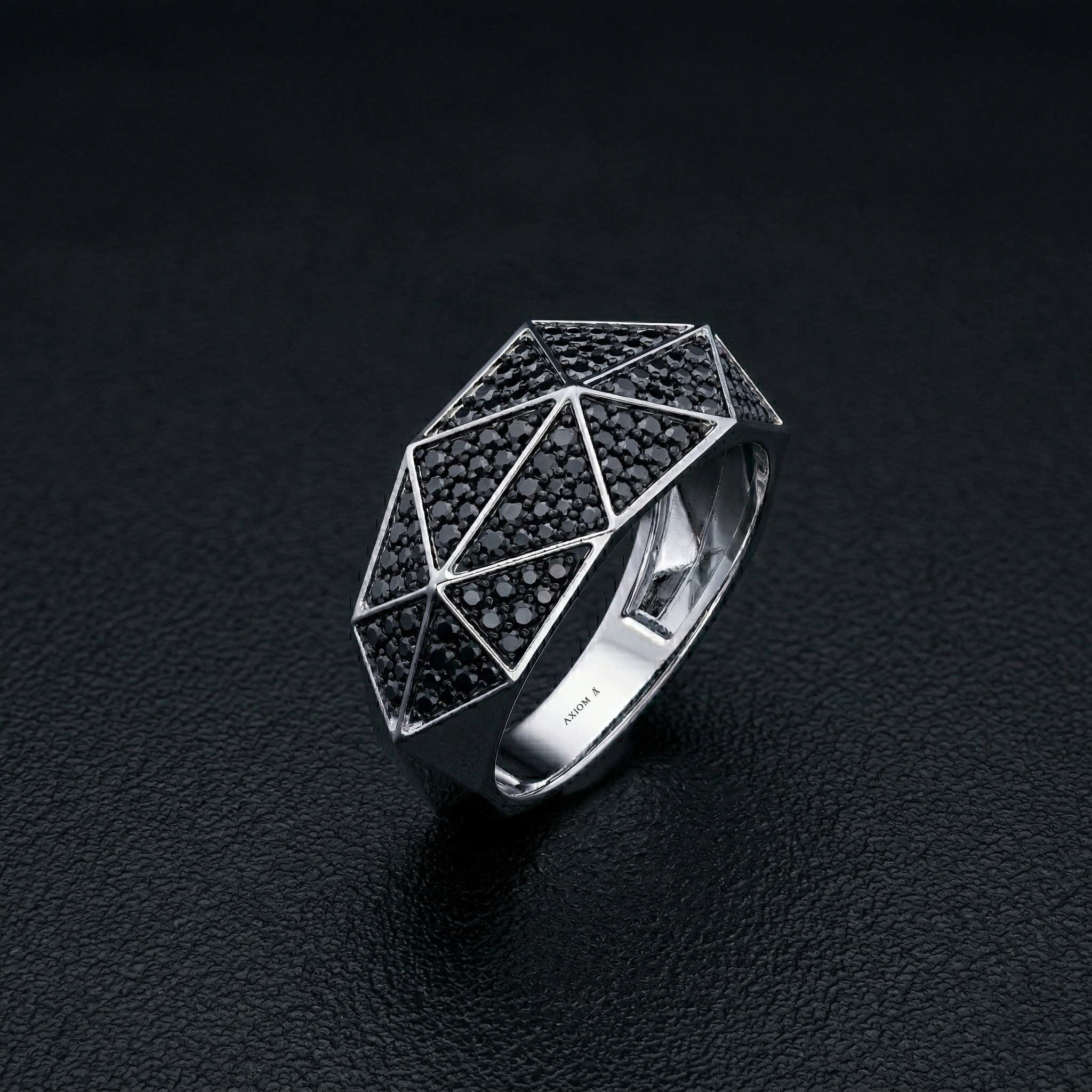
Custom jewellery is made in ten stages, from brief and sketch to CAD render, printed model, casting, stone setting, finishing, hallmarking and delivery, and you approve the design before any metal is cast. Most custom jewellery content in India is written either by manufacturers selling CAD services to other jewellers or by bridal brands designing for women. The process is the same for a man's ring, kada or pendant, but the decisions that matter are different: weight on the hand, how a setting survives daily wear, and whether a piece reads as understated or loud across a desk. This guide walks through each stage as a working bench sees it, so you know what to ask for, what to approve and where the time and money go.
How does custom jewellery work?
Custom jewellery works as a sequence of approvals. You describe what you want, the jeweller turns it into drawings and then a precise 3D model, and nothing is cast in metal until you sign off that model. After sign-off the work moves to the bench: casting, setting, finishing, hallmarking and dispatch.
The approvals are the part that protects you. A good maker will not skip the CAD stage for anything with stones or tight tolerances, because changing a render costs minutes and changing cast metal costs the piece.
The custom jewellery design process, step by step
The full process runs through ten stages. Some jewellers merge or rename them, but every well-made custom piece passes through each one.
- Brief. You share the occasion, references, budget, size and deadline. The jeweller asks how the piece will be worn and by whom.
- Sketch. Hand or digital sketches explore two or three directions. This is where proportion and overall character are decided.
- CAD model. The chosen sketch is built in jewellery CAD software, with exact dimensions: band width and thickness in millimetres, stone sizes, prong or channel positions.
- Render and approval. You receive photo-realistic renders, often from several angles and sometimes on a hand. You request changes until the design is right, then sign off.
- 3D print or wax model. The approved model is printed in castable resin or carved in wax. For rings, some makers let you try the resin model for fit and presence before casting.
- Casting. The model is set in plaster-like investment, burnt out, and replaced with molten metal. This is lost-wax casting, the method used for most fine jewellery.
- Stone setting. A setter fixes each stone by hand, raising and closing metal around it under magnification. Pavé and channel settings take the longest.
- Finishing. The piece is cleaned up, filed, polished or given a matte, brushed or textured finish. Engraving is usually done at this stage.
- Hallmarking and certification. Gold jewellery sold by BIS-registered jewellers in India carries a BIS hallmark with a six-digit HUID. Diamonds may come with a grading report depending on size and the maker's practice.
- Delivery. The piece is checked, packed and handed over or shipped, ideally with an invoice that states metal, purity, weight and stone details.
What each stage produces
| Stage | What you receive | What you approve |
|---|---|---|
| Brief | Questions and a rough estimate | Budget range and deadline |
| Sketch | Two or three design directions | One direction to develop |
| CAD and render | Dimensioned 3D model and images | Final design, sizes and stones |
| Resin or wax model | A physical proof (not always offered) | Fit and proportion |
| Casting and setting | Nothing to review in most studios | Nothing, the design is locked |
| Finishing | Photos before dispatch (ask for them) | Finish and engraving check |
| Hallmark and invoice | Hallmark, HUID, invoice, any certificate | Paperwork matches the piece |
Can I design my own ring without drawing skills?
Yes. Designing your own ring means making the decisions, not drawing the lines. The jeweller's job is to translate a photo, a rough pen sketch or even a sentence ("a flat-top band that looks like my grandfather's, but narrower") into a design that can be made.
For a man's ring, the decisions that shape the result most are:
- Width and profile. Flat, domed, comfort-fit (rounded inside) or bevelled edges. Width and profile change how heavy a ring looks more than the metal does.
- Stone placement. Flush or channel-set stones sit low and suit daily wear; raised prong settings catch on gloves, pockets and gym equipment.
- Finish. High polish shows scratches quickly; brushed and matte finishes hide them and can be refreshed.
- Engraving. Inside a band is private and protected; outside is decorative and wears faster.
If you are weighing a signet style, our guide to the signet ring for men in India covers face shapes and engraving depth.
How to brief a jeweller well
A strong brief saves at least one round of revisions. Bring these five things to the first conversation.
- Reference images. Three to five photos of pieces you like, and one or two you do not. Saying what you dislike is often more useful than what you like.
- A budget range. Give a range, not a ceiling you secretly plan to exceed. The jeweller will choose metal weight and stones to fit it.
- Size. Ring size, wrist measurement or chain length. If the piece is a surprise, borrow a ring he wears on the same finger.
- Wear habits. Desk job, manual work, gym, swimming, whether he takes jewellery off. This decides thickness, setting and finish.
- Deadline. The real date you need it, not a date with no margin. Tell the maker if the date is fixed, such as a proposal or a wedding.
What drives the cost of custom jewellery?
Custom jewellery cost is built from four parts: metal, stones, labour and design. There is no single price for "a custom ring" because each part moves independently.
| Cost driver | How it is priced | What pushes it up |
|---|---|---|
| Metal | Weight in grams multiplied by the day's rate for that metal and purity | Heavier profiles, gold instead of silver, higher karat |
| Stones | Per stone or per carat, by type and grade | Larger stones, higher colour and clarity grades, natural over lab-grown |
| Labour | Casting, setting and finishing time | Many small set stones, hand engraving, complex textures |
| Design | CAD time and revisions | Many rounds of changes, redesign after sign-off |
Two practical points follow. First, the same design in 925 sterling silver and in 18K gold can differ hugely in price because the metal rate is so different, while the labour stays similar. Second, revisions before sign-off are cheap; changes after casting can mean recasting, which costs metal and time.
So is custom jewellery expensive? It usually costs somewhat more than a comparable catalogue piece, because design and a one-off casting are carried by one order. It is not automatically more expensive, and a simple custom band can sit close to ready-made prices.
How long does it take to make a custom ring?
The time depends on approvals and sourcing more than on bench work. A maker cannot give a reliable date until the design is signed off and the stones are in hand.
These factors lengthen a commission:
- Revision rounds. Each round of changes to the CAD adds days, mostly waiting for your reply.
- Stone sourcing. Matched stones, unusual cuts or specific grades take time to find.
- Setting density. A band with dozens of small set stones takes far longer to set than a plain one.
- Hand engraving and textures. Detailed hand work cannot be rushed.
- Peak seasons. Wedding and festival months fill bench calendars.
The practical rule: ask for a delivery date at sign-off, not at the first enquiry, and keep a margin before any fixed occasion.
Can custom jewellery design be done online?
Yes, and for most pieces the whole process can run remotely. Sketches, CAD renders and revisions travel well over email or WhatsApp, and many buyers never visit the studio. What does not travel well is fit and feel, so remote commissions need a little more care in three places.
- Size. Measure an existing ring's inside diameter in millimetres, or get sized at any local jeweller, rather than guessing from a string. For a kada or bracelet, measure the widest part of the hand as well as the wrist.
- Scale. Renders can make a piece look larger or smaller than it is. Ask for the dimensions in millimetres and the estimated weight in grams, and compare them with something he already owns.
- Proof. Ask for photos or a short video of the finished piece before dispatch, and confirm that shipping is insured until it reaches you.
An in-person consultation is still worth it for heirloom work, where the jeweller needs to handle the original, and for anyone unsure about width or weight.
Recreating or redesigning an inherited piece
Heirloom work is one of the most common reasons men commission jewellery. A father's ring that no longer fits, a grandfather's worn chain, or a set of loose stones from a family piece can become something he will wear.
There are three routes, and it helps to decide which one you want before the first meeting:
| Route | What happens | Best when |
|---|---|---|
| Restore | The original is repaired, re-polished and resized | The piece fits his style already |
| Recreate | A new piece is made to match the original's design | The original is too worn or must stay with family |
| Redesign | Stones or motifs are reused in a new design | The design does not suit him, but the material matters |
Ask the jeweller to weigh and photograph the original before any work starts, and to confirm in writing whether your own metal and stones are being reused or replaced. If old stones are reused, expect the setter to check them for chips first, since older settings sometimes hide damage.
Hallmarking, certificates and paperwork
Hallmarking confirms metal purity, and it is the one piece of paperwork you should insist on for gold. Under Government of India rules, gold jewellery sold by BIS-registered jewellers carries three marks: the BIS mark, the purity in carat and fineness, and a six-digit alphanumeric HUID. You can check an HUID in the BIS Care app, as described on the BIS consumer protection page.
Silver hallmarking in India is voluntary. From 1 September 2025, BIS introduced HUID-based silver hallmarking under IS 2112:2025, with grades including 925, as set out in the PIB announcement on silver hallmarking. For diamonds, ask whether a grading report is included or available and from which lab, and make sure the invoice lists metal, purity, gross weight and stone details.
How AXIOM approaches bespoke commissions
At AXIOM, a commission runs in four steps: share the occasion, design it together through sketches and CAD until you sign off, forged by hand (cast, set and certified at the Bharat Diamond Bourse), and a piece made once, for one man. There is no deposit to begin, a photo, sketch or heirloom gets a reply within a day, and consultations can be virtual or in person at the Mumbai atelier. The bespoke commissions page sets out the steps, and the contact page is the fastest way to start. The team spent more than 15 years as a bench at the Bourse, making for other names, before AXIOM existed as a brand; the about page tells that story.
For the vocabulary, read bespoke vs custom vs made to order. If you are in Mumbai and want a ring specifically, commissioning a custom ring in Mumbai covers local routes and questions to ask.
The practical takeaway
Spend your effort on the brief and the CAD approval. Those two stages decide almost everything about the finished piece, and they are the only stages where changes are cheap. Once you sign off the render, the rest is craft, and your job becomes checking the hallmark, the invoice and the fit.
