
Most metal-colour advice is written for women and for fair skin, and most of what ranks for "rose gold for men" is about watches. Indian men need a different answer: one that covers the full range of Indian skin, the metals men actually wear (silver, white gold, yellow gold, rose gold, platinum, oxidised silver), and the practical side, which colour needs upkeep and which one his skin may react to. This guide covers all of that and keeps the styling rules in their place.
Is rose gold for men?
Yes. Rose gold is not a feminine metal; it is gold with a different alloy. What makes any metal read as masculine or feminine is the design: a heavy band, a plain bracelet or a solid kada in rose gold looks as masculine as the same shape in yellow gold.
Men's rose gold is most common in watches, followed by rings, bracelets, chains and wedding bands. If you are unsure, a rose gold watch case or a slim band is a low-risk way to try the colour before committing to a larger piece.
What is rose gold made of?
Rose gold is gold alloyed mainly with copper, often with a little silver. The more copper, the redder the colour. A typical 18K rose gold is 75 percent gold, with the remaining 25 percent made up mostly of copper and a small share of silver.
| Name | Typical 18K composition | Colour |
|---|---|---|
| Red gold | 75% gold, about 25% copper | Deep, coppery red |
| Rose gold | 75% gold, about 22% copper, about 3% silver | Warm pink |
| Pink gold | 75% gold, about 20% copper, about 5% silver | Lighter pink |
| Yellow gold | 75% gold, silver and copper in balance | Classic yellow |
| White gold | 75% gold with white metals such as palladium or nickel, usually rhodium plated | White to pale grey under the plating |
Exact recipes vary between refiners, so treat the percentages as typical rather than fixed. The gold content, which is what the karat measures, is the same 75 percent in every 18K colour.
Which metal colour suits Indian skin tones?
The usual rule is about undertone, not how light or dark your skin is. Warm undertones are said to suit yellow and rose gold; cool undertones suit silver, white gold and platinum; neutral undertones suit both. We know of no scientific study behind these rules. They are a styling convention, useful as a starting point and nothing more.
Indian skin covers a very wide range of depth and undertone, which is why no single metal suits every Indian man. Yellow gold has the longest tradition in India, but plenty of Indian men wear silver every day and look entirely natural in it.
| Undertone | How to recognise it (convention) | Metals that usually flatter |
|---|---|---|
| Warm | Veins look greenish; skin has golden or yellow hints | Yellow gold, rose gold, oxidised silver |
| Cool | Veins look bluish; skin has pink or red hints | Silver, white gold, platinum |
| Olive or neutral | Veins look blue-green; both look fine | Any; choose by clothes and watch |
The wrist test
A better test than any chart takes two minutes.
- Find something yellow-toned and something white-toned: a gold and a steel watch, two rings, or even gold and silver gift foil.
- Stand near a window in daylight, not under shop lighting.
- Hold each one flat against the inside of your wrist, then against the back of your hand.
- Note which one makes your skin look clearer and more even, and which makes it look dull or ashy.
- Repeat with rose gold if you can borrow a piece.
Which metal suits dark skin men?
Deeper skin carries both warm and white metals well; it is the contrast that changes. Yellow and rose gold sit close to the skin's own warmth and give a rich, glowing look. Polished silver, white gold and platinum stand out sharply against deeper skin and look crisp and modern.
Rose gold on deeper skin tends to read as a soft, warm sheen rather than obviously pink, which many men find easier to wear than they expected. Very red alloys can disappear against warm brown skin, so a pinker 18K rose gold usually shows better than a deep red gold.
Rose gold vs yellow gold vs silver for men
Colour is only one difference. Price, upkeep and tradition differ too.
| Metal | Look | Upkeep | Relative cost | Where it fits in India |
|---|---|---|---|---|
| Yellow gold (18K or 22K) | Warm, traditional | Low; polish occasionally | High | Weddings, festivals, family pieces |
| Rose gold (14K or 18K) | Warm, contemporary | Low; colour runs through the metal | High | Watches, rings, modern bracelets |
| White gold (18K) | Bright white | Rhodium plating wears and needs redoing | High | Bands, diamond settings |
| Platinum | Grey-white, heavy | Develops a soft patina; can be polished | High | Bands, engagement rings |
| 925 sterling silver | Bright white | Tarnishes; polishes back | Low | Everyday rings, kadas, chains, pendants |
| Oxidised silver | Dark grey to black | Raised areas brighten with wear | Low | Statement and textured pieces |
For deeper comparisons, see our guides to sterling silver vs white gold and white gold vs platinum.
Rose gold vs yellow gold for men: value and karat
At the same karat, rose and yellow gold contain the same amount of gold and are valued on the same basis; only the alloy metals differ. A rose gold ring and a yellow gold ring of equal weight and karat carry equal gold value.
Karat matters more than colour. 22K gold, the traditional Indian choice, is softer and richer in colour; 18K is harder and better for stone settings and daily rings. Rose gold is usually made at 18K or lower, because 22K gold leaves only about 8 percent of the alloy for copper and other metals, so the pink stays faint. Our guide to 18K vs 22K gold for men explains the trade-off.
In India, gold is hallmarked by purity, not colour. A rose gold piece sold by a BIS-registered jeweller in a mandatory district carries the same three marks as any gold: the BIS logo, the purity grade and a six-character HUID, as set out in the PIB notice on HUID hallmarking.
Black and oxidised finishes for men
Not every man wants a shiny metal at all. Oxidised silver is sterling silver deliberately darkened with a chemical treatment, so recesses turn grey or black while raised areas stay bright. It suits textured kadas, signets and pendants, and it flatters every skin tone because it reads as dark rather than warm or cool.
Two things to know. The dark finish on raised areas brightens with wear, which many men like because it shows the piece's history; a jeweller can re-oxidise it if you want it dark again. And black-plated or blackened finishes over base metal are a different thing: once that coating wears, the base metal shows.
Can men mix metal colours?
Yes, if the mix looks deliberate. The simplest rule is to repeat each metal at least twice: a steel watch and a silver ring, a gold kada and a gold chain. A two-tone piece, such as a ring with a white and a yellow band, also gives you permission to wear both colours alongside it.
Avoid three or more metal colours at once, and keep warm and white metals apart on the same hand unless one piece already contains both.
Skin reactions: which metal is kindest?
Metal allergy matters more than colour for some men. DermNet notes that most jewellery allergy is caused by nickel and cobalt, and suggests assuming jewellery contains some nickel unless it is 18K or 24K gold, sterling silver, stainless steel or pure platinum.
Two practical points follow. White gold alloyed with nickel is usually rhodium plated, and DermNet notes the plating wears off over months or years, which can expose sensitive skin to the nickel alloy; palladium white gold avoids this. And rose gold plating over brass, common in fashion jewellery, wears through and can mark the skin, which is why solid metal is worth the extra cost for anything worn daily.
Matching metal to his watch and clothes
The watch is the easiest guide. If he wears a steel watch every day, a silver or white-metal ring or bracelet will always look right. If he wears a gold or rose gold watch, matching that tone keeps the look intentional.
Clothes come next. Yellow gold has the strongest link with Indian occasion wear, sherwanis, kurtas in rich colours and festival dressing. Rose gold pairs well with brown leather, earth tones and pastel kurtas. Silver and white metals suit black, navy, grey and white, and look sharp with a bandhgala.
How AXIOM approaches metal colour
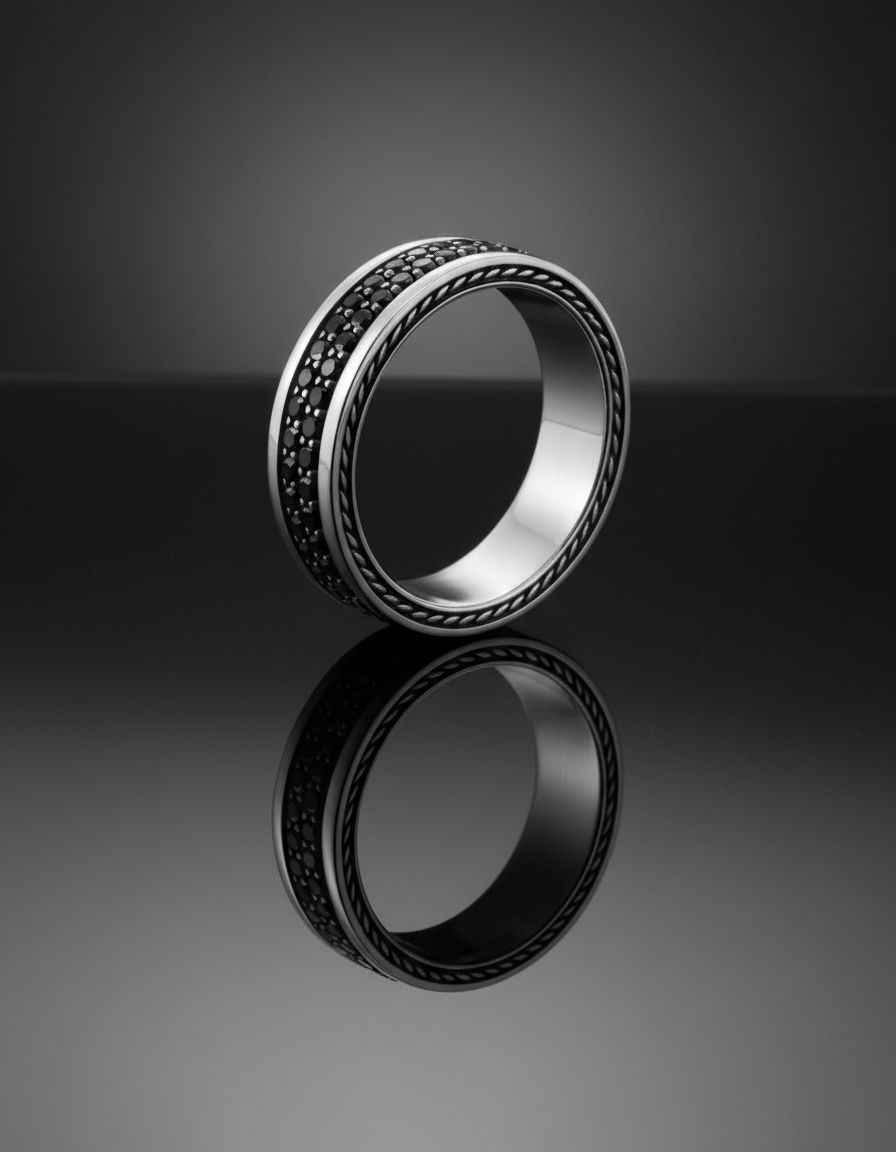
AXIOM works in white tones: most pieces are 925 sterling silver, and a few, such as the Valor Band with its two rows of natural black diamonds, are offered in 18K white gold as well as silver. There is no rose or yellow gold in the ready-to-wear range, so a warm-toned piece would be a bespoke commission, designed and approved in CAD before it is made.
The practical takeaway
Do the wrist test in daylight before you trust any chart, then let the watch he already wears decide between warm and white metals. If you choose rose gold, buy solid 14K or 18K rather than plating, and if his skin is sensitive, avoid nickel white gold and plated base metal altogether.
