
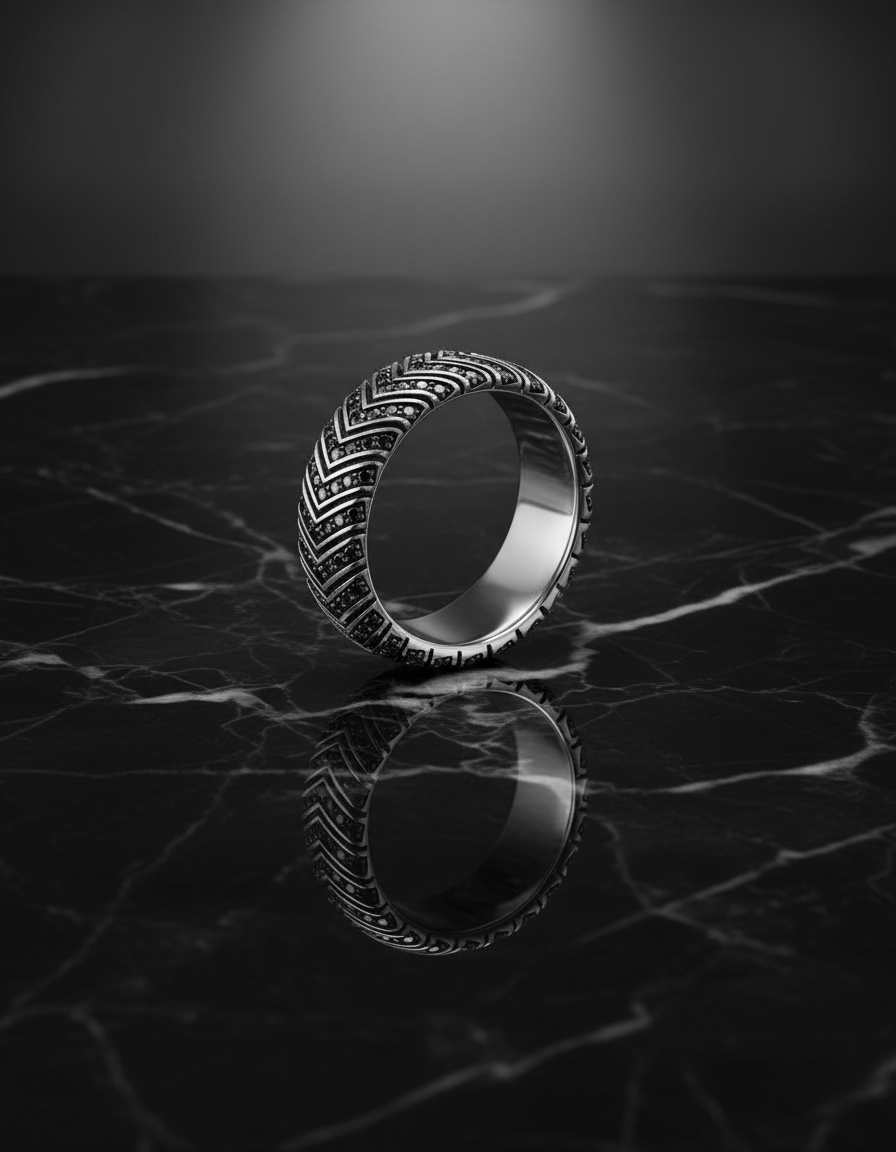
Indian jewellery shops are built around 22K. It is what most families buy for weddings and what sits in the bank locker. Men's jewellery that is worn hard every day, especially anything set with diamonds, lives by different rules, and that is where the choice between 18K and 22K becomes practical rather than traditional.
18K vs 22K gold: the key differences at a glance
The core difference is gold content: 18K is 75 percent gold, 22K is 91.6 percent. Everything else, from hardness to colour to price, follows from that one number.
| Factor | 18K gold | 22K gold |
|---|---|---|
| Gold content | 75% | 91.6% |
| BIS purity mark | 18K750 | 22K916 |
| Hardness and scratch resistance | Higher | Lower |
| Colour | Softer yellow; also made as white and rose gold | Deep, rich yellow |
| Holds diamonds and gemstones | Securely | Less securely in claws |
| Price per gram | Lower | Higher |
| Resale value per gram | About 75% of the pure gold rate | About 91.6% of the pure gold rate |
| Best for | Daily wear rings, bracelets, diamond pieces | Plain chains, traditional kadas, gold held for value |
Both are real gold, and both are hallmarked in India. The BIS hallmarking FAQ lists 18K (750) and 22K (916) among the gold grades permitted under the Indian standard IS 1417 (the others are 14K, 20K, 23K and 24K, plus a voluntary 9K grade added in 2025), and a hallmarked piece carries the BIS logo, the purity grade and a six character HUID.
Which is more durable, 18K or 22K?
18K is more durable. Pure gold is very soft, and the World Gold Council notes that alloying gold with other metals is what gives malleable gold more durability. With 25 percent alloy against 8.4 percent, 18K is markedly harder than 22K.
In practice this shows up in three ways. An 18K ring picks up fewer deep scratches, keeps its round shape when squeezed, and holds fine details such as engraving and sharp edges for longer. A 22K ring worn daily will soften at the edges and show a satin of fine scratches within months, which some men like and others do not.
Neither karat is fragile. Heavy 22K kadas and chains last generations because they are made thick. The difference is that 22K needs more metal to achieve the same stiffness, which makes the piece heavier and more expensive.
Is 22K gold too soft for diamonds?
Usually, yes. Claw and prong settings rely on thin tips of metal gripping a stone, and in 22K those tips bend more easily, so stones can loosen after knocks. That is why most diamond jewellery is made in 18K.
Bezel and flush settings, where metal surrounds the stone, are more forgiving, and some traditional Indian pieces set stones in 22K this way. For a men's diamond ring, band or bracelet that will be worn daily, 18K is the standard choice for a reason: the setting is only as secure as the metal holding it.
Colour: how 18K and 22K gold look on a man
22K has a deep, warm yellow that many Indian buyers associate with "real gold". 18K is a slightly softer yellow because of its higher alloy content, and its larger share of alloy lets it be made as white gold or rose gold. White gold needs more alloy than 22K leaves room for, so it is made in 18K or lower.
Colour is personal, but two practical points help. If you are matching an existing 22K chain or kada, a new 18K piece will look a shade paler beside it. If you want a white metal look in gold, you need 18K or 14K white gold, not 22K. Our 14K vs 18K gold comparison covers white gold in more detail.
Does 18K gold tarnish or turn black?
Solid 18K gold does not rust or corrode, and it does not tarnish the way silver does. With 25 percent alloy it can, in some conditions, dull slightly or leave a faint dark mark on skin where sweat, chlorine or cosmetics react with the alloy metals. A gentle wash in mild soap and warm water restores it.
22K, with less alloy, is even less prone to this, but it scratches faster, so it tends to look worn rather than dull. If a "gold" piece turns black and the colour rubs off to reveal a different metal underneath, it was plated, not solid, whatever karat was claimed.
18K gold vs 18K gold plated: not the same thing
"18K gold plated" means a thin layer of 18K gold over a base metal such as brass or copper. It is not 18K gold jewellery, and it has almost no gold value. The plating wears through with daily use, often within months on a ring.
The way to tell is the hallmark. Solid 18K gold sold in India carries 18K750, the BIS logo and a HUID that verifies in the BIS Care app. Plated pieces carry no BIS gold hallmark, and are often stamped GP or described as "gold tone". When a price looks far below the 18K rate for the weight, assume plating until the hallmark proves otherwise.
Why do Indian jewellers mostly sell 22K?
22K has been the standard for Indian gold jewellery for generations because families buy gold as both adornment and savings, and 22K keeps more of its value as metal. Wedding sets, bangles and plain chains are made heavy, so softness matters less.
18K has grown with diamond jewellery and with modern, lighter designs, because both need harder metal. For men's pieces worn daily, the balance usually tips towards 18K; for gold held as family wealth, towards 22K.
18K vs 22K gold price: how the maths works
Gold jewellery in India is priced per gram of metal at the rate for its karat, plus making charges and GST. The 22K and 18K rates follow directly from the pure gold rate multiplied by the purity.
Here is the method, with a placeholder rate used only to show the arithmetic:
- Take the day's 24K rate. Assume ₹10,000 per gram for this example.
- Multiply by the purity: 0.916 for 22K gives about ₹9,160 per gram; 0.75 for 18K gives about ₹7,500 per gram.
- Multiply by the net gold weight. A 10 gram ring would carry about ₹91,600 of gold in 22K or ₹75,000 in 18K.
- Add making charges, stone charges if any, and GST.
The gold value difference is real, but it is not the whole bill. Making charges on detailed 18K pieces are often higher than on plain 22K pieces, which narrows the gap. Our guide to gold making charges explains how to compare two quotes line by line.
Resale and exchange: what happens when you sell
Jewellers value gold for exchange or buyback on its tested purity and net weight, so 22K returns more per gram simply because it contains more gold. Making charges are almost never recovered, whatever the karat.
This matters most if you are buying partly as a store of value. A plain 22K chain with low making charges keeps more of its purchase price as gold than an intricate 18K diamond ring, where much of what you paid is design, labour and stones. Deductions on exchange vary by jeweller, so ask before you buy what they would pay back on the piece.
18K or 22K for men: a verdict by piece
The right karat depends on what the piece has to survive. Use this as a starting point.
| Piece | Better choice | Why |
|---|---|---|
| Daily wear ring or wedding band | 18K | Resists scratches and keeps its shape |
| Diamond or gemstone ring | 18K | Holds stones securely |
| Plain chain | Either | 22K for colour and gold value; 18K for thinner, stronger links |
| Chain with a pendant | 18K | Links and bail wear at contact points |
| Plain kada | Either | 22K if made thick; 18K for fewer dents |
| Kada or bracelet with stones | 18K | Settings and hinges need harder metal |
| Gold bought partly for value | 22K | More gold per gram, lower making charges |
For a man who wants one gold piece and wears it constantly, 18K is the safer choice. For a family piece that is worn on occasions and valued as gold, 22K remains the traditional answer. If you are still deciding whether gold is right at all, solid gold vs sterling silver sets out the trade-offs.
How to check you are getting the karat you pay for
Read the hallmark before you pay. It should show the BIS logo, the purity grade (18K750 or 22K916) and a HUID, and the HUID should verify in the BIS Care app with the same purity and article type.
Then match the bill: the karat, the net gold weight and the per gram rate should all agree with the hallmark. The numbers themselves are explained in 916 vs 750 gold.
AXIOM offers 18K white gold as an option on three designs, including The Apex Ring, and in bespoke commissions, with almost all of its catalogue in 925 sterling silver.
The practical takeaway
Buy 18K for anything you will wear every day or set with stones. Buy 22K when colour and gold content matter more than wear resistance. Either way, check the hallmark, verify the HUID and compare the bill line by line.
