
If you have ever turned a gold ring over and found "916" or "750" stamped inside, you have met the fineness system. The meaning of each number is simpler than it looks, and once you can read it you can check a jewellery bill, compare two quotes and spot a stamp that is missing its other half.
What does 916 mean on gold?
916 means the metal is 91.6 percent pure gold, which is 22 karat. The number is a fineness figure: parts of pure gold per 1,000 parts of metal. The remaining 84 parts are alloy metals such as silver, copper and zinc, added because pure gold is too soft to hold its shape as jewellery.
The maths is straightforward. Karat measures purity in 24ths, so 22 karat is 22 parts gold out of 24. Divide 22 by 24 and you get 0.9167, written as 916 parts per thousand. Every other fineness number works the same way.
Gold fineness numbers and their karats
Each karat has a matching fineness number. The table below shows the ones you will meet in India, with what each is typically used for.
| Fineness stamp | Karat | Gold content | Typical use |
|---|---|---|---|
| 999 | 24K | 99.9% | Coins and bars |
| 995 | 24K | 99.5% | 24K jewellery grade in the BIS standard |
| 958 | 23K | 95.8% | Some traditional jewellery |
| 916 | 22K | 91.6% | Most Indian gold jewellery: chains, bangles, kadas |
| 833 | 20K | 83.3% | Less common traditional pieces |
| 750 | 18K | 75% | Diamond and gemstone jewellery, white gold |
| 585 | 14K | 58.5% | Lighter, harder everyday pieces |
| 375 | 9K | 37.5% | Lighter budget pieces; added to the Indian standard in 2025 as a voluntary grade |
The BIS hallmarking FAQ lists six gold grades under the Indian standard IS 1417: 14K (585), 18K (750), 20K (833), 22K (916), 23K (958) and 24K (995), and these six are the grades covered by mandatory hallmarking. A seventh grade, 9K (375), was added to the standard in July 2025; BIS describes it as a voluntary grade, as reported in April 2026. So a 9K piece may or may not be hallmarked; if it is sold as hallmarked, check that it carries a full hallmark and a HUID that verifies.
What does 750 mean on gold?
750 means 18 karat gold: 750 parts pure gold per 1,000, or exactly 75 percent. The other 25 percent is alloy, and that larger share of alloy is what makes 18K noticeably harder than 22K.
That hardness matters most when a piece holds stones. Prongs and channels in 18K keep their grip on a diamond through years of knocks, which is why most diamond jewellery worldwide is made in 750 gold. White gold is also usually 18K or 14K, because the alloy metals are what whiten it.
What does 585 mean on gold?
585 means 14 karat gold, 58.5 percent pure. Strictly, 14 divided by 24 is 0.583, but the international convention rounds the standard up to 585, and the Indian standard uses the same figure.
14K is less common in Indian shops than 18K or 22K, but it has grown as gold prices have risen. It is the hardest of the three common jewellery grades and the least yellow. Our 14K vs 18K gold comparison covers where it makes sense.
Where to find the 916 stamp, and why it is not a hallmark on its own
Look on a flat, hidden surface: the inside of a ring shank, the tongue of a chain clasp, the back of a pendant bail or the inner wall of a kada. The marks are small, so use a phone camera zoomed in or a 10x loupe.
On any gold piece hallmarked in India since 1 July 2021, the number sits inside a three part hallmark. BIS describes it as the BIS logo, the purity in karat and fineness (for example 22K916) and a six digit alphanumeric HUID that is unique to that piece.
| Mark | What it looks like | What it tells you |
|---|---|---|
| BIS logo | A small triangle standard mark | The piece went through the BIS hallmarking system |
| Purity grade | 22K916, 18K750 or 14K585 | Karat and fineness together |
| HUID | Six characters mixing letters and numbers | A unique ID you can check on the BIS Care app |
A bare "916" with no BIS logo and no HUID is only a claim scratched into metal. Anyone can stamp a number. This is the most common confusion behind searches like "is BIS hallmark and 916 the same": 916 is one part of the hallmark, not the hallmark. To confirm a HUID belongs to your piece, follow the steps in our HUID number check guide.
Older pieces hallmarked before July 2021 carry a different, four part format that included the assaying centre's mark and the jeweller's mark instead of a HUID. You may also hear "916 KDM", which describes an older soldering practice. KDM is not a BIS purity mark and adds nothing to a hallmark.
Why is 916 used as shorthand for 22 karat in India?
22K has been the standard purity for Indian gold jewellery for generations, and 916 is its fineness number, so jewellers and buyers began using the number as the name. "916 gold" on a shop board simply means 22 karat.
The shorthand became stronger once hallmarking spread, because 916 is the figure physically stamped on the piece. It is also the grade most families buy for wedding sets and bangles, so it is the one people see most often.
How to use the number to check a gold bill
The fineness number lets you check that the rate you were charged matches the purity you received. Jewellers price gold per gram by karat, and the 22K rate sits at roughly 91.6 percent of the pure gold rate before any margin.
- Read the purity grade on the hallmark, for example 18K750.
- Check the bill states the same karat and the net gold weight in grams.
- Confirm the per gram rate on the bill is the rate for that karat, not the 22K or 24K rate.
- As a rough check, multiply the day's 24K rate by the fineness divided by 1,000 (0.75 for 18K, 0.916 for 22K).
As an example with a placeholder figure only: if a jeweller's 24K rate were ₹10,000 per gram, a fair 18K metal rate would be near ₹7,500 per gram and 22K near ₹9,160, before making charges and GST. Our guide to gold making charges explains the rest of the bill.
916 vs 750: which should you buy?
Choose by what the piece has to do. 916 suits plain gold where colour and gold content matter most; 750 suits anything set with stones or worn hard every day.
| Question | 916 (22K) | 750 (18K) |
|---|---|---|
| Gold per gram | More | Less |
| Colour | Deep yellow | Paler yellow, or white gold |
| Scratch and dent resistance | Lower | Higher |
| Holds diamonds securely | Not ideal | Yes |
| Typical pieces | Chains, bangles, plain kadas | Diamond rings, bands, bracelets |
For a man's everyday ring, the difference is covered in depth in 18K vs 22K gold for men.
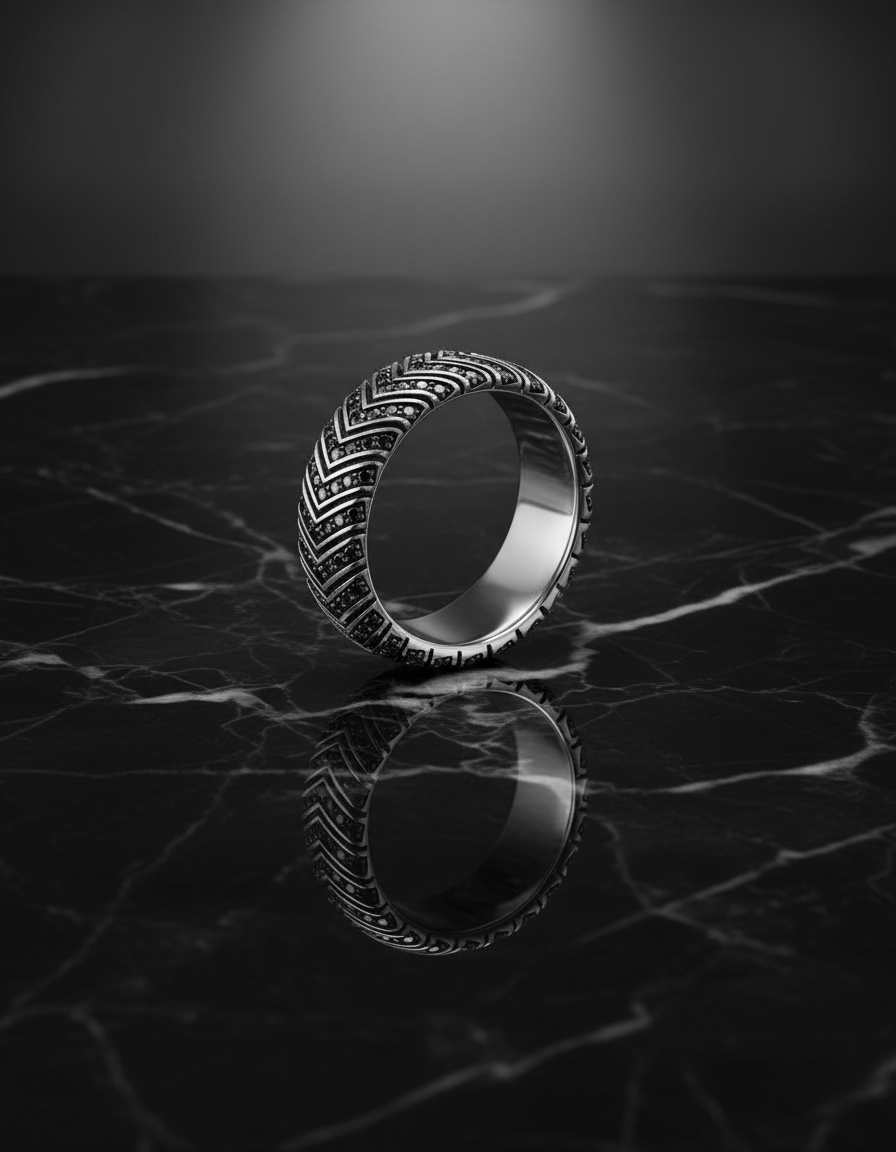
Most AXIOM pieces are 925 sterling silver set with diamonds, with 18K white gold offered on a few designs and on bespoke commissions, so the gold number to look for on its work is 750 rather than 916; each product page in the collection states the metal.
The practical takeaway
Treat 916, 750 and 585 as purity labels, and treat them as proof only when they sit beside the BIS logo and a HUID that verifies on the BIS Care app. Then check that the bill charges the rate for that exact karat.
