
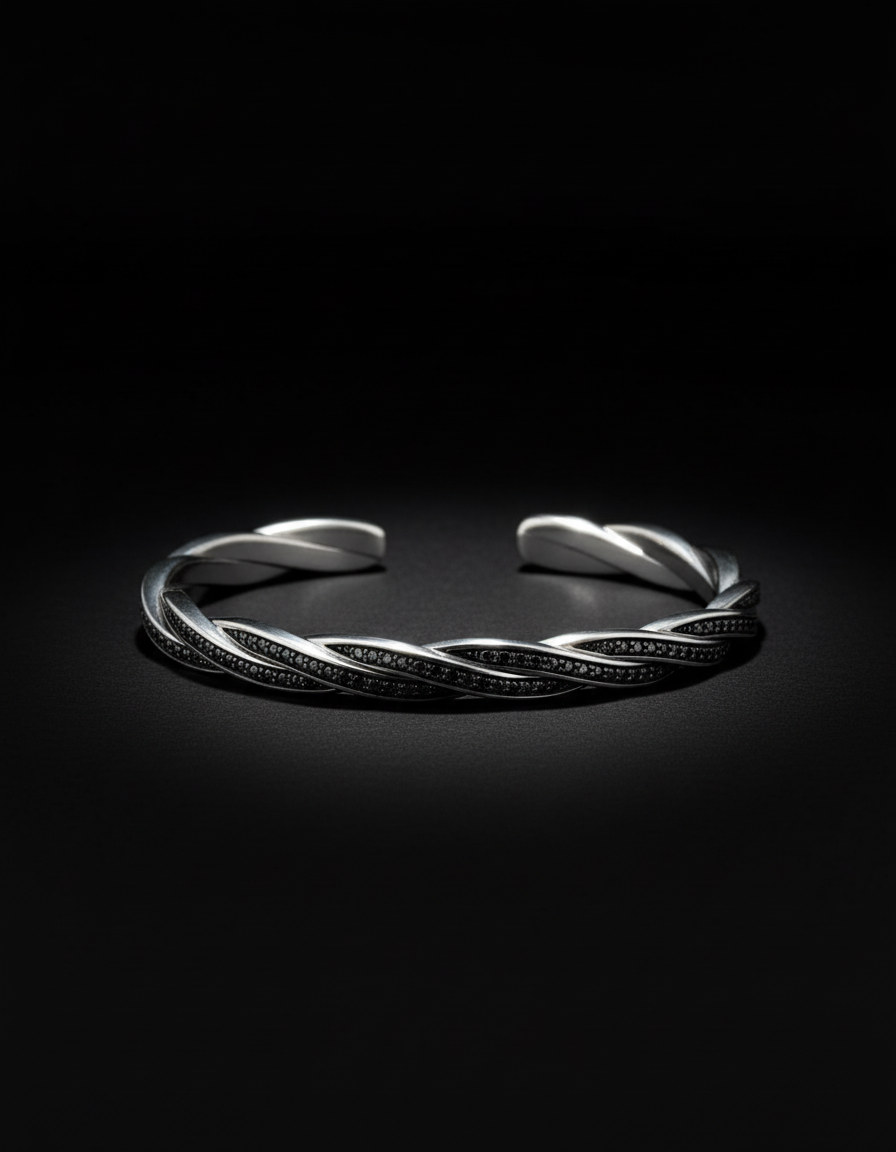
Personalisation is the most common way men are given jewellery with meaning, and the most common way it goes wrong is not the words but the method. A name laser-marked on the outside of a silver bracelet can look sharp on the day and soft within a few years, while the same name cut deep inside a kada can outlast the man who wore it. This guide covers what to engrave, where to put it on each type of piece, and which methods last.
What makes personalised jewellery last?
Three things decide how long engraving lasts: depth, position and metal. Depth matters most, because wear removes metal from the surface and a deep cut survives longer. Position comes next, because a surface that does not rub against skin, cuffs and desks barely wears at all.
Metal is the third factor. Sterling silver (92.5% silver) is softer than 18K gold, so engraving on an exposed face of a silver piece wears faster than the same engraving in gold. That does not rule out silver; it means putting the engraving somewhere protected and cutting it properly.
Engraving methods compared
Jewellers use four main methods, and they differ in depth, detail and durability.
| Method | How it works | Best for | Durability on silver |
|---|---|---|---|
| Hand engraving | An engraver cuts metal away with a steel graver | Monograms, script, decorative borders | Excellent when cut deep |
| Machine or rotary engraving | A rotating cutter follows a digital path | Block text, dates, logos | Good to excellent, depending on depth |
| Laser engraving | A laser vaporises or marks a thin layer of metal | Fingerprints, handwriting, fine detail | Fair: often shallow unless done in several passes |
| Deep seal engraving | Reverse-cut into a signet face, deep enough to press into wax | Crests and initials on signet rings | Excellent, the deepest of all |
Two methods sound similar but differ a lot. Laser marking changes the colour of the surface and has almost no depth, so it is the first to disappear. Laser engraving that removes metal lasts longer. Ask which one the jeweller means.
Where engraving works on each piece
Each type of men's jewellery has a natural place for engraving, usually the surface that faces the body.
| Piece | Best engraving area | How much text fits |
|---|---|---|
| Ring or band | Inside of the band | One short line: initials, a date, two names |
| Signet ring | The flat face (outside), or inside the band | A monogram or crest outside; a short line inside |
| Kada | Inner face | A longer line, such as a phrase or a mantra, on a wide kada |
| ID or bar bracelet | Back or front of the plate | A name and date on the front; a message behind |
| Pendant | Back face | A few words, a date, a fingerprint, or handwriting |
| Cufflinks | Front faces or backs | Initials on the front; a date or message on the back |
| Tie pin or lapel pin | Back of the head | Initials only |
The quantities are guidance rather than rules, since the space depends on the exact width and size. Ask the jeweller to lay the text out on a proof so you can see how large each letter will be.
Engraving ideas by occasion
The best engraving is short and specific. A single date or a few words in his own language carry more than a long quote.
- Engagement or wedding: the wedding date, both initials joined by a symbol, the coordinates of where you met, or a word from your vows.
- Anniversary: the original date and the current one, or a line in his first language. Our guide to the anniversary gift for your husband has more ideas.
- Birthday or milestone: his initials and the year, or a date that marks what he achieved.
- Father or son: a handwriting sample, a fingerprint, or a family name.
- Faith: a short mantra, a word in Gurmukhi or Devanagari, or a symbol. Keep it respectful and check the spelling with someone who reads the script.
- Memorial: a name and dates, often inside a band or on the back of a pendant where it stays private.
Name jewellery for men: engraved or cut-out?
A name can go on jewellery in two ways, and they wear very differently. It can be engraved into a solid surface, such as the plate of an ID bracelet or the face of a kada, or the letters themselves can be cut out and joined to form the piece, as in a name necklace.
| Style | How the name appears | Strength in daily wear |
|---|---|---|
| Engraved plate or kada | Letters cut into a solid surface | Strong: the piece keeps its full thickness around the letters |
| Cut-out name pendant | The letters form the pendant's outline | Weaker at thin joins between letters, especially in silver |
| Raised or cast lettering | Letters stand proud of the surface | Strong, but raised edges wear and catch on fabric |
For a silver bracelet or kada with his name, engraving on a solid surface is the most durable choice. For a name pendant, ask for thicker metal at the joins between letters, since those are the points that bend.
Silver or gold for engraved pieces?
Both engrave well; the difference is how the engraving ages. Gold holds a crisp edge longer because it is harder than sterling silver. Silver, in turn, often tarnishes slightly inside the cuts, which darkens the letters and can make them easier to read, not harder.
In practice, the choice of metal matters less than the choice of position and depth. A deeply cut name inside a silver kada will outlast a shallow mark on the outside of a gold one.
How to get the engraving right
Most engraving mistakes are made before the piece reaches the engraver. Five checks prevent them.
- Write the text exactly as it should appear, including capitals, punctuation and spacing, and send it in writing.
- Check every date in the format you want (18.09.2026, 18 SEP 2026, or XVIII.IX.MMXXVI).
- Ask for a proof, either the CAD render or a layout on a photo of the piece, and read it twice.
- Choose a simple font. Block capitals and clean serifs stay readable longest; thin scripts lose detail first.
- Confirm the depth and method, especially on silver, and ask whether the letters will be darkened for contrast.
Personalised ring, kada or signet: which suits him?
Choose the piece he will wear most, then personalise that. Engraving a piece that stays in a drawer is a sentiment nobody sees.
- A band suits a man who already wears a ring or is about to marry. The engraving stays private.
- A kada suits a man who wears one daily or for faith and family reasons. The wide inner face takes a longer line.
- A signet ring suits a man who wants the personalisation to be visible. For styles and face shapes, see the signet ring for men in India.
- Cufflinks suit a man who wears formal shirts often. Initials on the faces are the classic choice.
Are personalised and engraved pieces returnable?
Usually not. A piece engraved with one man's name or date is hard to resell, so most jewellers treat engraved and bespoke work as made to order and non-returnable. That makes the proof stage important: approve the text only when you are certain.
If you want a piece designed around a story rather than engraved after the fact, that is bespoke work; our guide to bespoke vs custom jewellery explains the difference, and how custom jewellery is made walks through the process.
How AXIOM approaches personalisation
At AXIOM, engraved and bespoke pieces are commissions, made to order. A commission starts with the occasion rather than a design, and the piece is refined through sketches and CAD until you sign off, so the words and their placement are agreed before anything is made. There is no deposit to begin, and the bespoke commissions page explains the steps. Like most engraved work, they are non-returnable. For ready-made pieces chosen for meaning, see gifts with meaning.
The practical takeaway
Engrave less, and engrave it deeper. A date and two initials cut inside a band will still be readable when the piece is handed down, which is the whole point of putting words into metal.
