
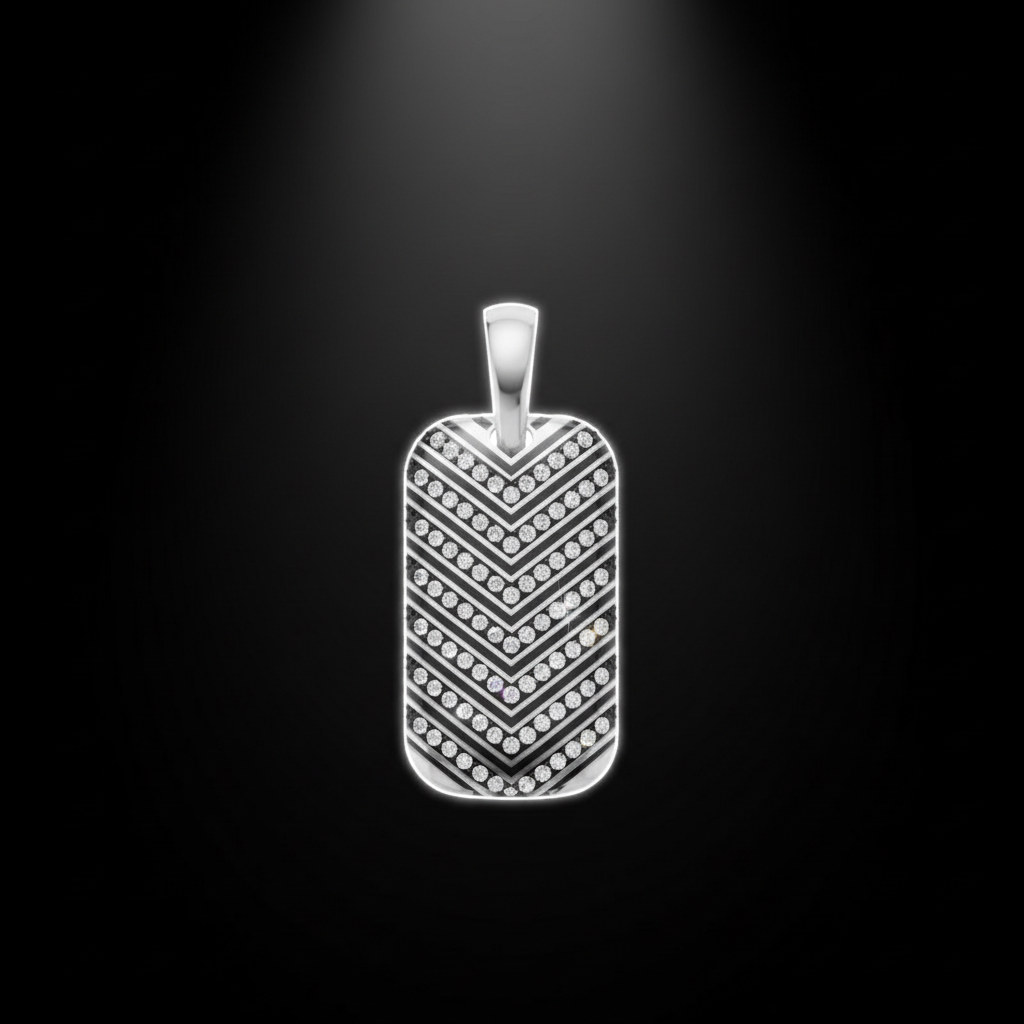
A diamond pendant is one of the few pieces of men's jewellery that can be worn with a T-shirt on Saturday and under an open collar at a wedding. Getting it right comes down to a handful of choices: black or white stones, natural or lab-grown, many small diamonds or one, silver or white gold, and a size that suits your frame. Each changes the look and the price more than the grading details most guides start with.
Black or white diamonds: which suits a men's pendant?
Choose white diamonds for sparkle and a classic, formal look, and black diamonds for a darker, graphic look that reads as understated. Mixed designs use black stones for the main form and white stones as accents.
| Factor | White diamonds | Black diamonds |
|---|---|---|
| Look | Bright, reflective, sparkling | Opaque, polished, graphic |
| Shows dirt | Quickly; needs regular cleaning | Hides everyday grime |
| Suits | Weddings, formal wear, gold and white metals | Dark clothing, everyday wear, silver |
| Treatment to ask about | Usually not a concern for colour | Many black diamonds are colour-treated |
According to GIA's guide to black diamonds, naturally black diamonds get their colour from countless tiny dark mineral inclusions such as graphite, and treated black diamonds are far more common in jewellery than naturally black ones. Treated black diamonds are still diamonds; you simply have a right to know which you are buying. Our explainer on whether black diamonds are real covers how they are made and identified.
Natural or lab-grown diamonds in a pendant?
Both are real diamonds, so the choice is about budget and what you value. The US Federal Trade Commission's guidance on diamond advertising describes lab-grown diamonds as having essentially the same optical, physical and chemical properties as mined diamonds.
| Factor | Natural diamonds | Lab-grown diamonds |
|---|---|---|
| Durability in a pendant | Identical | Identical |
| Price for the same size and grade | Higher | Usually much lower |
| Rarity | Finite | Can be produced to order |
| Resale market | Exists, with discounts | Limited today |
A pendant takes fewer knocks than a ring, so durability is not a deciding factor either way. For a fuller comparison in the Indian market, see our lab-grown diamond jewellery buyer's guide.
Pavé or single stone: which design should you choose?
Choose pavé (many small stones covering a shape) if you want the whole design to catch the light, and a single stone if you want one focal diamond. Most men's diamond pendants use pavé, because it lets a geometric or symbolic shape carry the diamonds without one large, expensive stone.
The small stones in pavé work are known as melee, diamonds under about 0.20 carat each. At that size, individual clarity and colour grades matter far less than whether the stones are well matched and securely set. For a single stone, cut, colour and clarity matter much more, and a grading report becomes worth asking for.
| Design | What you notice | Grading matters | Price driven by |
|---|---|---|---|
| Pavé shape | The overall form and texture | Little, per stone | Total carat weight and setting labour |
| Single stone (solitaire) | The one diamond | A great deal | Size and grade of that stone |
| Stone accents on metal | The metal design first | Little | Metal weight and design |
Silver or white gold setting?
925 sterling silver is the more affordable setting metal and looks bright white; 18K white gold is harder, heavier and costs several times more. Both hold diamonds well when the setting is properly made.
Silver is softer than gold, so in a silver pendant look for settings with enough metal around each stone. GIA's guide to ring settings notes that bezel settings give excellent resistance to chips and everyday wear, that channel settings are durable and suited to daily wear, and that pavé settings may need occasional maintenance to keep the stones secure. The same logic applies to pendants.
What drives the price of a men's diamond pendant?
Price is driven by the diamonds' origin and total carat weight, the metal and its weight, and the labour of setting. Because diamond and metal prices move, the useful thing to know is the logic rather than a fixed figure.
| Pendant type | Main cost driver | Relative price |
|---|---|---|
| Silver with a few accent diamonds | Metal and making | Lowest |
| Silver pavé, black or lab-grown white | Number of stones and setting labour | Moderate |
| Silver pavé, natural white diamonds | Diamond origin and carat weight | Higher |
| 18K white gold pavé | Gold weight plus stones | Higher still |
| Single natural diamond of meaningful size | That stone's size and grade | Highest |
When comparing quotes, ask for the metal and its weight in grams, the total carat weight, the number of stones, and whether each stone type is natural or lab-grown.
What size diamond pendant should a man wear?
Most men look right with a pendant 2.5 to 4 cm tall, bail included. Scale it to your height and build so it reads at conversation distance without dominating the chest.
| Frame | Pendant height | Chain width |
|---|---|---|
| Slim or under 5 ft 7 in | 2 to 3 cm | 1.5 to 2.5 mm |
| Average, 5 ft 7 in to 5 ft 11 in | 2.5 to 4 cm | 2 to 3 mm |
| Tall or broad, 6 ft and above | 3.5 to 5 cm | 3 to 4 mm |
What to check before you buy
Check these five things before paying for any diamond pendant:
- Setting security: shake it gently beside your ear and look under magnification; no stone should move.
- Bail strength: the loop should be thick, soldered and in proportion to the pendant's weight.
- Bail opening: it must be wide enough for your chain and its clasp.
- Stone disclosure: natural or lab-grown for each stone type, and whether black stones are treated, in writing.
- Certification wording: what document comes with the piece, and whether it is included or available on request.
How to wear a men's diamond pendant
A diamond pendant works with more outfits than most men expect. Match the chain length to the neckline.
- Over a T-shirt: 22 to 24 inches, pendant resting on the upper chest.
- Under an open collar: 20 to 22 inches, pendant just visible in the neckline.
- With a kurta: 22 to 24 inches, worn over the kurta or inside the placket opening.
- Under a buttoned shirt: any length, worn as a private piece.
Our men's chain length guide gives the full chart and explains how pendant height changes where it sits.
Which diamond pendant designs suit men?
Men's diamond pendants tend to work best when the diamonds follow a strong, simple form rather than forming a large sparkling cluster. Common designs include:
- Geometric shapes: bars, chevrons, shields and squares, often in black pavé with white accents.
- Crosses and religious symbols set with small stones.
- Initials and monograms outlined in diamonds.
- Emblems and crests, where diamonds pick out one element of the design.
- A single bezel-set stone on a plain metal pendant, for a minimal look.
Our men's pendant guide covers what each design family tends to say.
How to care for a diamond pendant
Diamonds are hard, but the metal around them and the grime that builds up behind them need attention.
- Soak the pendant in warm water with a drop of mild washing-up liquid, brush gently behind the stones with a soft toothbrush, rinse and pat dry.
- Keep it away from chlorine, perfume and harsh cleaners, which can dull silver and loosen deposits into the settings.
- Store it on its own, as a diamond can scratch other jewellery and the chain can tangle.
- Have the settings and bail checked every year or so, especially on pavé designs.
White diamonds need cleaning more often than black ones, since a thin film of skin oil visibly dulls their sparkle.
How AXIOM approaches this
AXIOM's diamond pendants are made in 925 sterling silver, and each product page states its stones. The Apex Pendant is set with natural black diamonds, from ₹73,200 at the time of writing, while the Ascent Pendant combines natural black diamonds with lab-grown white diamonds, from ₹86,000. Certification details are available on request, and the full range is in our pendants and chains category.
The takeaway
Decide black or white first, then natural or lab-grown, then pavé or single stone. Size the pendant to your frame, favour settings with metal around each stone, and get the stone origin and any treatment in writing.
