
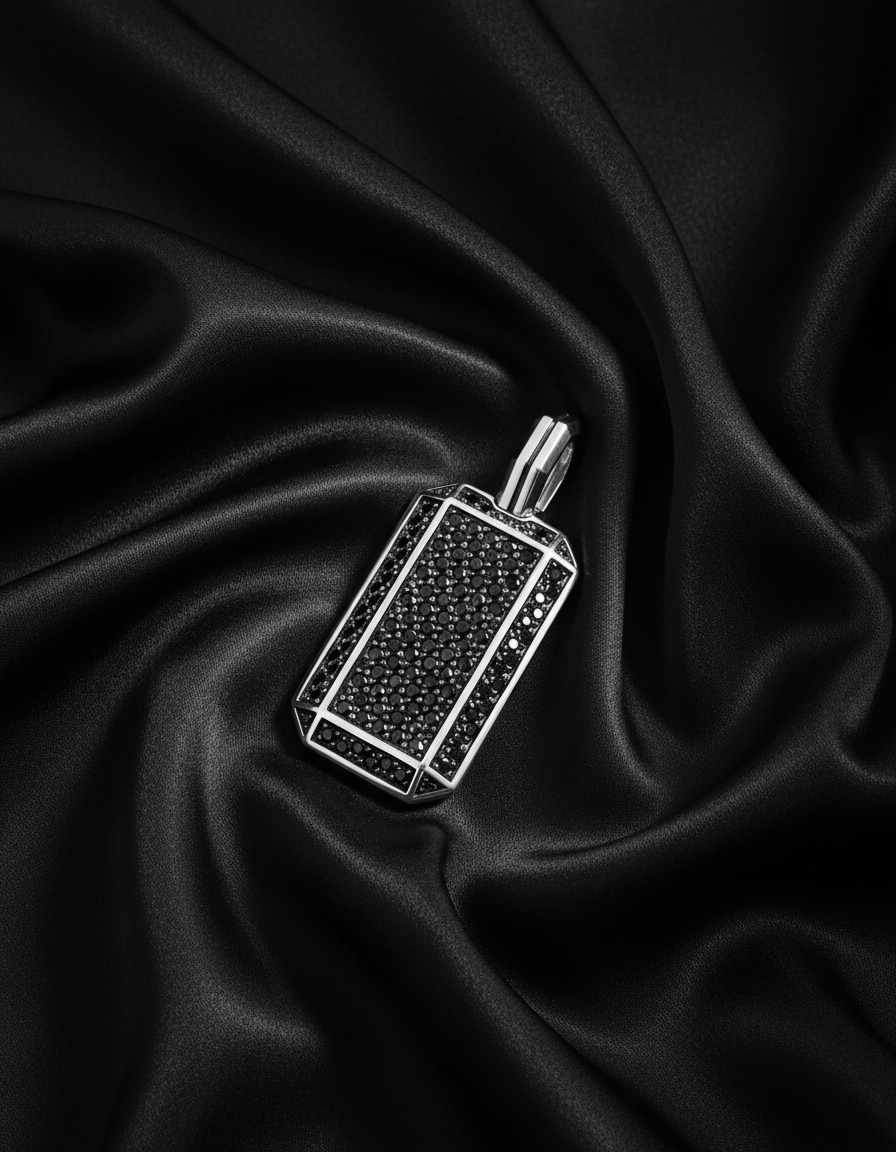
Most results for a customised pendant point to name pendants: a first name cut out in gold, chosen from a font list and delivered in days. That is a fine gift, but it is a different product from the one this guide covers. Here the subject is a pendant designed for one man around something that matters to him, set with real diamonds, and made to be worn for decades.
If you are still deciding between black and white stones or pavé and a single diamond, our guide to the men's diamond pendant covers those choices. This page is about commissioning: the brief, the design rules, the cost and the checks.
How is a custom pendant made?
A custom pendant moves from your brief to a sketch, a CAD render, a cast in metal, stone setting and finishing, with your approval needed at the sketch and CAD stages. Once you approve the CAD, the design is fixed.
| Stage | What happens | What you approve |
|---|---|---|
| Brief | You share the meaning, references, size and budget | The direction |
| Sketch | The designer draws one or more options | The concept and proportions |
| CAD render | A 3D model with exact dimensions and stone layout | Every millimetre, stone and engraving |
| Model and cast | The design is printed and cast in silver or gold | Nothing; production has begun |
| Setting | Diamonds are set by hand | Nothing; checked by the maker |
| Finishing | Polishing, any engraving, quality checks | The finished piece on delivery |
Timelines vary widely between makers. Simple name pendants can be turned round in under two weeks, while designed, stone-set pieces usually take several weeks. Our step-by-step guide to the custom jewellery design process explains each stage in more depth.
Custom pendant ideas for men beyond a name
The best men's custom pendants carry a meaning in their form, not in letters across the front. A name pendant says who; a designed pendant says why.
- An occasion. A wedding, a first child, a promotion or a retirement, marked by a shape and a date engraved on the back.
- A place. The outline of a city skyline, a mountain range or a coastline from a trip that mattered, with the place name inside.
- A symbol of faith. An Om, a khanda, a cross or a crescent, rendered with care and in proportions that respect the symbol. Ask your family or community about any conventions first.
- An emblem. A family crest, a regiment or college motif, or an animal that means something to him.
- An initial worked into geometry. A letter built into a shield or a bar, rather than written out.
- An artwork or a song. A motif from a painting he loves, or a few words from a favourite song engraved on the reverse.
Engraving lasts longest on the back of a pendant, where it does not rub against clothing. Our guide to personalised jewellery for men compares engraving methods and where each lasts.
How to brief a jeweller for a men's pendant
A good brief answers seven questions; the clearer each answer, the fewer revisions you will need.
- What does it mark? The occasion or meaning, in a sentence.
- What should it look like? Two or three reference images, plus anything you want to avoid.
- How big? Most men wear a pendant about 2.5 to 4 cm tall, bail included.
- Which stones? Natural or laboratory-grown, white or black, and roughly how many.
- Which metal? 925 sterling silver, or 14K or 18K gold, and which gold colour.
- Which chain? The chain style and width you will wear, so the bail is sized to it.
- What budget? A range, so the designer can scale stones and metal to match.
Design rules that make a custom pendant wear well
A men's pendant has to read clearly at conversation distance, hang straight and survive rubbing against shirts every day. Four details decide that.
- Silhouette. A bold outline reads from across a room; fine detail inside the shape is only seen up close. Design the outline first.
- Bail. The opening must pass your chain and its clasp, and the bail must be strong enough for the pendant's weight. Our guide to the best chain for a pendant covers widths and clasps.
- Back. A closed, polished back sits smoothly on the chest and can carry engraving. An open back lets light into the stones but can catch on fabric.
- Stone placement. Stones on the outer edges take the most wear. Bezel or channel settings protect them better than exposed claws.
Weight matters too. A heavy pendant pulls a slim chain and swings when you move, so ask for the expected finished weight in grams on the CAD.
Real diamonds in a custom pendant: what to ask
Ask for every stone to be named on the quote and invoice, because "custom diamond pendant" listings often include simulants.
| Stone | Real diamond? | How it should be described |
|---|---|---|
| Natural diamond | Yes | Diamond, or natural diamond |
| Laboratory-grown diamond | Yes | Laboratory-grown or laboratory-created diamond |
| Natural black diamond | Yes | Natural black diamond, with any colour treatment disclosed |
| Moissanite | No | Moissanite |
| Cubic zirconia (American diamond) | No | Cubic zirconia, CZ or American diamond |
According to the Gem and Jewellery Export Promotion Council's summary of IS 19469:2025, the unqualified word "diamond" refers only to natural diamonds, and lab-grown stones must be called laboratory-grown or laboratory-created diamonds. Simulants are a legitimate choice for a fashion piece, but they are not diamonds, and a commissioned pendant meant to last should say plainly what it contains.
How much does a custom diamond pendant cost?
A custom diamond pendant is priced from its parts: metal weight, diamonds, design and setting labour, and 3% GST on the total. That is why two quotes for the same idea can differ a great deal.
| Cost driver | What moves it up | What keeps it down |
|---|---|---|
| Metal | Gold, a larger or thicker design | Sterling silver, a lighter build |
| Diamonds | Natural white stones, larger total carat weight | Lab-grown white or natural black stones, fewer stones |
| Setting labour | Many small stones set by hand | Fewer, larger stones in bezels |
| Design work | Many revisions, complex 3D forms | A clear brief, a flatter design |
| Chain | Gold chain of matching weight | Silver chain, or one you already own |
To compare makers fairly, ask each for the metal and expected weight, the stone type, count and total carat weight, whether the chain is included, and any separate design fee. A pendant in 18K gold will weigh roughly 1.4 to 1.5 times the same design in silver, so the metal choice changes the quote more than most people expect.
Where can you get a custom pendant made in India?
You can commission one from a local jeweller, a large chain's customisation service, an online custom studio or a bespoke house; the right choice depends on how much design you need.
| Route | Strength | Watch for |
|---|---|---|
| Local jeweller and karigar | Personal, flexible, often quick | Ask for CAD and written stone details |
| Large jewellery chain | Standard billing and hallmarking | Customisation can be limited to set templates |
| Online custom studio | Convenient, often name-led | Check stone descriptions and refund terms |
| Bespoke house | Design from scratch around a meaning | Longer timelines; plan ahead |
Mumbai is home to the Bharat Diamond Bourse, which describes itself as the world's largest diamond exchange, so makers there handle stones daily, but a good maker anywhere will show you the CAD, name every stone and tell you the timeline before you pay.
How AXIOM approaches this
At AXIOM, a bespoke commission starts from the occasion rather than a catalogue, and keepsake pieces can carry a trip or a place, a favourite song or an artwork, worked into the design or engraved. The diamonds are chosen with you as natural or lab-grown, the pendant is made in sterling silver or in 14K or 18K gold, and it takes about three weeks to make plus delivery. There is no deposit to begin, and our ready designs in pendants and chains, such as the Sentinel Pendant in 925 sterling silver with natural black diamonds, show the scale and setting style we work in.
The practical takeaway
Start with the meaning, not the font. Write a seven-line brief, insist on a CAD render with dimensions and named stones, and check the bail against your chain before you approve. A custom piece cannot usually be returned, so every decision belongs at the approval stage.
