
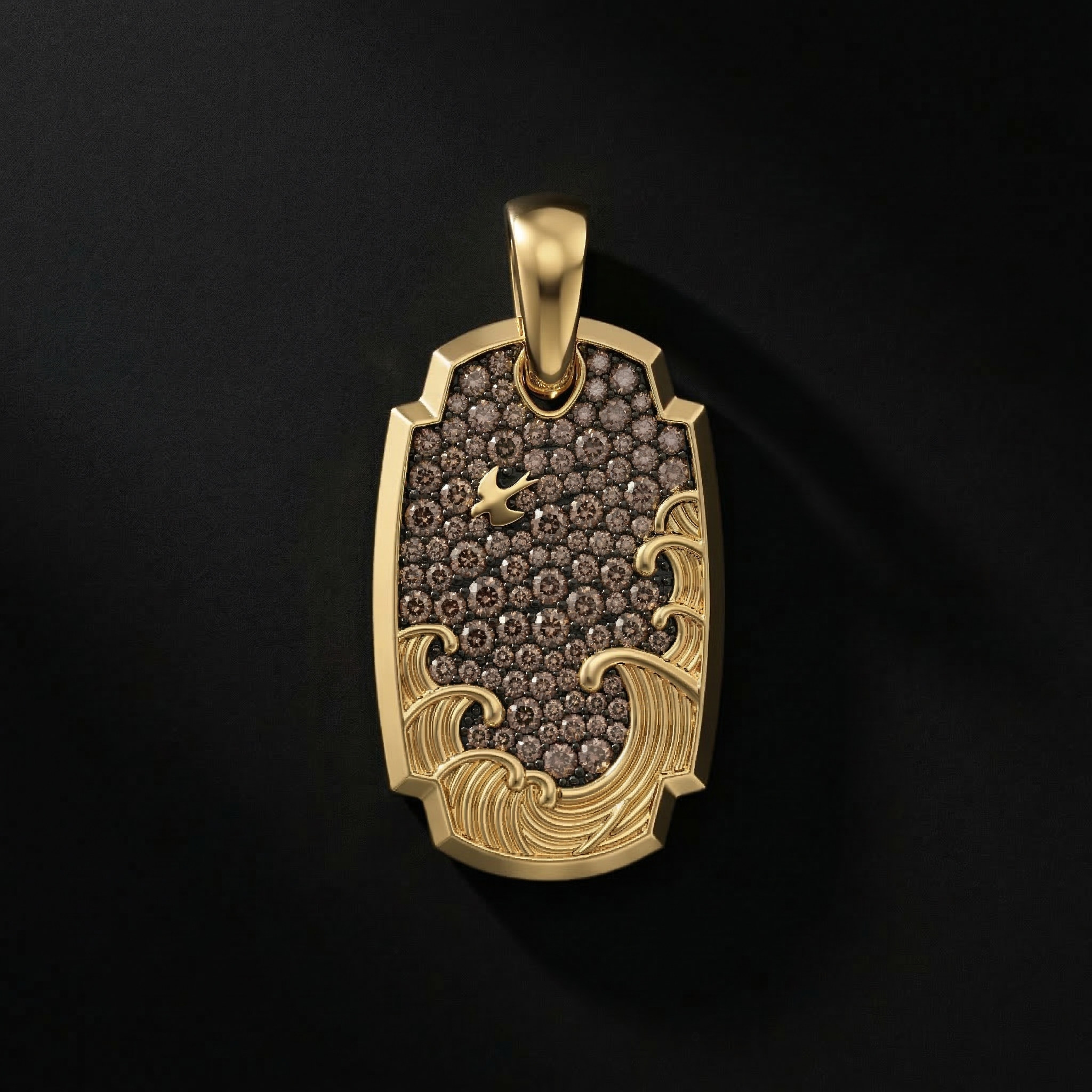
Most pendant problems are chain problems. A pendant that keeps flipping, a chain that snaps at the bail, a clasp that will not fit through the loop: all of these come from pairing the wrong chain with the pendant. The fix is to choose the chain by three things, in order: the pendant's weight, its bail opening, and how you want it to hang.
What is the best chain for a heavy pendant?
For a heavy pendant, the best chains are solid box, wheat, franco, Cuban, curb or rope chains of about 3 to 4 mm and wider. These styles spread the pendant's weight across many points of contact between links, so no single link carries the load.
Chains to avoid with a heavy pendant are snake, herringbone and fine cable chains. A snake chain kinks permanently under load, a herringbone chain creases, and a thin cable chain concentrates the weight on single links that stretch and open.
Chain width by pendant weight
Match the chain's width to the pendant's weight. The bands below are a practical rule of thumb for solid chains in 925 sterling silver or 18K gold; hollow chains need to go wider.
| Pendant weight | Example | Minimum chain width | Recommended link styles |
|---|---|---|---|
| Under 5 g | Small initial, slim cross, small charm | 1.5 to 2 mm | Box, cable, fine curb |
| 5 to 15 g | Most men's pendants, medium stone-set pieces | 2 to 3 mm | Box, wheat, curb, rope |
| 15 to 30 g | Large medallions, heavy silver pendants | 3 to 4 mm | Wheat, franco, box, Cuban |
| Over 30 g | Statement pieces, large coins | 4 to 6 mm or more | Franco, Cuban, heavy curb |
If you do not know the pendant's weight, ask the seller or weigh it on a kitchen scale that reads in grams. A pendant that feels heavy in the palm is almost always heavier than people guess.
How to check the bail fits the chain
The chain must pass through the pendant's bail, the small loop or tube at the top. Measure the bail's inside opening in millimetres and compare it with the widest part of the chain you will thread through it.
That widest part is often not the chain but its end hardware. A lobster clasp or end cap can be wider than the links themselves, so a 3 mm chain may still refuse to pass through a 3.5 mm bail. Two practical fixes:
- Thread the chain from its other end, where there is usually only a small ring rather than the clasp.
- If neither end fits, choose a slimmer chain in a stronger style, such as box or franco, which gives more strength per millimetre of width.
A bail that is far larger than the chain has the opposite problem: the pendant slides, spins and knocks against the chain. Aim for a bail opening slightly larger than the chain, not several millimetres larger.
Which chains keep a pendant flat and centred?
Box, franco and wheat chains keep a pendant most stable. Their links have flat faces or a tight braid, so the chain resists rolling and the pendant faces forward.
| Link style | Pendant behaviour | Notes |
|---|---|---|
| Box | Stays flat and centred | Slim for its strength; fits small bails |
| Franco | Stays centred, rarely turns | Stiff; very strong |
| Wheat | Stable, hangs straight | Good for heavier pendants |
| Curb | Mostly stable | Lies flat; versatile |
| Rope | Can turn slightly | Strong, textured look |
| Cable | Pendant may slide and flip | Fine only for light pendants |
| Snake | Pendant slides freely | Kinks under heavy pendants |
For more on each link style, see our guide to the types of chains for men.
Does a pendant come with a chain?
It depends entirely on the listing. A pendant is the hanging ornament; a chain is a separate component. Some pendants are sold alone, some as a set with a chain, so read the product description and, if it is unclear, ask the seller before you order.
Buying a pendant without a chain: what to measure first
If your pendant arrives on its own, note four measurements before shopping for a chain:
- Pendant weight in grams, to choose the width from the table above.
- Bail inner opening in millimetres, height and width, to confirm the chain and clasp will pass through.
- Pendant height, bail included, to work out where it will sit on your chest.
- Pendant metal, so you can match it.
With these, you can choose a chain in one visit rather than returning one that does not fit.
How long should the chain be?
Choose the length so the pendant, not the chain, sits where you want it. A pendant hangs below the chain by its own height, so a larger pendant needs a slightly longer chain to sit flat on the chest rather than against the throat. For most men, 22 to 24 inches (56 to 61 cm) works for a medium pendant. Our men's chain length guide has the full chart and the pendant maths.
Which clasp is best for a pendant chain?
A lobster clasp is the best everyday choice for a pendant chain: it closes with a spring-loaded lever, holds firmly and is easy to fasten. For heavier pendants it matters more than the link style, because the clasp is often the first thing to fail.
| Clasp | Security | Best for |
|---|---|---|
| Lobster | High | Most pendant chains, including heavy ones |
| Spring ring | Medium | Light chains and small pendants |
| Box clasp | High when well made | Wider chains; sits flush |
| Magnetic | Low to medium | Light chains only; can pull open |
Check the clasp's width against the bail opening before buying, since a large lobster clasp may not pass through a small bail.
How AXIOM approaches this
AXIOM's pendants and chains category lists every pendant with its exact metal and stones. The Crest Pendant, for example, is 925 sterling silver, from ₹67,900 at the time of writing. Before pairing any pendant with a chain, check the product page for what is included and ask on WhatsApp for the bail opening if you need it.
The takeaway
Weigh the pendant, measure the bail, then pick a solid box, wheat, franco or curb chain wide enough for the weight and slim enough, clasp included, to pass through the bail. Skip snake and fine cable chains for anything heavy, and set the length by where the pendant should sit. For design ideas before you pair, our men's pendant guide covers styles and meanings.
