
A chain's link style decides how it looks, how it moves, whether it tangles and how long it survives daily wear. Two chains of the same weight and length can behave completely differently: one lies flat for years, the other kinks in a month. This guide covers the fifteen link styles men actually wear, compares them on strength, pendant fit and tangle risk, and ends with a quality check you can run in the shop.
The main types of chains for men at a glance
The table compares each style in solid construction at a typical everyday width of 3 to 5 mm.
| Chain type | Look | Strength | Holds a pendant | Kink or tangle risk |
|---|---|---|---|---|
| Curb | Flat, twisted oval links | High | Yes | Low |
| Cuban (Miami Cuban) | Thick, dense curb links | Very high | Yes, if bail fits | Very low |
| Figaro | Pattern of one long and two or three short links | Medium to high | Yes | Low |
| Rope | Twisted strands forming a spiral | Medium to high | Yes | Medium |
| Box | Square, box-shaped links | High | Very well | Low |
| Franco | Tight V-shaped links, four-sided | Very high | Very well | Very low |
| Wheat (spiga) | Braided, ear-of-wheat pattern | High | Very well | Low |
| Singapore | Fine twisted, diamond-cut links | Low to medium | Light pendants only | Medium |
| Snake | Smooth, flexible tube | Low to medium | Light pendants only | High (kinks) |
| Cable (rolo, belcher) | Plain round or oval rings | Depends on thickness | Yes, if thick enough | Medium to high when fine |
| Mariner (anchor) | Oval links with a bar across each | Medium to high | Yes | Low |
| Bead (ball) | Small metal balls on a wire | Low | Very light pendants only | Low |
| Herringbone | Flat, slanted plates in a smooth ribbon | Low | No | Very high (creases) |
| Byzantine | Dense, interwoven links in a rope-like round profile | Very high | Yes | Low |
| Paperclip | Long, flat oval links like a paperclip | Medium | Light pendants only | Low |
If you want one chain to wear every day with or without a pendant, a solid curb, box or franco chain of 3 to 4 mm is hard to go wrong with.
Curb and Cuban chains
A curb chain is made of uniform oval links, twisted so they lie flat against the skin. It is the most common men's chain style because it looks clean, rarely tangles and suits both a pendant and wearing alone.
A Cuban chain, often called a Miami Cuban, is a heavier, denser curb. Its links are thicker and packed more tightly, so it feels solid and drapes like a flat rope of metal. Cuban chains are commonly made from about 3 mm to well over 10 mm wide. Below 5 mm a Cuban reads as a strong everyday chain; above 8 mm it is a statement piece with real weight on the neck.
Figaro and mariner chains
A figaro chain repeats a pattern of one elongated link followed by two or three short ones. It is a curb variant, so it lies flat and resists tangling, and the rhythm of the pattern makes it recognisable from a distance. It is usually worn alone or with a small pendant.
A mariner, or anchor, chain uses oval links with a bar across the middle of each, like a ship's anchor chain. The bar stiffens each link, which helps it hold shape. It has a nautical, slightly heavier look than a cable chain of the same width.
Rope and wheat chains
A rope chain twists several strands of small links into a spiral that catches light along its length. It carries a pendant well and looks richer than its weight suggests, but thin rope chains can snag and are hard to repair if a section breaks.
A wheat or spiga chain braids four strands of oval links into a pattern like an ear of wheat. It is stiff, holds its round profile and is one of the better choices for a heavier pendant, because the braid spreads the load across many links.
Box and franco chains
A box chain is made of square links joined at their edges, giving a clean, geometric line. It keeps a pendant from sliding and twisting, and it is one of the most reliable pendant chains at modest widths of 2 to 3 mm.
A franco chain interlocks V-shaped links so tightly that the chain has four flat faces. It is among the strongest link styles for its width, almost never kinks and keeps a pendant centred. The trade-off is stiffness: a franco chain does not drape as softly as a curb.
Snake, Singapore, cable and bead chains
A snake chain is a smooth, flexible tube of tightly fitted plates. It looks sleek and modern, but once bent sharply it kinks, and a kink is often permanent. It suits light pendants and careful wearers.
A Singapore chain twists fine, diamond-cut links into a sparkling, fluid line. It is elegant but delicate, better for light wear than a gym bag.
A cable chain is the simplest construction: plain round (rolo) or oval (belcher) links joined one to the next. A thick cable chain is sturdy; a fine one tangles and can snap under a heavy pendant. Bead or ball chains string small metal balls on a wire, and are best kept for dog tags and very light pendants.
Herringbone, Byzantine and paperclip chains
A herringbone chain lays flat, slanted plates side by side to form a smooth, liquid-looking ribbon. It looks striking and lies completely flat, but it is the most fragile common style: one sharp bend creases it permanently, and it should never carry a pendant.
A Byzantine chain interweaves four or more links into each other in a dense, repeating pattern with a round profile. It is heavy for its length, very strong and rarely kinks, so it works well worn alone as a substantial chain or with a heavier pendant.
A paperclip chain uses long, flat oval links, usually 6 to 10 mm long, joined end to end. It has become popular in silver in the last few years as a light, modern chain. The open links are comfortable and easy to layer, but they are not strong for their width, so keep pendants light.
Which chain is strongest?
Solid franco, Cuban, Byzantine, curb and box chains are the strongest common styles, in roughly that order at the same width. Snake, Singapore, herringbone, fine cable and bead chains are the weakest.
Link style is only part of strength. Three other things matter just as much:
- Wire thickness: a 5 mm curb is far stronger than a 2 mm curb.
- Solid or hollow links: solid links resist crushing; hollow ones dent.
- Soldered links and a sound clasp: an unsoldered link or a weak spring clasp is where most chains fail.
Hollow vs solid chains: why hollow chains dent
A hollow chain is made from tubes of metal rather than solid wire, so it looks as wide as a solid chain while using a fraction of the metal. That makes it cheaper, but the thin walls dent when pressed, crease when kinked and are difficult to repair without the repair showing.
A quick test is weight for length. Hold two chains of the same style, width and length: the solid one feels noticeably heavier. Ask the seller directly whether a chain is solid or hollow, and ask for its weight in grams. For a chain you will wear every day, a solid chain one size narrower almost always outlasts a hollow chain one size wider.
Silver or gold: which chain types suit each metal?
Most link styles are made in both 925 sterling silver and gold, but silver is softer, so it rewards sturdier styles and slightly wider widths.
| Metal | Styles that work well | Styles to be careful with |
|---|---|---|
| 925 sterling silver | Curb, Cuban, box, franco, wheat at 3 mm and above | Fine snake, fine rope and Singapore below 2 mm |
| 18K or 22K gold | Almost all styles, including fine ones | 22K fine chains, which are soft and stretch |
| Hollow gold | Rope and Cuban for a big look | Any daily wear where knocks are likely |
Silver chains also tarnish and need occasional cleaning. Our guide to the silver chain for men covers weight, thickness and price in silver.
How to check chain quality before you buy
Check any chain in good light, flat on a table, before paying.
- Run it through your fingers: every link should be the same size and shape, with no flat spots, kinks or twisted sections.
- Look at the links near the clasp: they take the most strain and should be soldered closed, with no visible gap.
- Check the clasp: a lobster clasp is more secure than a spring ring for heavier chains, and it should snap shut firmly.
- Compare weight for length: a chain that feels light for its width is probably hollow.
- Find the stamp: silver should carry a 925 mark, and gold should carry the BIS hallmark.
- For hallmarked gold, check the three marks BIS describes in its hallmarking FAQ: the BIS logo, the purity grade and a six-character alphanumeric HUID.
Which chain type suits which man?
Choose by how you will wear it. A man who wears one chain daily and forgets about it needs a flat, tough style; a man who wants a statement piece can afford a softer, showier one.
| Wearer | Chain type | Width |
|---|---|---|
| First chain, everyday | Curb or box | 2 to 3 mm |
| Pendant wearer | Box, wheat, franco or rope | 2 to 4 mm |
| Wants a bold look | Cuban or franco | 5 to 8 mm |
| Office and formal | Box or fine curb | 1.5 to 2.5 mm |
| Layering two chains | Box with curb, or rope with figaro | Vary by 1 to 2 mm |
For how long each chain should be and how to layer them, see our men's chain length guide. If you are buying the chain for a particular pendant, our guide to choosing a chain for a pendant covers bail size and load.
How AXIOM approaches this
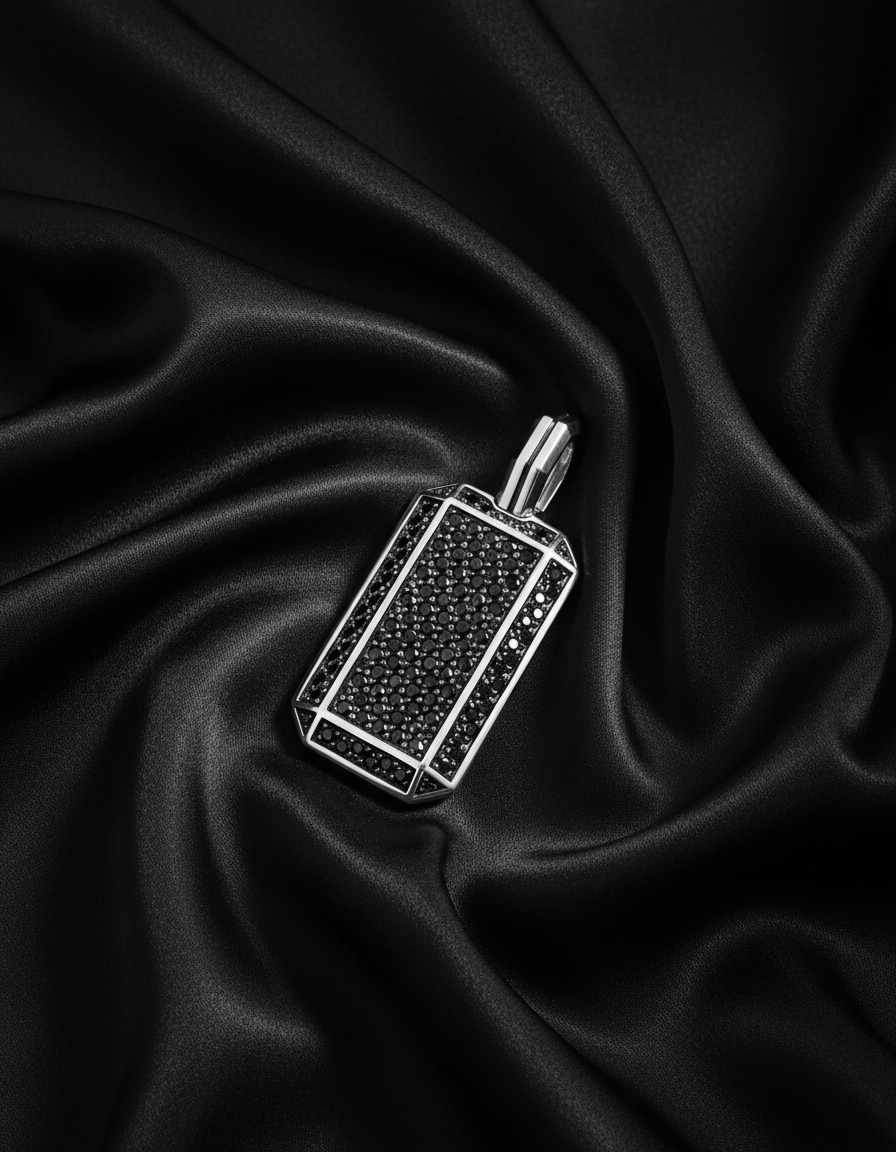
AXIOM's catalogue is pendant-led rather than chain-led. Each piece in our pendants and chains category is listed with its exact metal and stones, such as the Apex Pendant in 925 sterling silver with natural black diamonds. If you are unsure which link style will suit a particular pendant, ask on WhatsApp before ordering.
The takeaway
For one chain that lasts, buy a solid curb, box or franco chain of 3 to 4 mm with a lobster clasp and a proper purity stamp. Save snake, Singapore, paperclip and fine cable chains for light pendants and careful wear, keep herringbone chains for occasional wear without a pendant, avoid hollow chains for daily use, and check every link and the clasp before you pay.
