
Anyone who has checked the silver rate and then looked at a designer silver ring has had the same thought: the numbers do not match. The gap is real, and it is not all margin. This guide explains why, shows how to find the silver value of any piece, what the rest of the price pays for, and when a high price is justified and when it is not.
How much is the silver in a 925 ring actually worth?
Multiply the weight in grams by 0.925, then by the day's fine silver rate per gram. Sterling silver is 92.5% silver, and 925 is one of the silver fineness grades in India's hallmarking standard, as the BIS hallmarking FAQ lists.
The benchmark rate is published daily by the India Bullion and Jewellers Association. On 25 September 2026 its closing rate for 999 silver was ₹2,23,053 per kg (IBJA rates), or about ₹223 per gram. That is a bullion benchmark, not a retail price, and it moves every day.
| Piece | Typical weight | Silver content (× 0.925) | Silver value at ₹223 per gram |
|---|---|---|---|
| Slim band | 5 g | 4.63 g | about ₹1,030 |
| Men's ring | 10 g | 9.25 g | about ₹2,060 |
| Heavy signet | 20 g | 18.5 g | about ₹4,130 |
| Chain | 30 g | 27.75 g | about ₹6,190 |
| Solid kada | 50 g | 46.25 g | about ₹10,310 |
So a silver ring priced at ₹20,000 contains roughly ₹2,000 of silver. The other ₹18,000 is everything else.
What goes into the price of fine silver jewellery?
Stones, design and handwork usually cost far more than the silver in a finished piece. The table shows each component, what makes it larger or smaller, and what to ask the seller.
| Price component | What makes it bigger | What to ask the seller |
|---|---|---|
| Silver | Weight and solidity | What does it weigh? Is it solid or hollow? |
| Stones | Natural or lab-grown, total carat, number of stones | Are they diamonds, and which kind? Cubic zirconia? |
| Design and modelling | Original design, CAD work, prototypes | Is this an original design? |
| Casting and assembly | Complex shapes, multiple parts, hinges or clasps | Is it cast, hand-built or machine-made? |
| Stone setting | Number of stones and setting style (pavé, channel, flush) | How are the stones set? |
| Finishing | Hand-polishing, texturing, plating | Is it plated with anything? |
| Hallmarking and certification | Hallmarking each piece, grading reports | Is it hallmarked? Are stone details available? |
| Small-batch or made-to-order production | Lower volumes cost more per piece | Is it made to order or mass produced? |
| Overheads and margin | Brand, retail space, service, guarantee | What after-sales service is included? |
| GST | 3% of the total price | Is GST included in the price shown? |
Two lines deserve more explanation.
Stones. In a diamond-set silver piece, the stones are usually the biggest single cost, larger than the silver by a wide margin. Natural diamonds cost more than lab-grown, and more stones mean more cost even when each is tiny.
Setting labour. Every stone is set by hand: a seat is cut, the stone placed, and metal pushed over to hold it. A band with 40 stones means 40 of those operations, and each one has to be secure enough for a man's hand. On a pavé piece, setting can cost more than the silver.
Making charges on gold follow similar logic; we explain how they are calculated in gold making charges explained.
A worked example: where the money goes
The illustrative figures below show how a ₹20,000 diamond-set silver ring can break down. They are invented to show the proportions, not the costs of any brand, including ours.
| Line | Illustrative amount | Share |
|---|---|---|
| Silver (10 g of 925) | ₹2,060 | 10% |
| Small diamonds | ₹6,500 | 33% |
| Design, casting and finishing | ₹3,000 | 15% |
| Stone setting | ₹2,500 | 13% |
| Hallmarking, packaging, insured shipping | ₹700 | 4% |
| Overheads and margin | ₹4,657 | 23% |
| GST at 3% | ₹583 | 3% |
| Total | ₹20,000 | 100% |
Change the stones from lab-grown white to natural white and the stone line grows. Remove the stones and the price falls sharply. Double the silver weight and the price barely moves. That is the key point: in fine silver jewellery, silver is the cheapest ingredient.
Why is some 925 silver jewellery so cheap?
Because cheap pieces save on the parts that cost the most: stones, handwork and weight. None of these is dishonest if it is disclosed, but they explain the price difference.
- Mass production. Thousands of identical castings or machine-made chains spread the design and tooling cost thin.
- Light or hollow construction. Less metal, and hollow pieces dent.
- Simulated stones. Cubic zirconia looks like diamond when new and costs a tiny fraction.
- Plating. Gold or rhodium plating over silver changes the look cheaply but wears off with use.
- Not really 925. Some pieces stamped 925 are lower purity or silver-plated base metal. A hallmark showing the fineness is more reliable than a stamp alone.
For whether sterling silver suits men's everyday wear at all, see is 925 sterling silver good for men.
Is 925 silver jewellery a good investment?
No. Silver jewellery is not a silver investment, because at resale you get the silver content, not the price you paid. A buyer tests the purity, weighs the piece and pays a rate linked to the day's silver price, usually with a deduction. Design, labour, stones and GST are not recovered.
| What you paid for | What a buyer typically pays for |
|---|---|
| Silver content | Yes, by weight, often below the day's rate |
| Diamonds set in silver | Rarely; small stones are usually not valued |
| Design and handwork | No |
| Brand, service and guarantee | No |
| GST | No |
Diamonds follow a similar pattern at resale, which we cover in diamond resale value in India. This is general information, not financial advice. If silver prices are what interest you, bullion and other silver products track the metal far more directly than jewellery ever will.
How to tell whether a silver piece is fairly priced
- Ask the weight and work out the silver value with the formula above.
- Ask what the stones are: natural diamonds, lab-grown diamonds, or simulants.
- Look at the setting under good light: are stones level, secure and evenly spaced?
- Check the finish inside the band and on the underside, where shortcuts show.
- Check for a hallmark with the 925 fineness.
- Ask what after-sales service is included, and read the return and cancellation terms.
A high price is justified by real diamonds, dense hand-setting, solid weight and good finishing. It is not justified by a logo on a lightweight, plated casting with simulated stones.
How AXIOM approaches this
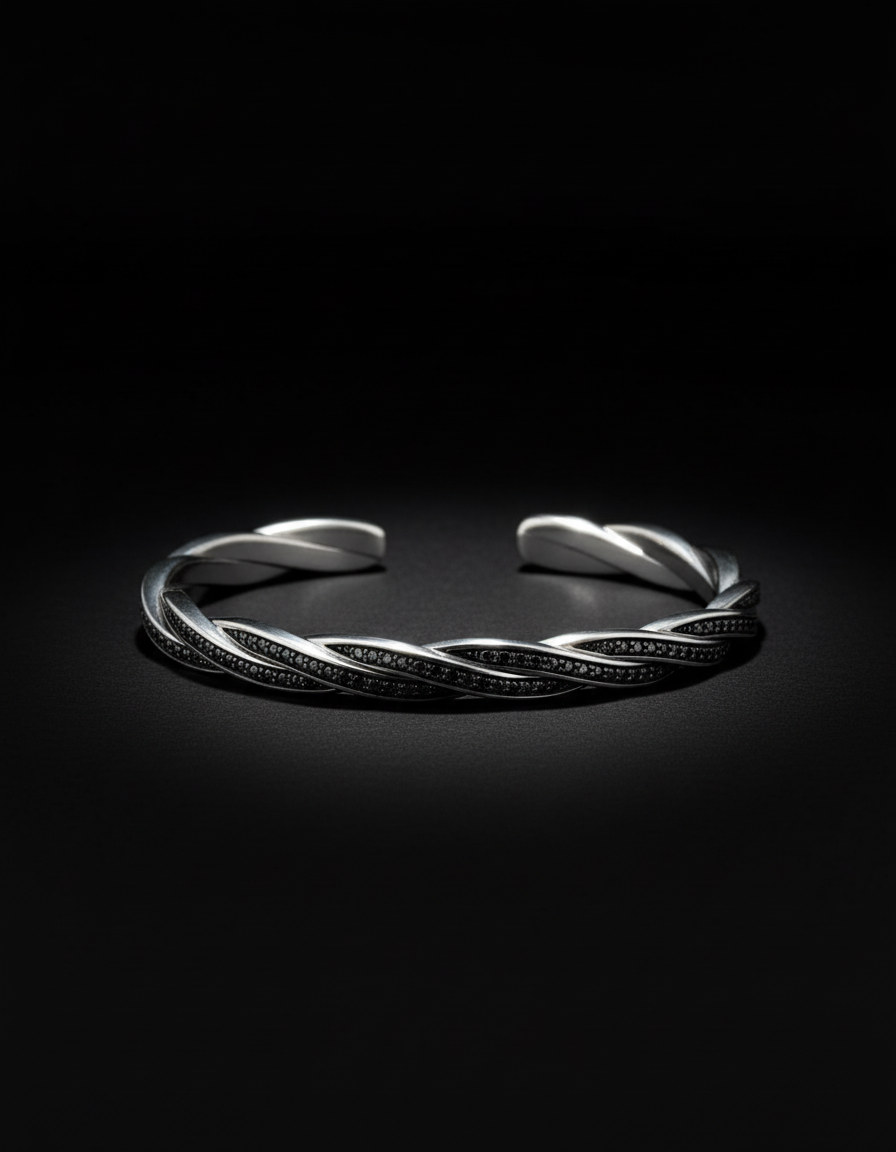
Almost every AXIOM piece is solid 925 sterling silver rather than plated base metal, and most are set with natural black or lab-grown white diamonds, and each is made to order and hand-finished at the Bharat Diamond Bourse in Mumbai. So the price goes into stones and handwork rather than a coating that wears off, and prices across the full collection run from ₹4,500 to ₹3,75,000 at the time of writing, with every piece carrying a lifetime craftsmanship guarantee. AXIOM does not offer a buyback, exchange or trade-in programme; our about page explains how we work.
The practical takeaway: work out the silver value first, then ask what the rest of the price buys. If the answer is real stones, hand-setting and solid metal, the gap makes sense. If the answer is a brand name, keep looking.
