
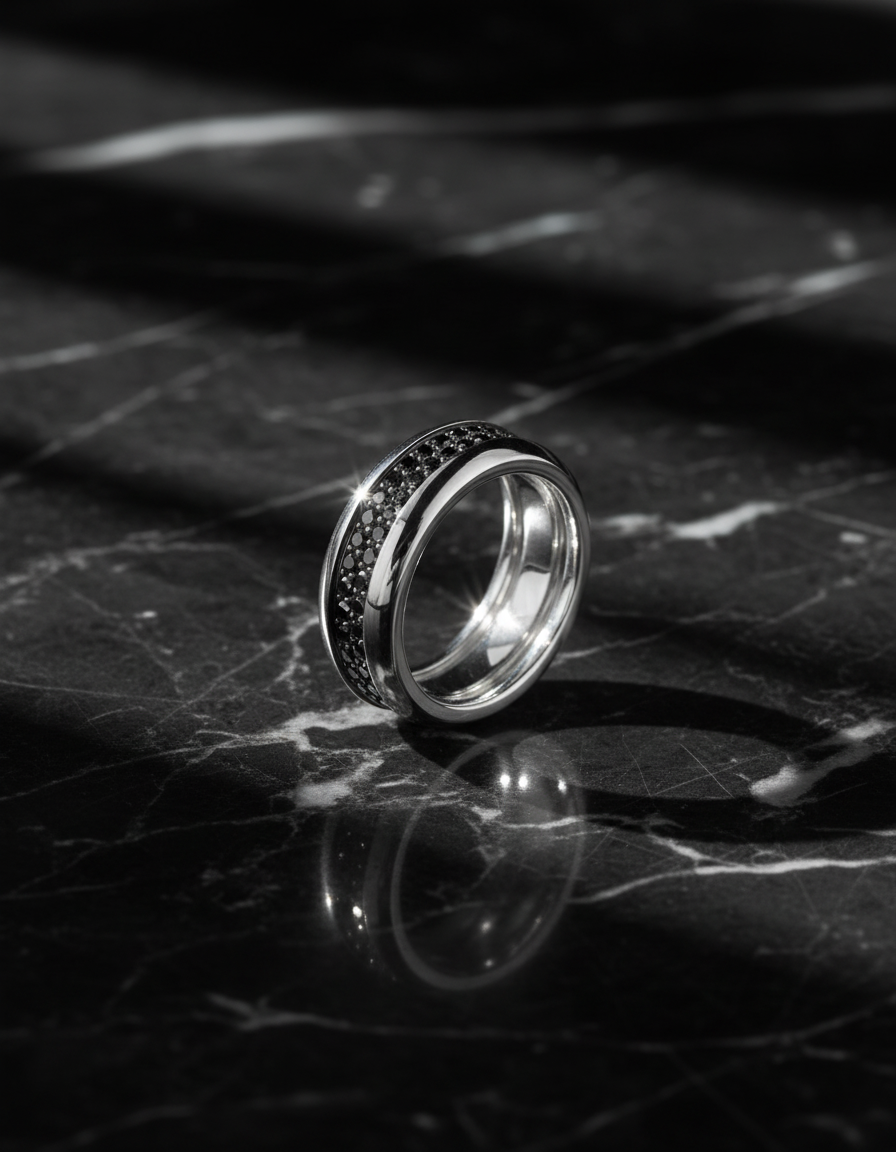
Most guides to diamond shapes are written for engagement rings worn by women: one large centre stone on a delicate band, chosen for how it looks from above. A man's ring lives differently. It meets steering wheels, gym bars, laptop edges and car doors, and on most men's pieces the diamonds sit in rows on a band rather than in a raised claw. That changes which shapes make sense, and how each one has to be set.
What are the main diamond shapes and their names?
There are ten shapes you will meet in almost any jeweller: round, princess, cushion, oval, emerald, Asscher, radiant, marquise, pear and baguette. Round is the standard; every other outline is called a fancy shape. The chart below sets out each one by outline, cutting style and how it behaves on a man's hand.
| Shape | Outline | Cutting style | Risk in daily wear | Typical men's use |
|---|---|---|---|---|
| Round | Circle | Brilliant | Low: no corners | Solitaires, pavé, eternity bands, studs |
| Princess | Square, sharp corners | Brilliant | Higher: four pointed corners | Channel-set bands, solitaires with V-prongs |
| Cushion | Square or rectangle with curved sides | Brilliant | Low: rounded corners | Solitaire rings, signet-style centres |
| Oval | Elongated circle | Brilliant | Low | Solitaires set east-west or north-south |
| Emerald | Rectangle with bevelled corners | Step | Low to moderate | Solitaires with a clean, architectural look |
| Asscher | Square with cropped corners | Step | Low to moderate | Solitaires, Art Deco-style rings |
| Radiant | Rectangle or square, trimmed corners | Brilliant | Low to moderate | Solitaires wanting sparkle in a square outline |
| Marquise | Long oval with two points | Brilliant | High: two thin tips | Accent stones, statement pieces |
| Pear | Teardrop with one point | Brilliant | Moderate: one tip | Pendants, statement rings |
| Baguette | Small rectangle, straight or tapered | Step | Low when channel set | Side stones, rows across a band |
The "risk" column is about chipping, not hardness. Diamond is the hardest natural material, but hardness is resistance to scratching. A sharp corner or thin point can still chip if it takes a sharp knock at the wrong angle.
What is the difference between diamond shape and diamond cut?
Shape is the outline you see when you look down at the stone; cut, or cutting style, is how its facets are arranged. GIA's guide to diamond shapes draws exactly this line, and it explains why two square diamonds can look completely different.
There are two main cutting styles:
- Brilliant cuts use triangular and kite-shaped facets that break light into sparkle. The round brilliant, princess, cushion, oval, radiant, marquise and pear are all brilliant-style.
- Step cuts use long, parallel facets arranged in rows, like steps. They give broad flashes of light rather than sparkle. The emerald, Asscher and baguette are step cuts.
The modern round brilliant has 57 or 58 facets, and it is the only shape that receives an official GIA cut grade. For the full grading picture, including why cut quality matters most on small stones, see the 4Cs of diamonds explained.
Which diamond shape is best for a man's ring?
Round is the most practical shape for a man's ring, with cushion and emerald close behind; princess works when its corners are protected. The right choice depends on the look you want and how hard you are on your hands.
Round: the safe, versatile choice
A round brilliant has no corners at all, which makes it the least likely shape to chip. It sits well in every setting, from a bezel to a six-prong head to a flush setting sunk into a band. It also gives the most sparkle per stone, which matters on small diamonds. If you are unsure, round is the shape least likely to disappoint.
Princess: sharp, modern, needs guarding
The princess cut was developed in 1979 and is the second most popular shape for engagement rings after the round. Its square outline and crisp lines suit a masculine design, and GIA notes it costs less per carat than a round brilliant. The catch is its four pointed corners, which GIA identifies as vulnerable to chipping. Choose V-shaped prongs, split prongs at each corner, a bezel, or a channel that covers the corners.
Cushion: square, but softer
A cushion is a square or squarish rectangle with curved sides and rounded corners, descended from the old mine cut. The rounded corners make it sturdier than a princess while still giving a squarer outline than a round. It suits a solitaire men's ring or the centre of a signet-style design.
Emerald and Asscher: the architectural step cuts
The emerald cut is a rectangle with bevelled corners; the Asscher is its square cousin. Their bevelled corners avoid the sharp points of a princess, and their long facets give a clean, structured look many men prefer to sparkle. The trade-off: step cuts show inclusions and colour more easily, so buy a higher clarity grade than you would for a round of the same size.
Marquise and pear: statement shapes with fragile tips
The marquise is a long oval with two points, and the pear has one. GIA notes that a marquise looks larger face-up than other shapes of the same weight, which is part of its appeal. The points are the weakest part of any diamond outline, so these shapes need a V-shaped prong or bezel over each tip. On a man's ring they work best as accents or in a protected setting; as a pendant, a pear is far less exposed.
Which shapes work best in men's bands and eternity rings?
Small round brilliants, princess cuts and baguettes are the three shapes that do almost all the work in men's diamond bands. On most men's rings the diamonds are not one centre stone but a row, or two rows, running across or around the band.
| Band style | Usual shape | Usual setting | Why it suits men |
|---|---|---|---|
| Pavé or eternity band | Small rounds | Shared prongs or beads | Rounds sit evenly in rows and have no corners to catch |
| Channel-set band | Princess or baguette | Channel between two metal walls | The walls cover the corners and keep the surface flat |
| Flush-set band | Rounds | Sunk into the metal, rim pushed over | Nothing stands proud of the band |
| Two-row band | Small rounds | Shared prongs or channel | More stones without a tall profile |
A channel is the reason princess cuts and baguettes, both with sharp corners, are so common in men's bands. The metal walls on either side protect the edges, and the stones sit level with the band so nothing snags on a pocket or a sleeve. Baguettes are almost always channel set, and the stones in one row have to match each other in length, width and taper, or they will not sit level in the channel.
Full eternity bands are hard to resize once every stone is set, which is worth knowing before you choose a row of any shape. Our guide to eternity rings for men covers half versus full eternity and one-row versus two-row bands.
How does setting protect a diamond's shape?
The setting should cover a shape's weak points: corners on a princess, tips on a marquise or pear, and the girdle edge on any stone in a high-wear position. GIA's recommendations are specific.
| Shape | Weak point | Protective setting |
|---|---|---|
| Princess | Four sharp corners | V-prongs, split prongs at each corner, bezel or channel |
| Marquise | Two tips | V-shaped prongs or bezel at each end |
| Pear | One tip | V-shaped prong at the point |
| Emerald and Asscher | Bevelled corners, visible inclusions | Four-prong or bezel; higher clarity grade |
| Round, oval, cushion | No sharp points | Any secure setting; bezel for heavy use |
For a man who uses his hands for work or sport, a bezel or flush setting protects any shape best because metal surrounds the whole edge. Setting styles in detail, including when pavé is a sensible choice for daily wear, are covered in our guide to men's diamond ring settings.
How do you choose a shape for your hand and style?
Choose the shape for how the ring will be worn first, and for how it looks second. A few practical rules help:
- If the ring will be worn every day, start with round, cushion or a channel-set row. These forgive knocks.
- For broad hands and thicker fingers, a square or rectangular outline (cushion, emerald, Asscher or a channel of princess cuts) holds its presence without looking small.
- For longer-looking fingers, an elongated shape (oval, emerald or marquise set north-south) draws the eye along the finger.
- For a quiet ring, step cuts or flush-set rounds give light without obvious sparkle.
- For the most diamond for the money, consider princess or other fancy shapes rather than round, which costs more per carat.
Black diamonds follow the same shape logic, though their appeal is the dark, glossy surface rather than sparkle, so the outline and setting matter more than facet pattern.
How AXIOM approaches this
Several AXIOM bands set their diamonds in rows across the band rather than in a single raised head, which keeps the profile low on a working hand. The Oath Band is a two-row eternity band in 925 sterling silver set with natural black diamonds, and The Trinity Band sets lab-grown white diamonds in 925 sterling silver. Our product pages do not list stone shape, so if a particular shape matters to you, ask us before you order; certification details are available on request.
The practical takeaway: pick the shape that will survive your week before the one that photographs best. Round, cushion and channel-set rows forgive almost anything; princess, marquise and pear shapes are fine on a man's hand once the setting covers their corners and tips.
