
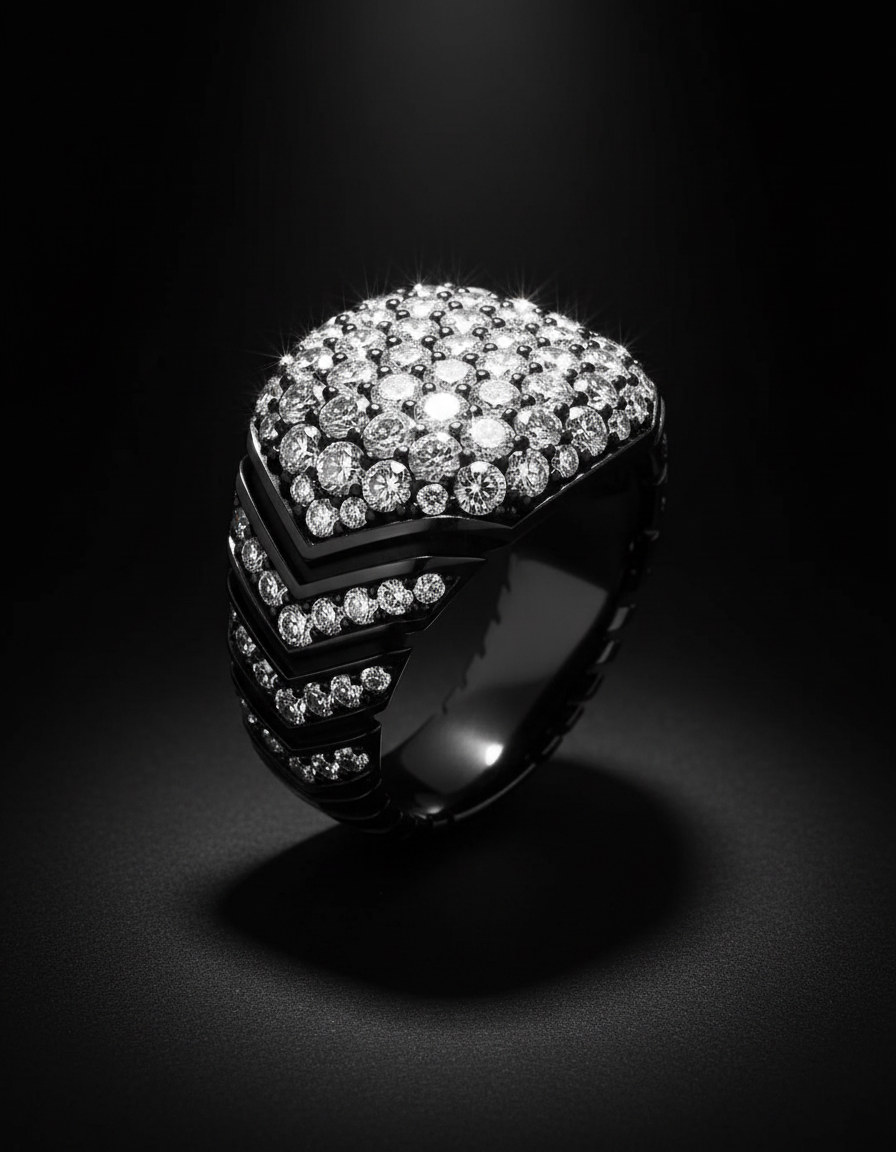
Most pages about solitaire rings are written for brides, and most men's ring guides stop at "bands or signets". This one sits in between. It compares the ways a diamond can be set in a man's ring, solitaire, cluster, pavé, channel, bezel, flush and tension, by what matters on a man's hand: how exposed the stone is, whether it snags, whether it can be resized, and what each costs for the look you get.
What is a solitaire ring?
A solitaire ring is a ring set with a single diamond and no side stones. The word describes the design, not the size: a 0.10 carat stone in a plain band is technically a solitaire, as is a 2 carat engagement ring.
In Indian jewellery retail, "solitaire" is often used loosely to mean a single larger diamond as opposed to small set stones, and there is no standard size at which a stone becomes a solitaire. When you compare prices, compare carat weight and quality, not the label.
Diamond ring settings for men compared
The setting decides how a diamond ring behaves on a man's hand far more than the stone does. The table below uses GIA's guide to ring settings for how each one holds the stone.
| Setting | How it holds the stone | Edge protection | Snags on cuffs and gloves | Resizing |
|---|---|---|---|---|
| Prong (claw) | Metal claws bent over the stone | Low | Most likely | Usually possible |
| Bezel | A rim of metal wraps the stone's girdle | High | Rarely | Usually possible |
| Flush (gypsy) | Stone sunk level with the band's surface | High | Almost never | Usually possible |
| Channel | Stones side by side between two metal walls | Good | Rarely | Limited |
| Pavé | Many tiny stones held by small metal beads | Moderate | Can catch fibres | Difficult |
| Cluster | Small stones grouped to look like one larger shape | Varies with claws | Moderate | Varies |
| Tension | Stone held by pressure between the band's ends | Low | Moderate | Very difficult, sometimes impossible |
Two practical notes follow from GIA's descriptions. Prongs wear over time and may need re-tipping, which means rebuilding worn tips with new metal. And tension-set rings can be very difficult, sometimes impossible, to resize, which matters for a ring a man may wear for decades.
Solitaire vs cluster vs pavé: which suits a man?
Each answers a different question. A solitaire says one clear thing; a cluster gives presence for less money; pavé turns the band itself into the feature.
| Solitaire | Cluster | Pavé | |
|---|---|---|---|
| Look | One stone, clean and direct | Several small stones reading as one larger shape | Surface covered in small stones |
| Price for the same total carat | Highest | Lower | Lower |
| Daily-wear risk | One stone takes every knock; low settings help | Many small claws to check | Tiny beads can wear and loosen |
| Resizing | Usually simple | Depends on design | Difficult once the band is set |
| Best for | Engagement, milestone, signature ring | A bigger look on a budget | A band with sparkle across the top |
The price gap is not marketing. GIA explains that a 1-carat diamond weighs the same as four 0.25-carat diamonds, but even at equal quality the larger stone is worth much more than the four smaller ones combined. A cluster or pavé buys the same total weight for less.
Our sibling guide to the eternity ring for men covers the fourth option: a continuous line of stones around the band.
What size solitaire suits a man's ring?
On a man's ring, a round diamond of about 4 to 5 mm across, roughly 0.25 to 0.50 carat, reads clearly without looking like a borrowed engagement ring. Larger stones work on wider bands and larger hands.
| Round diamond diameter | Approximate carat | How it reads on a man's ring |
|---|---|---|
| 3.0 mm | 0.10 ct | A small accent, best flush-set |
| 4.0 to 4.1 mm | 0.25 ct | Clearly a diamond; easy everyday size |
| 5.1 to 5.2 mm | 0.50 ct | Confident; suits a 5 to 7 mm band |
| 5.8 to 5.9 mm | 0.75 ct | A statement on most hands |
| 6.4 to 6.5 mm | 1.00 ct | Bold; needs a substantial band |
Proportion matters as much as size. A stone wider than the band looks perched on top; a stone a little narrower than a 6 to 7 mm band looks anchored. Our guide to types of rings for men explains band widths and profiles.
Which setting for which man?
Choose the setting by how he lives, not by the photograph.
| How he uses his hands | Best settings | Avoid |
|---|---|---|
| Desk work, typing | Bezel, flush, channel, low prong | Very tall prongs |
| Gym, sport, cycling | Flush, or take the ring off | Prong, pavé, tension |
| Manual or workshop work | Plain band, or flush with a small stone | Any raised stone |
| Formal and occasion wear | Any, including prong solitaires | Nothing in particular |
| Forgets to take rings off | Flush or bezel | Pavé and cluster |
Solitaire ring for men in silver or gold?
A solitaire can be set in 925 sterling silver, 18K white or yellow gold, or platinum. The choice changes cost and upkeep more than appearance.
Silver brings the metal cost of a man's ring down sharply, which leaves more of the budget for the stone. For a single stone in silver, choose a bezel or a substantial setting, keep the band thick enough not to flex, and have the setting checked yearly. Our guide on whether diamonds can be set in silver covers how silver settings hold up.
18K gold is the traditional choice for a larger natural stone bought as an heirloom. White gold matches the stone's colour; yellow gold suits men who already wear a gold watch or kada.
What drives the price of a solitaire ring for men?
The stone drives most of the price, and its carat weight drives most of the stone's price. Four factors matter, in roughly this order:
- Carat weight. Price per carat rises with size, and stones just above popular weights such as 0.50 or 1.00 carat cost noticeably more than stones just below.
- Natural or lab-grown. Lab-grown diamonds cost far less for the same size and grade, with little resale value.
- Colour, clarity and cut. Matter more on a single stone than on small pavé stones.
- Metal and weight. Gold costs far more than silver; a heavier band adds metal cost.
For worked examples by budget, see our guide on how to choose a men's diamond ring.
How to wear and care for a solitaire ring
In India, a man's engagement ring is commonly worn on the ring finger, though which hand varies by family and community. A solitaire chosen as a fashion ring often looks better on the middle or index finger, where a larger stone reads as deliberate.
For care: take it off for the gym and heavy work, clean it with warm water, mild soap and a soft brush, and have the setting checked about once a year. If a claw has worn thin, a jeweller can re-tip it before the stone is at risk.
Signs a diamond setting needs attention
Settings fail slowly, and the warning signs are easy to spot if you look once a month. Take the ring to a jeweller if you notice any of these:
- The stone moves. Hold the ring near your ear and tap it gently; a rattle or a visible wobble means a claw or bead has loosened.
- A claw tip looks flat or thin. Worn prong tips can be rebuilt by re-tipping before the stone is at risk.
- The ring catches on fabric. A claw snagging on a jumper or a cuff has usually lifted or bent.
- A gap appears around a bezel. The rim should sit tight against the stone all the way round.
- A small stone is missing. On pavé and channel bands, one missing stone usually means its neighbours need checking too.
- The band is out of round. A knock that bends the shank can loosen the setting above it.
Questions to ask before buying a solitaire ring for men
- What is the carat weight, and is the stone natural or lab-grown?
- Is a grading report available, and from which laboratory?
- How high does the stone sit above the band, in millimetres?
- What is the band width and thickness, and the metal and purity?
- Can the ring be resized later, and by how many sizes?
- What servicing does the maker offer if a claw wears?
How AXIOM approaches solitaires
AXIOM does not list a solitaire in its ready-to-wear range; its rings are bands and sculptural designs, many set with small stones, such as the Legacy Ring in 925 sterling silver with lab-grown white diamonds. A solitaire is made as a bespoke commission: you share the occasion and references, approve sketches and CAD that show the stone's height and setting, and the ring is cast and set by hand at the Bharat Diamond Bourse.
The practical takeaway
Decide the setting before the stone. For a man who will wear the ring every day, a bezel or flush solitaire, a channel row or a modest cluster will outlast a tall claw setting. Then spend on the stone what the setting can protect.
