
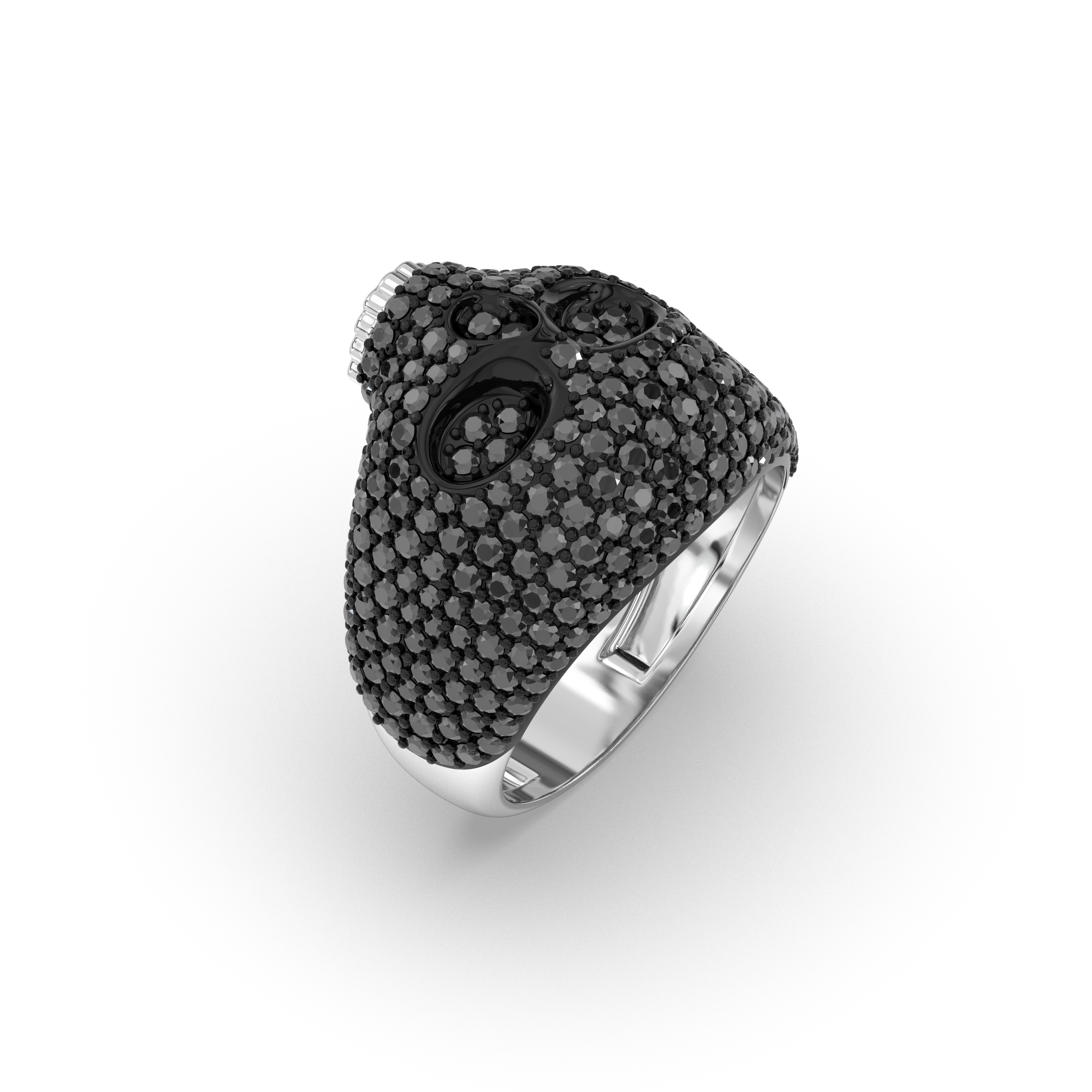
Men's rings used to fall into two groups: the wedding band and everything else. Today there are at least eight clearly different types, each with its own finger, occasion and way of wearing, and knowing them is the fastest way to choose a ring that actually suits you. This guide names each type, shows how it is worn, and links to our detailed guides where a type deserves its own page. It ends with the three decisions that matter more than type: width, profile and metal.
The main types of rings for men at a glance
Each type of men's ring has a natural finger and occasion. The table gives the short version; each type is explained below.
| Type | What it looks like | Usual finger | Best occasion |
|---|---|---|---|
| Plain band | Smooth metal band, no stones | Ring finger | Daily, wedding |
| Textured band | Brushed, hammered or patterned metal | Ring or middle | Daily, casual |
| Stone-set band | Band with small stones set flush or in a channel | Ring or middle | Daily, wedding, evening |
| Eternity band | Continuous line of matching stones | Ring finger | Wedding, anniversary |
| Signet ring | Flat engraved face | Little finger | Daily, heritage |
| Solitaire | One prominent stone | Ring or index | Engagement, occasions |
| Statement or sculptural | Bold, architectural shape | Index or middle | Evening, style |
| Thumb ring | Wide band sized for the thumb | Thumb | Style |
Plain bands
The plain band is the foundation of men's rings: a smooth circle of metal, usually 4 to 8 mm wide. It works as a wedding band, as an everyday ring and as the quiet partner to a bolder ring on the other hand.
What changes one plain band from another is the profile and finish. A domed or comfort-fit band feels softer on the finger; a flat band with sharp edges looks more modern. A high polish shows every scratch, while a brushed finish hides them. Our men's wedding band guide covers widths, profiles and fit in detail.
Textured bands
A textured band has a surface worked into a pattern: brushed lines, hammered facets, grooves, knurling or carved motifs. Texture adds interest without stones and hides everyday wear, which makes it one of the most practical daily rings.
Texture also changes how a ring reads in silver. A plain, highly polished silver band can look thin and shiny; a brushed or carved silver band looks deliberate and holds its character as it ages.
Stone-set bands
A stone-set band has small stones set into the band, usually flush with the surface, in a channel or in a single row across the top. It is the most common way for men to wear diamonds, because the stones are protected by the metal around them.
| Setting | How stones are held | Durability | Look |
|---|---|---|---|
| Flush (gypsy) | Sunk into the metal, level with the surface | Very high | Minimal, a few points of light |
| Channel | Between two walls of metal | High | Clean line of stones |
| Pavé | Many tiny stones held by small metal beads | Moderate | Surface of sparkle |
| Bezel | Metal rim around each stone | High | Crisp, framed stones |
Black diamonds are a popular choice for stone-set men's bands because they add texture rather than sparkle. Our guide to black diamond rings for men explains the different kinds of black diamond and how they are priced.
Eternity bands
An eternity band carries a continuous line of matching stones, either all the way round (full eternity) or across the top (half eternity). For men it is most often worn as a wedding or anniversary band, in one or two rows.
The main thing to know before buying is that a full eternity band can be resized very little or not at all, because there is no plain metal to cut. Our guide to eternity rings for men covers full versus half, one row versus two, and what the ring is meant to mark.
Signet rings
A signet ring has a flat face, usually oval, cushion or round, engraved with initials, a crest or a symbol. It was originally a working seal pressed into wax, and it is traditionally worn on the little finger, which leaves the ring finger free for a wedding band.
For Indian buyers, a signet opens up engraving in Devanagari, Gurmukhi, Urdu or other scripts, which needs a larger face and careful design. Our guide to signet rings for men in India covers face sizes in mm, engraving methods and cost.
Solitaire rings
A solitaire is a ring built around one prominent stone. For men it is usually held in a bezel or a low, heavy setting rather than tall claws, which keeps the stone safer and the ring more masculine in proportion.
Solitaires are common for men's engagement rings and for occasion rings. They need more care than bands, because a single raised stone takes every knock. If you choose one for daily wear, choose a bezel setting.
Statement and sculptural rings
A statement ring is defined by its shape rather than its stones: architectural lines, heavy geometry, open forms or chevrons. It is worn to be noticed and sits best on the index or middle finger, where it has room.
Statement rings are where men's jewellery design has the most freedom. They often combine sculpted metal with a few set stones, and they are usually heavier than bands, so fit matters. A statement ring that spins or pinches will not be worn.
Thumb rings
A thumb ring is a wide band sized for the thumb. It descends from the archer's ring used across Asia, including in Mughal India, and today it is a style choice. Because the thumb's knuckle is wide, thumb rings are often made slightly open or larger at the back.
Which finger does each type of ring go on?
Each type has a conventional finger, but the rules are loose for anything that is not a wedding or engagement ring. A few principles help:
- Ring finger: wedding bands, eternity bands and engagement rings, left or right hand depending on family and country.
- Little finger: signets and slim bands, where they rarely get in the way.
- Index and middle fingers: statement rings, solitaires and wide bands.
- Thumb: thumb rings only.
Our guide to which finger a man should wear a ring on covers Western convention, Indian practice and astrological beliefs in full.
Width and profile: matching a ring to your hand
A ring's width should follow the size of your hand and fingers. Slim or short fingers look best with 4 to 5 mm bands; average hands suit 5 to 7 mm; large hands carry 7 to 9 mm and heavier statement rings.
| Hand and fingers | Band width | Statement ring size |
|---|---|---|
| Slim or short fingers | 4 to 5 mm | Compact, low profile |
| Average | 5 to 7 mm | Medium, moderate height |
| Large hands, long fingers | 7 to 9 mm | Bold, taller forms |
Profile matters for comfort. A comfort-fit (court) profile, rounded on the inside, slides over the knuckle more easily and is the most comfortable choice for a ring you wear all day. Wider rings also need a slightly larger size, because they grip more of the finger.
Which metal should a man choose for a ring?
The metal decides a ring's colour, durability, upkeep and most of its price. The three most common choices for men's fine jewellery rings are sterling silver, gold and platinum.
| Metal | Look | Durability | Upkeep | Price basis |
|---|---|---|---|---|
| 925 sterling silver | Bright white | Softer; scratches and dents more easily | Tarnishes; polish now and then | Lowest |
| 18K gold (yellow or white) | Warm or white | Good | Low | By weight at the day's gold rate |
| Platinum | Grey-white, heavy | Very durable | Low | Highest |
Silver rings for men: the everyday entry point
Sterling silver is where many men start, and for good reason. It is a real precious metal at a fraction of the price of gold, it looks right with a steel watch or a silver kada, and it can hold diamonds. The trade-offs are honest ones: it is softer than gold, it tarnishes in humid weather, and thin silver bands dent. Choose a thicker band, a textured finish and low-set stones, and a silver ring lasts for decades. Look for the 925 mark and, in India, a BIS hallmark where available.
How AXIOM approaches men's rings
AXIOM's rings are made to order in 925 sterling silver at the Bharat Diamond Bourse in Mumbai, most of them set with natural black or lab-grown white diamonds, with 18K white gold offered on a few designs. The Axis Ring is a 925 sterling silver ring from the Code Collection, and the Revenant Ring, a sculpted piece from the Strength Collection, is 925 sterling silver with natural black diamonds. The full range, including eternity and stone-set bands, is in men's rings and bands, and a signet can be made as a bespoke commission.
The practical takeaway
Choose the type by where and how you will wear the ring: a band for every day, a signet for heritage, an eternity band for commitment, a statement ring for presence. Then get the width, profile and metal right for your hand and life. The right first ring for most men is a 5 to 7 mm band in a metal they can live with, and everything else can be added later.
