
Men's brooches have come back into Indian menswear through weddings, but most advice stops at "add a brooch to the sherwani". That leaves the practical questions unanswered: which side, how high, how big, and what to do on a kurta or bandhgala that has no lapel. This guide answers them garment by garment.
It applies to men wearing a brooch as a guest, at festivals, at formal dinners and with Western suits. If you are the groom, the full wedding picture, including how the brooch works with buttons, mala and kalgi, is in our groom jewellery for sherwani checklist.
Brooch or lapel pin: what is the difference?
A brooch is larger and pins through the fabric with a long pin and a locking catch. A lapel pin is smaller and usually fixes through the lapel buttonhole with a post and clutch back. That difference decides where each can go.
| Feature | Brooch | Lapel pin |
|---|---|---|
| Typical size (a rough guide, not a standard) | Larger, commonly around 3 cm to 6 cm across | Small, commonly under about 2.5 cm |
| Fastening | Long pin with a safety catch or lock, sometimes two pins | Short post with a clutch or butterfly back |
| Where it goes | Lapel or directly on the chest of any garment | Lapel, usually through the buttonhole |
| Suits garments without lapels | Yes: kurta, bandhgala, sherwani | Not really |
| Visual weight | A statement | An accent |
If you want something small on a suit lapel, a lapel pin is usually the better choice. Our guide on how to wear a lapel pin covers that in detail. The rest of this guide is about brooches.
Where to place a brooch on each garment
The brooch always goes on the left side. The height and exact point change with the garment, as the table shows. The sizes are working guidance from the bench, not a rule; scale them to your frame.
| Garment | Placement | Brooch size (guide) | Occasion |
|---|---|---|---|
| Suit or blazer | Left lapel, near or just below the buttonhole | Small to medium, 3 cm to 4 cm | Receptions, formal dinners, cocktail events |
| Bandhgala or Jodhpuri | Left chest, a hand's width below the collarbone | Medium, 3 cm to 5 cm | Weddings, festive dinners, receptions |
| Sherwani (as a guest) | Left chest, in line with the middle of the shoulder | Medium; smaller than the groom's | Weddings, sangeet |
| Kurta | Left chest, just below the collarbone | Small to medium, and light | Festivals, pujas, daytime functions |
| Nehru jacket | Left chest, above the pocket or on the pocket line | Small to medium | Festive evenings, office events |
On a suit or blazer
Pin the brooch on the left lapel, a little below the buttonhole, following the angle of the lapel. On a narrow lapel choose a smaller piece, since a brooch wider than the lapel looks like it is falling off. Keep the pocket square simple when you wear one.
On a bandhgala or Jodhpuri
With no lapel, the brooch goes on the left chest. A useful guide: place it about a hand's width below your collarbone, in line with the middle of your shoulder. That keeps it visible in half-length photographs and clear of the collar.
On a sherwani
For guests, the same position as a bandhgala works, with a slightly smaller brooch than the groom's, so you are not competing with him. A chain brooch, where a fine chain runs from the brooch towards the centre buttons, is a traditional variation that suits a plainer sherwani.
On a kurta
On a kurta, the brooch sits a little higher, just below the collarbone on the left. Cotton and linen are light fabrics, so choose a lighter brooch, or one with two pins, to stop the fabric sagging forward.
How to choose the right size for your frame
Scale the brooch to your chest and lapel, not to the occasion. A broad-shouldered man in a bandhgala can carry a 5 cm brooch; a slim man in a narrow-lapelled suit looks better with 3 cm.
A simple test: hold the brooch against your chest in a mirror at arm's length. If it is the first thing you see, and you did not want a statement, go smaller. If you cannot find it, go larger or choose more contrast between the brooch and the fabric.
Which designs and stones suit men?
Men's brooches work best with a clear subject and a restrained outline. Four families of design cover most choices:
- Animals and emblems. Lions, wolves, falcons, horses and snakes are traditional in Indian and Western menswear alike. They read as strength or loyalty and suit bandhgalas and suits.
- Botanical. Leaves, flowers and sprays. They soften a formal outfit and work well on ivory and pastel.
- Geometric and stars. Clean shapes that suit modern bandhgalas and minimalist suits.
- Single stone. One central stone in a simple frame, the quietest option.
For stones, contrast is what matters. White diamonds and pearls stand out on dark fabric. Black diamonds show best on ivory, grey and pastel. Coloured stones such as emeralds and sapphires work when they echo a colour already in the outfit.
How to match a brooch with buttons and cufflinks
Keep one metal tone and let one piece lead. If the brooch is large, wear plain buttons; if the buttons are elaborate, choose a smaller brooch.
| Worn with | Match | Can differ |
|---|---|---|
| Sherwani or kurta buttons | Metal colour | Motif and stones |
| Cufflinks | Metal colour | Design |
| Watch | Metal colour of the case, ideally | Everything else |
| Chain or mala | Metal colour | Keep the chain from covering the brooch |
Our sherwani buttons guide explains button types, and men's jewellery with a kurta shows how a brooch sits alongside a chain and bracelet.
How to pin a brooch so it stays straight
A brooch that droops or spins looks careless. Pin it this way.
- Put the garment on first. Mark the spot with a fingertip while looking in a mirror.
- Take the garment off and lay it flat. Pinning flat avoids puckering.
- Push the pin through twice. In through the fabric, then back out a few millimetres further along, so the fabric holds the pin at two points.
- Close the catch fully. You should hear or feel it lock.
- Add support for heavy pieces. A small square of felt or thick fabric behind the pin spreads the weight on silk and linen.
How AXIOM approaches this
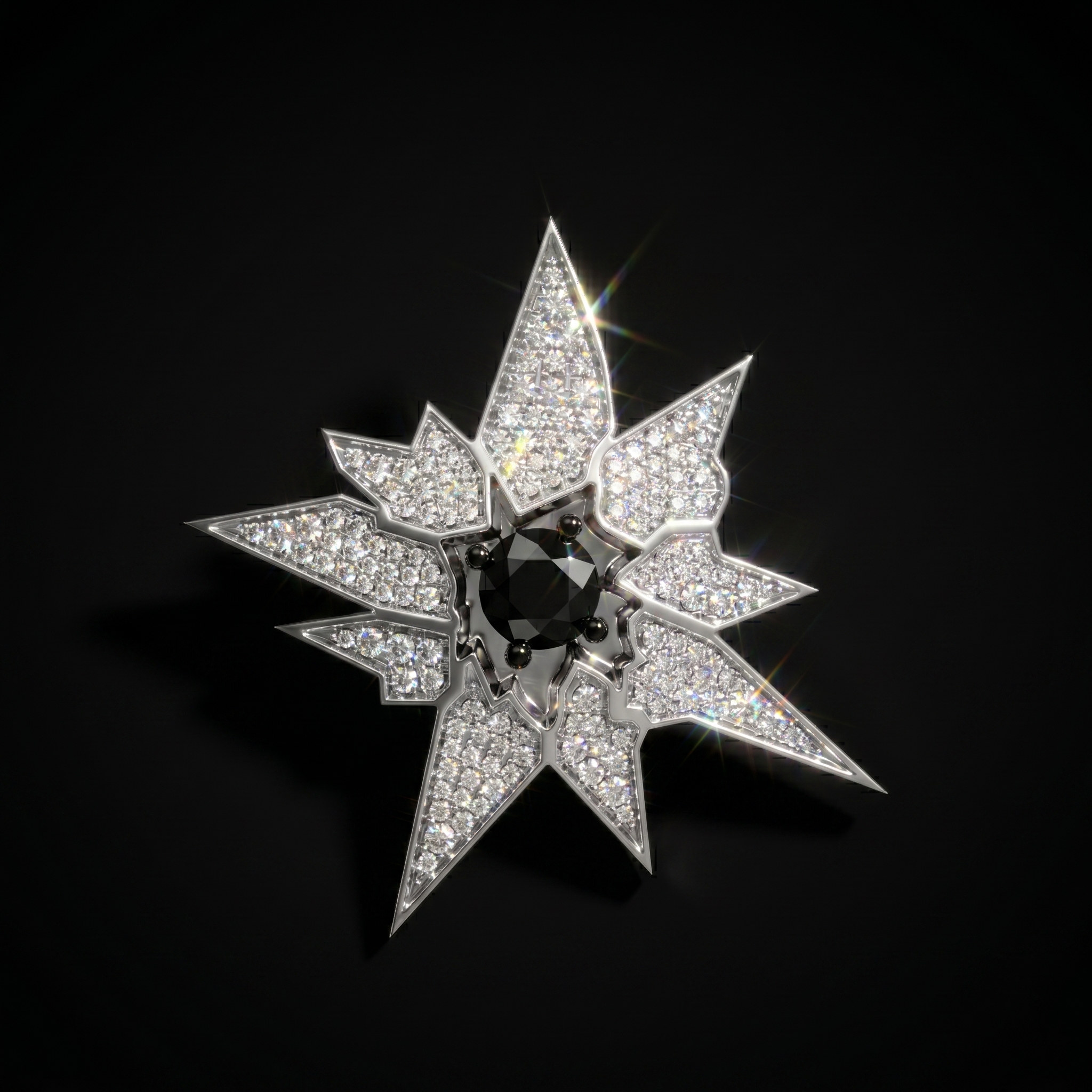
AXIOM makes emblem and motif pieces for the chest and lapel in solid 925 sterling silver rather than plated base metal, made to order at the Bharat Diamond Bourse in Mumbai. The Midnight Star, in 925 sterling silver with natural black diamonds and lab-grown white diamonds, is listed from ₹67,500 at the time of writing, and the Wolf Crest, a wolf's head in 925 sterling silver, from ₹70,500. Both sit with lapel pins, buttons and cufflinks in our accessories, where some atelier pieces are priced on request. Ask which fastening suits your garment before you order, since a heavy silk sherwani and a wool lapel hold a pin differently.
The practical takeaway
Wear the brooch on the left, a hand's width below the collarbone on Indian garments and on the lapel on a suit. Size it to your frame, pin it through twice, and match its metal to your buttons and cufflinks. One well-placed brooch does more for a bandhgala than any amount of other jewellery.
